There was still plenty of daylight left as I was returning from Sharpsburg last weekend, so I took a rare detour from Alt-40 over to Fox’s Gap.

The glorious charge of the 23rd and 12th Ohio Volunteers …(1864, Library of Congress)
There are a pair of interpretive signs, two monuments, and a regimental tribute at the spot where the road crosses the Gap, noting the combat there on 14 September 1862. But that’s all there is to see as one arrives.
There was no one else there when I pulled up. It was blessedly quiet. I took a couple of snapshots to bring some of the place home with me.
The battlefield of Fox’s Gap consists of an otherwise unremarkable meadow and patch of woods covering about half a mile of the crest of South Mountain. In among the trees is the dramatic North Carolina monument [picture, more] erected in October 2003.
Having just come from Antietam and the specific site of the 17th Michigan Infantry’s adventures there on 17 September 1862, it was destiny, I guess, that I should come upon that unit again at Fox’s.
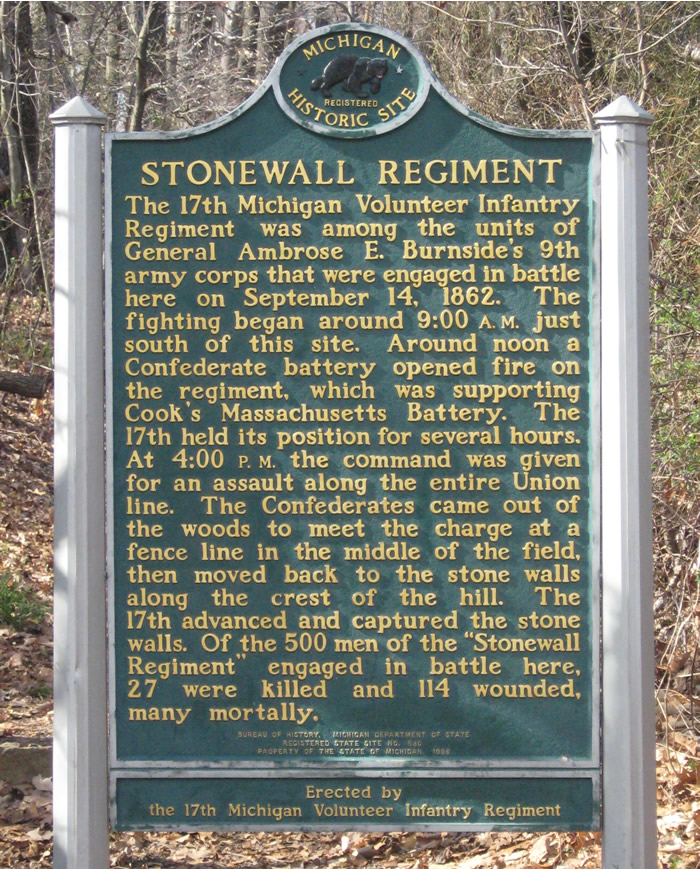
Along the road is this tablet put up in 1986 by reenactors of the 17th Michigan, who have been active in preserving and noting their unit’s history. They’ve also scanned and posted a fair copy of the CWPT map of the battle at Fox’s Gap.
Somewhat older is this large obelisk placed in 1889 by veterans of the Federal IX Corps to mark the spot where their commander Major General Jesse Reno was mortally wounded in action.

North face, Reno Monument: 9th ARMY CORPS, September 14, 1862 RENO
The text on the other three sides read:
West:
This monument marks the spot where Major Gen. Jesse Lee Reno Commanding 9th Army Corps, U.S. Vol’s was killed in battle Sept. 14, 1862
South:
Battles
Vera Cruz – Cerro Gordo
Cantreras – Churubusco
Chapul Tepec – Roanoke Island
New Berne
Camden – Bull Run
Chantilly and South Mountain
East:
Erected by the survivors of the 9th Army Corps to their Commander and Comrade September 14, 1889
Added to the landscape at Fox’s Gap more than 100 years later in 1993, this modest headstone-sized marker remembers the other General officer killed here, Confederate Brigadier Samuel Garland.

______________________
I wonder, though …
How does one go about putting up a monument on a Civil War battlefield, as has been done fairly recently with the 17th Michigan marker, Garland stone and North Carolina Monument? When is it not a good idea? Remember the flap of 2005 about putting additional unit memorials on the field at Antietam?
I’d appreciate hearing from those in the know about the legal and ethical dimensions.
______________________
Notes
The original of the somewhat stylized portrayal of the battle at Fox’s Gap, reproduced above, is from the collection of the Library of Congress. The full text at the bottom reads:
The glorious charge of the 23rd and 12th Ohio Volunteers (Col Scammon) against the 23rd and 12th North Carolina, under the rebel Gen. Garland, who was killed in the battle.
For more about the history of Fox’s Gap, see the online home of A Gap in Time, a 2002 archaeological project of the Indiana University of Pennsylvania. For even deeper study, find their results, along with recommendations for further preservation and interpretation.
There’s something Michigan in the air this week. Harry’s just connected with the Stonewall Regiment from another angle, too. For the visually challenged, the 17th Michigan sign bears the following fine print at the bottom:
Bureau of History, Michigan Department of State
Registered State Site No. 580
Property of the State of Michigan, 1986
The Garland monument was placed by the Garland-Rodes SCV Camp #409, Lynchburg, Virginia.
All of the modern installations were made under the auspices of the Central Maryland Heritage League, who’ve also posted a summary page on the battle.
And, by the way, Reno’s son Jesse W. was the inventor of the escalator. Garland’s wife and son Samuel, however, tragically preceded him in death in 1861.


Leave a Reply to Curt Older Cancel reply