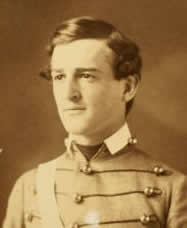
USMA Cadet Joseph Crain Audenried
(c. 1861, from an image at Gettysburg College)
Joseph Audenried (1839-1880) was fresh from the US Military Academy at West Point as the American Civil War began in the Spring of 1861. On graduation he was commissioned 1st Lieutenant in the 3rd US Cavalry, beginning a career that would last nearly twenty years til his death at age 41.
He was a staff officer with “Bull” Sumner at Antietam and Fredericksburg, US Grant at Vicksburg, and William Tecumseh Sherman to Atlanta and on the March to the Sea. He remained with Sherman for the rest of his life: later in the Indian Wars in the West and then on to Washington when Sherman became General-in-Chief of the US Army.
Audenried came from a prominent Philadelphia family and was appointed to West Point in 1857. He graduated 17th in the class of 1861 on June 24th, and was assigned to the Cavalry. Less than a month later he was aide-de-camp (adc) on the staff of Brigadier General Daniel Tyler, who commanded one of the five Federal Divisions at the first battle of Bull Run (Manassas). In that service he first met Colonel William T. Sherman, who led one of Tyler’s Brigades.
Following the Federal disaster at Manassas, Lieutenant Audenried was attached to the 2nd US Artillery regiment in the defenses of the capital through March 1862. He then joined the Army of the Potomac in the field as acting assistant adjutant-general (aaag) to the 1st Cavalry Brigade under Brigadier General William H. Emory. He saw action with them on the Peninsular Campaign at Williamsburg and Hanover Courthouse.
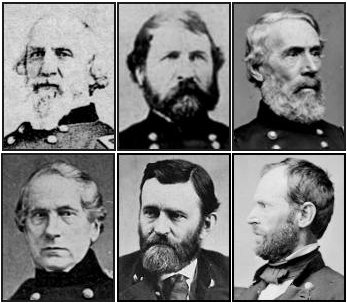
Federal Generals (top) D. Tyler, W. Emory, E. Sumner, (below) J. Wool, U. Grant, W. Sherman
In July 1862, he was detached from the Regiment for duty as aide-de-camp to Major General Edwin V. Sumner, commanding 2d Army Corps, and in August was promoted to Captain in the Staff Corps. In September they were off on the Maryland Campaign, finding particularly vicious combat at the West Woods on the 17th. As the General mentioned in his after action report:
… I would also beg leave to recommend my staff officers, Lieut. Col. J. H. Taylor, adjutant-general; Lieut. Col. P.J. Revere, inspector-general; Lieut. Col. C. D. Blanchard, chief quartermaster, and my aides, Maj. L. Kip, Capt. W. G. Jones, Capt. J. C. Audenried, and Capt. S.S. Sumner. These young men behaved in the most gallant manner, and did all that men could do to aid me throughout this trying battle.
Lieutenant-Colonel Revere and Captain Audenried were both severely wounded, and obliged to leave the field …
After recovering, the Captain was again in action at Fredericksburg, Virginia in December, and he continued to serve on Sumner’s staff until the General resigned his field command in March 1863.
He was briefly on the staff of Department commander Major General John E. Wool, headquartered at Baltimore, before transferring west in June to work for Major General Ulysses S Grant, then besieging Vicksburg on the Mississippi.

General Grant and Staff, detail
from “Siege of Vicksburg–13, 15, & 17 Corps, Commanded by Gen. U.S. Grant, assisted by the Navy under Admiral Porter–Surrender, July 4, 1863” (1888, Kurz & Allison/Library of Congress)
Captain Audenried was present at the surrender of the city, and afterwards on the road with Grant to Tennessee.
On Grant’s recommendation, he transferred to the staff of Major General William T. Sherman at Memphis on 1 October 1863, and was in action nearly continuously thereafter on the Chattanooga and Knoxville campaigns. In his Memoirs, General Sherman later related an incident of the evening of 12 Feb 1864 near Decatur, Mississippi, with the Army enroute to Meridian:
Intending to spend the night in Decatur, I went to a double log-house, and arranged with the lady for some supper. We unsaddled our horses, tied them to the fence inside the yard, and, being tired, I lay down on a bed and fell asleep. Presently I heard shouts and hallooing, and then heard pistol-shots close to the house. My aide, Major Audenried, called me and said we were attacked by rebel cavalry, who were all around us. I jumped up and inquired where was the regiment of infantry I had myself posted at the cross-roads. He said a few moments before it had marched past the house, following the road by which General Hurlbut had gone, and I told him to run, overtake it, and bring it back. Meantime, I went out into the back-yard, saw wagons passing at a run down the road, and horsemen dashing about in a cloud of dust, firing their pistols, their shots reaching the house in which we were.
Gathering the few orderlies and clerks that were about, I was preparing to get into a corn-crib at the back side of the lot, wherein to defend ourselves, when I saw Audenried coming back with the regiment, on a run, deploying forward as they came. This regiment soon cleared the place and drove the rebel cavalry back toward the south, whence they had come.
Audenried served in the ensuing campaign for Atlanta, the infamous March to the Sea, and finally through the Carolinas to his War’s-end when General JE Johnson surrendered his army near Raleigh, North Carolina on 26 April 1865.
By then Audenried had been recognized three times for his “gallant and meritorious service” by brevets to Captain (Antietam), Major (Atlanta) and Lieutenant Colonel (War service).
In July 1866 he was promoted to Captain in the 6th US Cavalry and served at Headquarters in St Louis and in the West fighting Indians with field commander Sherman until 1868 when General-in-Chief Grant took office as President, and Sherman was appointed in his place. They both then moved to Washington, DC.
Audenried was promoted to full Colonel, Staff Corps, USA, in March 1869.
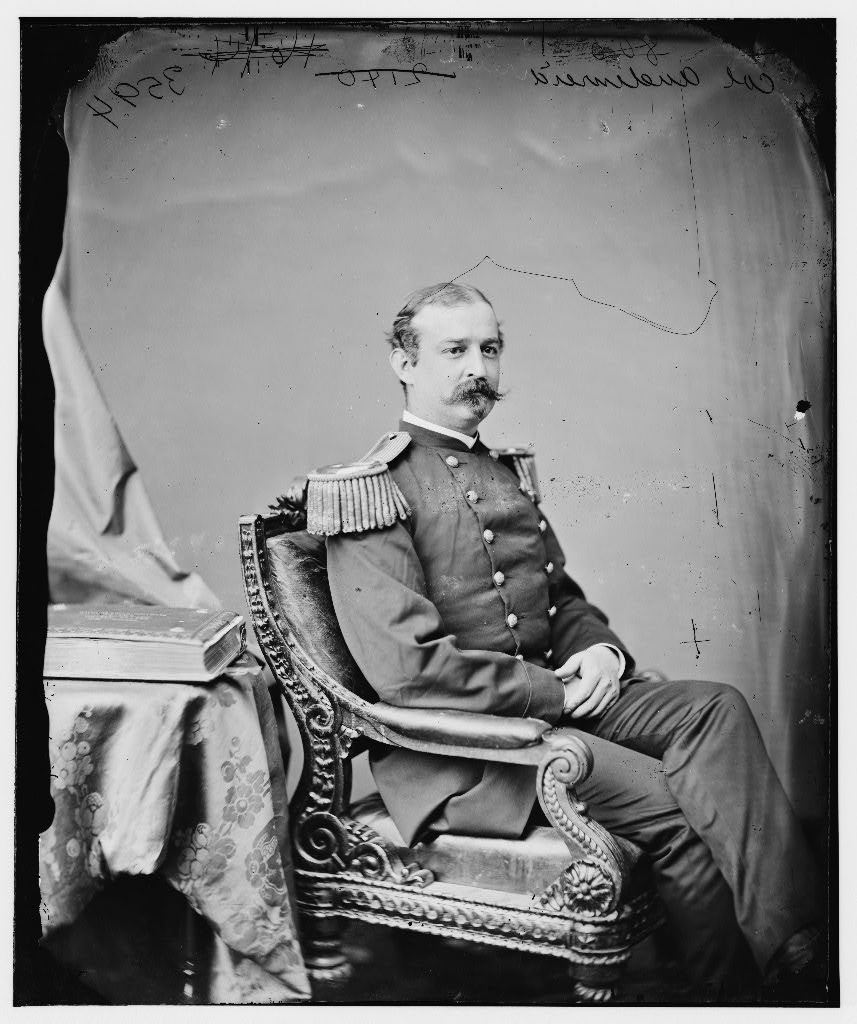
Colonel Audenried (c. 1870-75, Brady Studio/Library of Congress)
In peacetime Washington, Colonel Audenried cut a dashing figure. An observer of that social scene of the 1870s noted
Equestrian exercise was not then quite so popular in Washington as later, but it had its devotees, among whom was Colonel Joseph C. Audenried, an unsually handsome man … accompanied by daughter Florence, then a child…
… one of the most polished gentlemen in the army, noted for his personal bearing and deportment.
In late 1871, weary of political infighting and feeling constrained by the Secretary of War, General Sherman accepted the President’s suggestion of a military tour to Europe. With only Audenried and Lieutenant Fred Grant (1850-1912)–the President’s son–for staff, he departed for the Continent from New York on 17 November 1871 aboard the Navy frigate USS Wabash. They would be gone exactly 10 months.

General Sherman at Pompeii, detail (1873, Harper’s Monthly)
From the trip, Audenried later wrote this vignette:
On the 21st of February of last year [1872] General Sherman and his party, consisting of Colonel Audenried and Lieutenant Grant, arrived in Naples from Rome … [a]n excursion was made to the ruins of Pompeii, during which a special excavation was made. Quite a large number of Americans participated in this picnic; and in one of the ancient buildings of Pompeii toasts were drank, songs were sung, and the walls gave back Sherman's March to the Sea.
The excavations did not bring forth any hidden treasures. With the exception of some broken tiles, water-jugs, a few buckles, some copper coins, and the bones of a chicken which may have been sacrificed to the hungry manes of one of the ancient inhabitants of the city, nothing was found; and even these indifferent articles were so carefully watched by the police as to make it impossible to take away one as a souvenir.
The party made the ascent of Mount Vesuvius, and wandered about the cone in very dangerous proximity to its mouth. A few days afterward Vesuvius was emitting a stream of burning lava. The general was quite exhausted by this excursion, and I doubt if the marches of the war so completely fatigued him …
The primary purpose of the excursion, however, was to meet the senior European military and government leaders and ride the battlefields of the Franco-Prussian War (1870). On this mission the three Americans visited the British Isles, France, Austria, Switzerland, Prussia, Russia, Italy, Turkey, and Egypt.
They returned to Washington on 17 September 1872–also, incidentally, the 10th anniversary of the Battle of Antietam.
Sherman moved his headquarters to St. Louis in 1874, presumably to get some distance from bureaucratic and political enemies in Washington. He, Audenried, and the rest of the staff returned to Washington at President Hayes’ request in 1877.
Although it’s not clear what the malady was, this passage from a letter from Ellen Sherman to the General, then visiting Washington, hints that something was terribly wrong with his faithful aide in those last years:
St. Louis, Mo.
May 2nd, 1876 Tuesday morningDearest Cump,
Florence Audenried has been with us since yesterday morning. The poor Colonel was taken to the hotel & Mrs. Audenried says they had to go in a walk for fear of jolting injuring him which made her realise more than anything else his very bad condition. Dr. Alexander was too late with his treatment & I fear he may never get well, although he sends me word he is no worse this morning. He is so intensely anxious to get east that they will go tomorrow or next day at all risks I think. He looks dreadfully & feels discouraged & Mrs. A. has had no rest day or night …
Ever your truly affectionate,
Ellen.
Whether from the same illness or some other cause, on 3 June 1880, Joseph Audenried died ‘suddenly’ in Washington, at the age of 41.
_______________
General WT Sherman and the Widow Audenried
24 year old Joseph Auderied had married 18 year old Mary Jane Colket in 1863. She was also from well-to-do Philadelphia, her father Coffin Colket (1809-83) a rags-to-riches success story, then President of the Long Island Rail Road. Her mother Mary was a Pennypacker; another notable Pennsylvania family.
At her husband’s untimely death in 1880, 35 year old Mary and daughter Florence (1867-1932) were financially independent due to a large annual income from Father Colket, but were apparently ‘taken under the wing’ of General Sherman.
In his 1995 book Citizen Sherman author Michael Fellman makes much of Sherman’s difficult relationship with his wife Ellen Ewing (1824-88), and says he was unfaithful on many occasions. He proposes that the relationship with Mary was far more than one of fatherly concern, that, in fact, they had a sexual affair beginning as soon as six weeks after Audenried’s death. An affair which lasted through the decade.
Fellman makes his case by interpreting the language in a number of letters from Sherman to Mary, but notes that all of Mary’s replies were burned–so her feelings and actions can only be inferred.
Mark Grimsley hit it on the head–sharing my discomfort with this author’s approach–in a review on h-net:
Not everyone will agree with Fellman’s emphases or interpretations, and his conclusions sometimes outrun his evidence. For example, although Sherman assuredly liked to flirt, there is precious little to support Fellman’s contention that the general actually bedded either the sculptress Vinnie Reams or Mary Audenried, the widow of a trusted aide. I think Sherman probably did, but I’m guessing, just as Fellman is guessing.
Not to mention the rather extreme father-daughter/lover fantasies associated with Mary Audenried which Fellman attributes to Sherman. And his characterization of Sherman as ‘homicidal’ and in almost continuous ‘rage’.
Personally, I find the practice of psychoanalyzing dead people hard to take seriously. Such analysis is marginal at best even on live subjects. Besides, as Sigmund Freud may or may not have declared to his daughter,
Sometimes a banana is just a banana, Anna.
Mary Jane (Colket) Audenried had the last laugh, though, as she likely inherited the $2 million Coffin Colket reportedly left in his estate when he died in 1883. She remained prominent in Washington society through at least 1905 when she was noted entertaining at the inauguration of President Theodore Roosevelt.
_______________
Notes
Information for Audenried’s Army service is largely from George W. Cullum’s Biographical Register (3rd Edition, Vol. 2, pp. 824-825), with help from the Official Records. Some details about his relationships with Sherman and Grant are from The Right Hand of Command: The Use and Disuse of Personal Staffs in the Civil War by R. Steven Jones, pg. 140, Mechanicsburg (Pa): Stackpole, 2000.
The general officer’s faces above are from Mikel Uriguen’s convenient and comprehensive collection at the Generals of the American Civil War website.
Audenried’s 1873 travelogue is online in General Sherman in Europe and the East, [pt. 1] [pt. 2] [pt. 3] Harper’s New Monthly Magazine, July-Sep-Oct 1873. Sherman himself wrote of the trip for the Century Magazine of June 1899.
Also online are the Memoirs of General William T. Sherman (1875), source of quotes from him here. The letter from Ellen Sherman above is among the William T. Sherman Family Papers at Notre Dame.
The reference to Mary Auderied entertaining at the Roosevelt Inaugural and a pointer to the Colket family is from The Autobiography of a Pennsylvanian by cousin Samuel Whitaker Pennypacker, Philadelphia: Winston Co., 1918.
Details of Coffin Colket’s life and an engraved portrait of him are found in Scharf and Wescott’s History of Philadelphia, 1609-1884, Volume III, pp. 2201-03, Philadelphia: Everts & Co., 1884.
Mrs. Marian Campbell Gouverneur wrote of the Colonel on horseback in As I Remember: Recollections of American Society During the Nineteenth Century, New York and London: D. Appleton and Company, 1911.
Michael Fellman’s Sherman study is: Citizen Sherman: A Life of William Tecumseh Sherman, New York: Random House, 1995.


Leave a Reply to Don Cancel reply