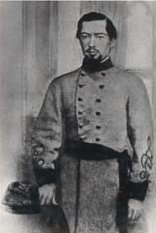
This is Assistant Surgeon Simon Baruch (‘ba-rook’) of the 3rd South Carolina Battalion. I found him by following a thread in a CW Society post, part of their recent conversation about Jewish Confederates. Among those prominent in that service it mentioned
… Nahum Baruch, the father of financier Bernard Baruch, was a doctor and Colonel in Barksdale’s Mississippi Brigade. He was present at Gettysburg.
As is my wont, I saw the thread sticking out and gave it a yank. Who was this Nahum?
It turns out this Baruch was not Nahum, actually. Nor a Colonel, though he ended the War in Barksdale’s famous Brigade. He did have a successful son, was a doctor, and was at Sharpsburg and that other northern battle, too. There’s lots more to his story.
From Schwersenz, east of Posen, then part of Prussia (now Poland), Simon Baruch came to South Carolina in 1855 at 15 years of age. He was, perhaps, worried about conscription into the Prussian Army, but equally likely, about his economic future. He joined the household of Mannes Baum who had emigrated from Schwersenz some five years before, and worked as a bookkeeper in the family store in Camden.
About 1860 the Baums sent him to South Carolina Medical College and then the Medical College of Virginia, Richmond. Simon graduated with an M.D. in early 1862 and accepted a commission as Assistant Surgeon of the 3rd South Carolina Battalion on 4 April of that year. He reportedly said he had entered the service “without even having lanced a boil.”
His Battalion was assigned to Virginia and saw their first action near Yorktown that same month. They fought with General Lee’s Army of Northern Virginia in Drayton’s and Kershaw’s Brigades, seeing combat at Second Manassas, on the Maryland Campaign, at Fredericksburg, Chancellorsville, Gettysburg, in the Wilderness, and at Spottsylvania Courthouse.
In August 1864 Baruch transferred to the 13th Mississippi Infantry Regiment and was appointed full Surgeon to date from 18 July. He probably served with that unit for the rest of the War.
By then, Dr Baruch would have had considerable surgical experience. The 3rd Battalion was hard hit in two battles in particular: at Fox’s Gap on South Mountain during the Maryland Campaign, and at Gettysburg, Pennsylvania.
On 14 September 1862, Drayton’s Brigade, part of Longstreet’s Command, was thrown into Fox’s by General D.H. Hill in a desperate defense against the assault of Federal General Reno’s IX Corps. The Battalion was severely damaged that day, suffering about 50% casualties, providing strenuous work for the surgeon in treating those wounded men who were not left behind on the battlefield.

Gettysburg Field Hospital, 1863
(Confederate Relic Room and Museum, Columbia, South Carolina)
The following July they were at Gettysburg, where Baruch was assigned to McLaws’ Division hospital in the Black Horse Tavern (site above). As he described it
All day and night the work continued at the field hospital, and throughout the following day also the wounded came pouring in, many on foot, among them several captured Union soldiers, on two of whom I operated. The field hospital contained now 222 seriously wounded men, 10 orderlies, and 3 surgeons.
Baruch and the other hospital staff remained behind with the wounded when the Confederate Army retreated on 4 July 1863, and surrendered to the Federals at 7 a.m. on the 5th. He continued to treat the wounded there for about six weeks, and was then imprisoned at Fort McHenry in Baltimore. He was paroled in October and returned to his unit in December.
At some point following, probably in the Spring of 1864, Baruch was relieved or resigned his commission on account of health, but he was back in service by summer and served as Surgeon for the duration with the 13th Mississippi Regiment.
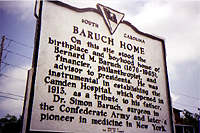
state historical marker, from Jewish tour of the Carolinas
Afterward, he returned to Camden and was in practice as a physician. There he married Isabelle (Belle) Wolfe, a niece of his benefactor, Mannes Baum. He also organized the South Carolina Medical Society and was president of the State Board of Health.
Baruch practiced medicine in South Carolina for the next 16 years but was increasingly dissatisfied with the indiscriminate use of unproven remedies which, as often as not, did more visible harm than good. His studies brought him to appreciate the healing philosophies of the Austrian physician, Vincent Priessnitz [1799-1852], who had established a successful therapeutic spa in the Silesian mountains. Preissnitz employed therapies largely confined to the use of water for frequent bathing and irrigating the gastrointestinal tract. His patients recuperated in a restful, tranquil environment, ate a prudent diet with neither alcohol nor tobacco, and were encouraged to exercise. He called his alternative form of medicine, hydrotherapy … (from Aronson)
Apparently not content with his rural practice or the trends in modern medicine, Dr Baruch moved his family to New York City in 1881, where he practiced on West 57th Street and became a force in the public health causes of bathing and hydrotherapy:
Although in Europe public baths had been made available since the early nineteenth century and in this country public plunge (swimming) pools were relatively commonplace in some of the larger cities, it was not until the 1890s that attempts to establish municipally-sponsored bath houses were to meet with governmental approval. One of the first pleas for their establishment was made by Dr. Simon Baruch of New York and appeared in an 1889 editorial in the Philadelphia Medical Times and Record …(from Philipse Manor Hall, Yonkers)
Even in New York, though, the Baruchs remained strong Southerners
Mrs. Baruch became a member of the United Daughters of the Confederacy, and the couple raised their children with pro-Southern views. If a band struck up “Dixie,” Dr. Baruch would jump up and give the Rebel yell, much to the chagrin of the family. A man of usual reserve and dignity, Dr. Baruch nevertheless would let loose with the piercing yell even in the Metropolitan Opera House … (from Mandes)

Simon Baruch (after 1890, from CUNY)
Son Bernard Mannes (1870-1965), a rather more famous Baruch, went on to a very profitable career on Wall Street, and became a financial advisor to US Presidents from Woodrow Wilson to Harry Truman.
He is credited, among many other things, with coining the term Cold War to describe the US-Soviet conflicts, and with one of my all-time favorite quotes
If all you have is a hammer, everything looks like a nail.
His vast fortune enabled him to donate and endow university chairs, medical facilities, and other philanthropies, many in his father’s name. Between these gifts and the work of various civic organizations recognizing his achievements, Simon Baruch’s name will probably outlive all of us.

Examples of Simon Baruchisms in America today:
- Baruch Playground, NYC
- Simon Baruch Houses, public housing project, NYC
- Mrs Simon Baruch University Award – history prize from the UDC
- Buildings, halls, and chairs at Columbia University, Clemson University, New York University’s College of Medicine, and the Medical College of Virginia/VCU
- Simon Baruch Middle School, NYC
_______________
Myth or Fact?
Simon Baruch is credited in a number of places with having been on “General Lee’s staff”: there’s no evidence of that. He’s also occasionally mentioned, in family and neighborhood lore, as being Surgeon General of the Confederacy. There’s no evidence of that, either. There were only two of those; David C DeLeon and Samuel P Moore.
Many interweb pages cite Dr. Baruch as the first to successfully perform surgery for appendicitis. This is probably not true:
The first report of an appendectomy came from Amyan, a surgeon of the English army. Amyan performed an appendectomy in 1735 without anesthesia to remove a perforated appendix. Reginald H. Fitz, an anatomopathologist at Harvard who advocated early surgical intervention, first described appendicitis in 1886. Because he was not a surgeon, his advice was ignored for a time. Then, at the end of the 19th century, the English surgeon H. Hancock successfully performed the first appendectomy in a patient with acute appendicitis … (from eMedicine)
He’s also mentioned as an active member of the Ku Klux Klan in the years immediately following the Civil War. This is most often stated in websites and literature which also promote the International Zionist Conspiracy theory, among whose favorite targets is Bernard Baruch, which is suspicious. Membership in the KKK is plausible, but I don’t know for sure.
_______________
Notes
For much more about the doctor see
- Patricia Spain Ward, Simon Baruch: rebel in the ranks of medicine, 1840-1921, Tuscaloosa and London: University of Alabama Press, 1994
- Stanley M. Aronson, MD, The Bathhouses of Manhattan, Medicine & Health\Rhode Island, Vol. 89 No. 4 (April 2006 pdf)
- Thomas C. Mandes, Blacks, Jews fight on side of the South, The Washington Times, June 15, 2002 (transcribed)
The portrait of Simon on this page is from the collection of the Camden Archives and Museum. It was used on the cover of the Ward book. Legend has it that Belle Wolfe, later Simon’s wife, painted him in 1862. Perhaps this is that piece.
The photograph taken at Gettysburg, above, is from an online exhibit of the Libraries of the University of North Carolina, and has scrawled on its face handwritten notes concerning Dr Baruch’s role there. I’ve attempted a transcription here (top to bottom):
“lines of battle of Gen Robt E Lee”
“Barn and Tavern which Dr Baruch ___ed after the battle by direction of Gen Lee”
“spot where Dr Baruch surrendered the hospital to the advance guards July 5th, 1863 7 a.m.”
“site of hospital of McLaws Division, Longstreet’s …”
… and on the mat: “Presented by Mrs Simon Baruch” and “S Baruch MD, Asst Surg 3d SC Battalion, Kershaw Brigade, McLaws Division”


Leave a Reply to The KKK Had Openly Jewish Members « seedofjapheth Cancel reply