A recurring theme in the study of George McClellan’s record with the Army of the Potomac is his apparent propensity for overestimating the size and mettle of the opposing force. I really don’t have a good understanding of why this was or what his sources of information were. Except for a nodding acquaintance with Pinkerton (below), I don’t understand his intelligence apparatus at all.
I’m now reading Edwin Fishel’s The Secret War for the Union [more at Amazon], and I think there might be some help there. I have to admit I skipped ahead when I first got the book, Sunday last, looking for tidbits on the Maryland Campaign. Fishel has some very fine specifics on events of early September 1862 that I’d read of in summary elsewhere. I appreciate well documented details, though it doesn’t make for light reading in this case. Now that I’ve got a good feeling from the author in my small area of expertise, I’ll go back and begin at the beginning of the book. I promise.
Side note: I went to school and played music with a Fishel in the early 70’s in Arlington (Va). Great trumpet player. I knew his father, slightly, as a Dixieland bandleader and jazz musician. Had no idea he was a spook. Now I know “the rest of the story”.
There has been a discussion recently on H-CivWar about Antietam. About whether it was a draw or victory, and some of the common “what-ifs” have made their appearances: if only McClellan had insert cliches here … the usual suspects.
In an outgrowth from this, Tom Clemens and others have pointed out that it was what McClellan believed at the time about his opponent that guided his actions, not what we know now to be the reality. I think Professor Joe Harsh – although more concerned with Lee – and other recent writers have made this point well. I’m inclined to that school of thinking myself.
McClellan sincerely believed he was outnumbered at Antietam. Whether this was self-inflicted or based on factual information, delusional or reasonable, I don’t have the facts to appreciate. More digging is required.
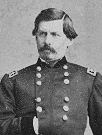
In his post-battle report of October 15, 1862, by way of example, he said:
“… With the day [17 September] closed this memorable battle, in which, perhaps, nearly 200,000 men were for fourteen hours engaged in combat …” [note: McClellan counted just under 90,000 of his own, here crediting Lee with 110,000, more than twice as many as he probably had]
“…The object and results of this brief campaign may be summed up as follows … The army of the Union, inferior in numbers, wearied by long marches, deficient in various supplies, worn out by numerous battles, the last of which had not been successful, first covered by its movements the important cities of Washington and Baltimore, then boldly attacked the victorious enemy in their chosen strong position and drove them back, with all their superiority of numbers, into the State of Virginia…”
Even if this is crafted for public consumption, or in defense of criticism, it does give some feel for McClellan’s perspective. I need to better understand where this came from.
_____
Extra credit
Among otherwise cogent arguments he’s offered in that H-CivWar exchange, Jim Epperson has posed a bizarre thesis: that 1860 Federal Census data gave McClellan the basis for knowing, in fact, that Lee’s army couldn’t have been as large as he claimed.
Yesterday he summarized a previous post:
“… My point was that a trained soldier who knew the census figures should have known it was not likely he faced an enemy army of 200,000.”
I have high regard for Mr Epperson’s previous scholarship – I know him best from his Causes of the Civil War site – and I know he’s been around, but this sounds absurd to me.
How should this have worked, exactly?
- McClellan and/or staff, (or, previously, someone at Army HQ or the War Department in Washington) have census data on hand
- They actively recognize that there are relationships between population data and military service figures
- They know the rates at which populations joined the CS army (by county, state; minus those serving in local militia/home guards, essential industry, etc)
- They know the portions of the total enlisted who were assigned to units in the ANV
- McClellan knows which units of the ANV are across the creek from him at Antietam
- McClellan knows what portion of the theoretical total of these enlistees are actually present for duty.
If someone went through all this, and Mr Epperson isn’t claiming that anyone actually did, the margin of error would be too large to make the number useful.
I think this is getting out of hand 🙂


Leave a Reply to behind AotW » Blog Archive » Fishel: Secret War for the Union Cancel reply