Category: quickPost/Pix

side notes

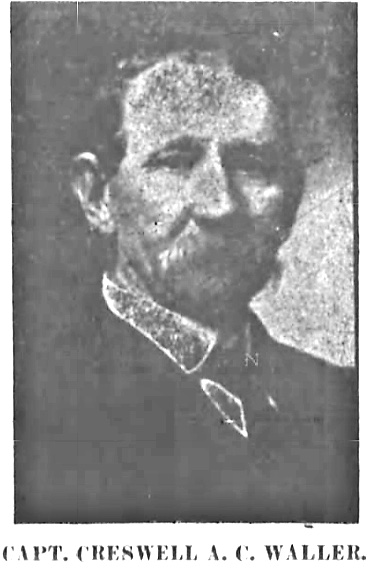
  • Capt. Creswell A.C. Waller (1910)

    This is Creswell Archimedes Calhoun Waller of Greenville, SC from a photograph published in the Greenwood Evening Index of 3 March 1910.

    He was a Private in the 2nd South Carolina Infantry at Sharpsburg in September 1862. He later rose to be a Captain in the 36th Georgia Infantry and was a successful business man and politician in Greenwood after the war.

    He was one of 8 children – 7 boys, one daughter – of Albert “Squire” Waller and Jane Elizabeth Creswell “Betsy” Waller, who had a substantial and successful plantation near Greenwood before the war. Many of the boys had interesting names like Creswell, who was named for his mother’s family, the Greek mathematician, and the US Senator from South Carolina. Among his brothers were Codrus D., Cadmus Garlington, and Pelius Augustus Waller, who was killed at Olustee, FL in February 1864.

    Two of his brothers were also at Sharpsburg, and both were killed.

    Robert Aurelius Waller was Captain of Company B of the 8th Florida Infantry and commanded the regiment briefly after Colonel Coppens was killed, but was himself shot down near the Sunken Road “with the colors of the regiment draped over his shoulders.”

    Private James Leonidas Waller was with Captain Garden’s Palmetto Light Artillery at Sharpsburg and was mortally wounded by an exploding shell. He died in October at a hospital in Winchester, VA.

  • Columbie et Guyanes (1870)

    Doctor Thomas Smith Waring, late Assistant Surgeon of the 17th South Carolina Infantry was living in Venezuela in 1870. Like thousands of other ex-Confederates, he’d left the United States after the Civil War, perhaps hoping to recreate something of the Confederacy in South America.

    By 1880, though, he, like most of the ex-pats, was back in North America. He practiced medicine in Colleton County, South Carolina to his death in 1901.

    The map above, by P. Bellier, Paris, c. 1870, was sold by Sephora Antiques in May 2020.

  • The Connecticut, from Long Island Sound

    The capacity of the [US Army Hospital Steamer] ‘Connecticut’ was four hundred patients. She made altogether forty-seven trips and conveyed eighteen thousand nine hundred and nineteen (18,919) patients.

    One of those patients was Private George Perry Williams of the 17th South Carolina Infantry. He’d been captured at Petersburg in March 1865 and was a prisoner at Point Lookout, MD. Although probably not previously wounded, in late July he had “partial paralysis of left side of body,” and was sent to a hospital in Washington, DC aboard the Connecticut. He was finally released in August 1865.

    George had a tough early life, too. In October 1843, when he was 5, his father Rev. Martin Jones Williams (b. 1806) was murdered – poisoned by arsenic. His mother Sarah Kearse Williams (1807-1865) was tried for the crime but not convicted, for lack of evidence to prove it was her. She later had children with at least 2 men but did not remarry. She was from a wealthy and influential family but by 1850, when George was 12, she’d lost her land and the slaves her father had left her in 1838.

    The quote above is from the Medical and Surgical History of the War of the Rebellion (1870), online from the US National Library of Medicine. The picture of the US Army Hospital Steamer Connecticut is from Miller’s Photographic History of the Civil War (Vol. 7, 1911), online from the Hathi Trust. Georges’s postwar photo below is from Charles L.D. Carlson, SCV Camp 842.

    ____________________

    Another soldier of the 17th South Carolina got a trip on a USA Hospital Steamer, in May 1865.

    Private Nicholas Welsh of Company I was wounded at Turner’s Gap and at the very end of the war at Appomattox Court House on 9 April 1865, after which he was sent to a hospital in Washington, DC on the State of Maine, seen below. That photograph is from the collection [pdf] of the National Museum of Health and Medicine.

  • Thomas M Carroll and children (c. 1900)

    These are Thomas Marion Carroll and 3 of his 11 or 12 children: his youngest, Martha Julia/Jane Carroll (1899-1985), Henderson M. Carroll (1893-1963), and Addie Priscilla Carroll (later Harrison, 1888-1966).

    Addie had 7 children of her own, one of whom must have written ‘Mama” on this photograph, which was shared to the Family Search database by a descendant.

    Thomas was 17 years old when he enlisted as a Private in Company F of the 17th South Carolina Infantry in November 1861. He was at Turner’s Gap on South Mountain and at Sharpsburg in September 1862 and fought with his regiment until captured at Petersburg, VA in March 1865. He was afterward a farmer in Rutherford County, NC for about 40 years.

  • Pvt Samuel L Johnston

    Here’s Private Samuel Lee Johnston who enlisted a month after his 17th birthday as a Private in Company E – the Indian Land Tigers – 17th South Carolina Infantry in November 1861. Johnston’s is one of the few happy-ending stories I’ve seen recently: he survived the fight at Turner’s Gap on 14 September 1862 and the rest of the war without apparent injury, and went home in April 1865 after the surrender at Appomattox Court House.

    He lived to be 75 and had at least 9 children with two wives.

    His photograph is a garage sale find shared on his Findagrave memorial by user Lanie in 2014.