This is a group photograph of the officers of the 6th Vermont Infantry at Camp Griffin, VA, near Washington, DC in October 1861. Among them, front row to the right of the colors, is Major Oscar S Tuttle. He commanded the regiment in Maryland in 1862. In the back at far right is his brother Lyman Mower Tuttle who was Assistant Surgeon.
The photograph is hosted by Tom Ledoux on Vermont in the Civil War; its from the Ed Italo Collection.
Colonel Matthew S Quay commanded the 134th Pennsylvania Infantry in Maryland. They arrived on the battlefield of Antietam on the morning of 18 September after an all night march. He resigned due to illness in December, but was a Fredericksburg, VA on the 13th as an aide to General Erastus Tyler. Quay was awarded the Medal of Honor for his actions there. By the end of the war he was private secretary to Governor Curtin.
He began his career in the Pennsylvania legislature in 1864 and was a political “boss” in the state for the rest of his life. He was US Senator for two terms, from 1888-1899 and again from 1901 to his death in 1904. Quay once said politics was “the art of taking money from the few and votes from the many under the pretext of protecting the one from the other.”
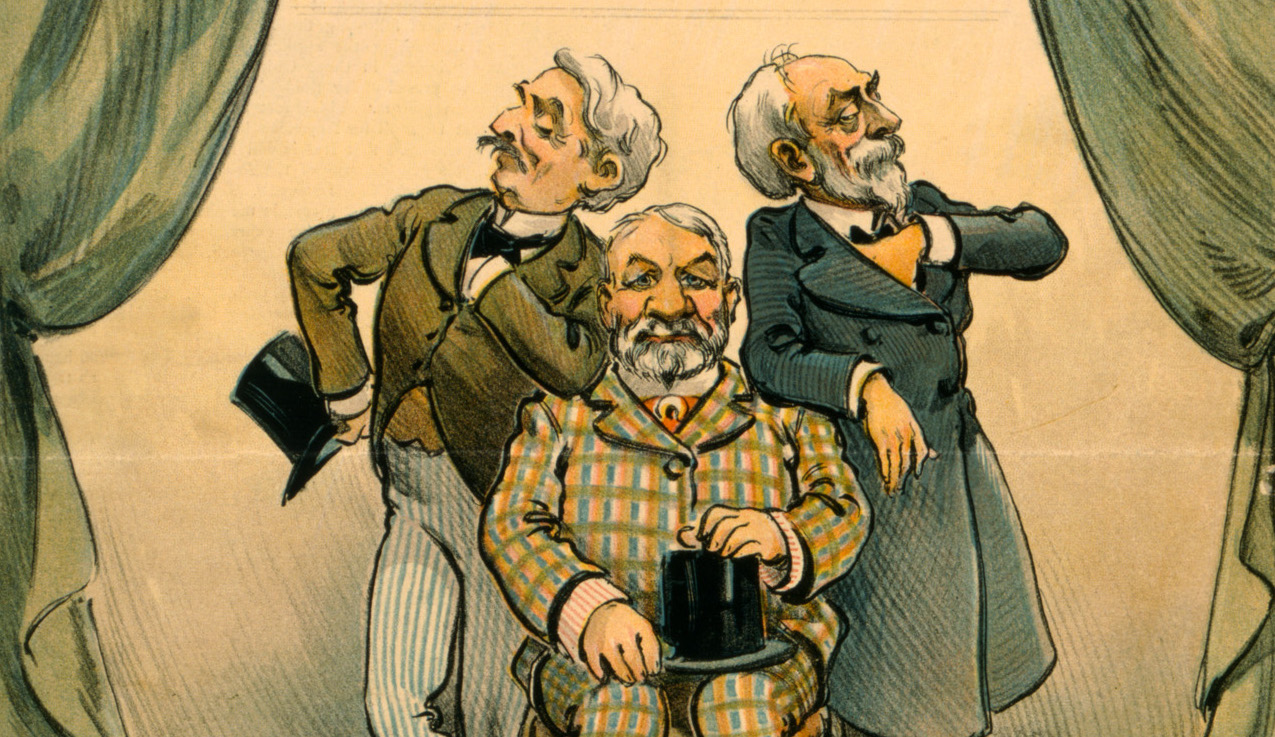
This lovely caricature of bosses Quay (left), Richard Crocker of Tammany Hall (seated), and Senator Thomas Collier Platt of NY (right) was on the cover of the Puck Magazine of 24 January 1900, online from ExplorePAHistory.
Colonel Henry M Bossert commanded the 137th Pennsylvania Infantry in Maryland, and his rookies saw their first enemy fire at Crampton’s Gap on 14 September 1862 and were in reserve at Antietam. This photograph of him is from Sue Bossert Hannegan, published in Roger D. Hunt’s Colonels in Blue (2007).
William Harrison Humphrey enlisted as a Private in the 2nd United States Sharpshooters in October 1861 and was with the regiment at Antietam. He later remembered:
[Very early on 17 September] while crossing the [Miller’s] field shot and shell drop about us in a careless manner, we think. Some of the boys speak how careless they are while others thought they meant to be … I have often thought if it had not been for now and then a good joke cracked just in the nick of time it would have been hard to have kept the boys in line had someone put on a long face and moaned about the horrors …
He was promoted through the ranks to First Lieutenant of his Company by November 1864 and transferred to the 4th Vermont Infantry in February 1865. He was seriously wounded by a shell at Petersburg, VA two months later and lost his right leg.
The picture on the right is held by the Vermont Historical Society. The other photograph shows him after his leg was amputated, with William F. Tilson (left), who was wounded by the same round as Humphrey. It’s from the Tilson Photograph Album, hosted online by Tom Ledoux.
Private Christopher Columbus Blake, 2nd United States Sharpshooters was seriously wounded on the top of his head at Antietam. He was discharged afterward for disability but lived a full life as a lawyer and newspaperman in Iowa, Illinois, Colorado, and finally Kansas.
Descendants and historians located his previously unmarked grave in 2011 and the US Department of Veterans Affairs provided a new headstone. That’s local historian Iona Spencer placing flowers during the dedication of the new stone; photograph from Chris Hong’s Lawrence (KS) Journal-World story about the event.