Antietam on the Web was a bit overdue for an overhaul: some of the PHP code had been deprecated (gone obsolete), much of the HTML was clumsy and likewise obsolete, and the site navigation didn’t make it easy to find the information on the site. Most of the navigation dated from 2005, and even the newest PHP and HTML code was last updated in 2010.
So I re-wrote and re-organized the whole thing.
The content is now gathered into big clusters for people (soldiers & units), places (maps), events (narrative), and features (special projects). I hope you’ll find it easier and more intuitive to use. It’ll certainly run more efficiently and be easier for me to maintain.
Here’s a quick visual comparison, new vs. previous home page design.
I have been busy with the business of life, but not entirely ignorant of the world outside! I certainly noticed the October 2010 announcement of the incredible generosity of the Liljenquist family who donated their collection of more than 700 Civil War ambrotypes and tintypes to the Library of Congress. The Library is creating a physical exhibit for them opening in April 2011 as part of the Sesquicentennial observations.
In the meantime, they’ve scanned and posted the collection online on their own pages and through a Flickr photostream. I’ve explored this treasure a little, and found some intriguing images with connections to our favorite battlefield.
Woman wearing mourning brooch and displaying framed image of soldier (1861 – 1865, Library of Congress via Flickr)
I’m sorry that so few of the subjects of these pictures are identified. Only a couple of dozen are named, another dozen or so are identified by military unit from clues on their uniforms or in the photo background. The remaining hundreds are unidentified.
I am moved all the more, however, by the anonymity of this woman in her grief. I presume from the context that the soldier in her lap has recently been killed. Her husband? It reminds me again of the deadly way the War ripped through families and brings perspective to battle maps, memorials and markers … (more…)
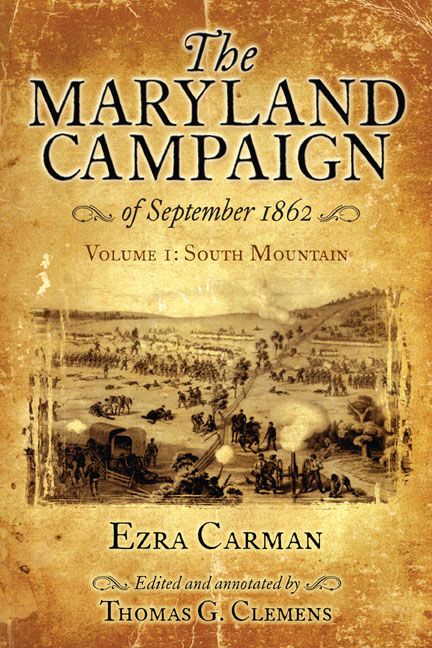
Tom Clemens makes his debut in the blogosphere today on The Maryland Campaign of 1862. That’s also the title of his two-volume series coming soon from Savas-Beatie: a carefully annotated edition of General Ezra Carman’s life’s work.
Volume 1: South Mountain arrives mid-May 2010.
Among other things, Tom promises to use the site to get some of the hundreds of letters from battle veterans to Carman and the Antietam Battlefield Board online. Those eyewitness accounts formed much of the factual basis for Carman’s iconic narrative of the battle.
Tom’s new website/blog uses WordPress software, with a custom visual design built on the Thematic framework. I can recommend this software combination to anyone who wants to get online quickly, while still serving clean, fast-running and compliant code, with simple maintenance and vast flexibility in visual appearance.
In short, the tool doesn’t get in the way of the content.
WordPress makes it easy for Tom – who is not a web guy by profession – to maintain both the content and the look & feel of his online home down the road.
Frank Schell accompanied the Army of the Potomac on the Maryland Campaign of 1862, and was on the field for the battle on 17 September. He was a civilian there from New York – a sketch artist for Frank Leslie’s Illustrated Newspaper.
Fortunately for those who study the battle, a number of his original battlefield sketches have survived. I’ve recently discovered a set sold at auction in 2007, and a group preserved in a collection at Boston College, in particular. I’ve grabbed some selected gems among them to use here.
Even better, in 1904 Schell published his recollection of the events that were going on around him as he was drawing these same pictures. So in sharing his pictures and his superb eye, I can also leave the writing to Frank – to narrate his own drawings and give us a sense of his Battle of Antietam.
Hooker’s Corps crosses the Antietam (16 September 1862, pub. Leslie’s 11 Oct 1862)
As I awoke soon after daylight on the morning of September 17, 1862, the air was already vibrating with mighty sounds of battle … With spirits aflame, I speeded at my best from Keedysville for the headquarters of the commanding general … I joined the group about the commanding general, who was anxiously scanning through his field glass the situation to the right, across the Antietam. Looking more to the left, the thick west wood, with its dark, broad front so clearly emphasized by the little white Dunker church, was clearly in view along its entire extent upon the Hagerstown turnpike.
General McClellan suddenly lowered his glass, and, with a few animated words and expressive gestures, called Porter’s attention to something that caused an immediate ferment of buzzing excitement throughout the group and a close scrutinizing of the bit of woodland, for the time being, the focus of such absorbing interest …
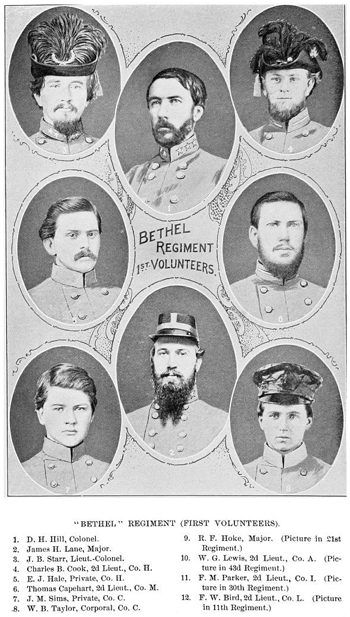
An excellent companion to Moore’s Roster for researching North Carolina troops is the 5 Volume Histories of the Several Regiments and Battalions from North Carolina in the Great War, 1861-1865, published by the State of North Carolina in 1901. Editor Walter Clark was Adjutant of the 35th Regiment at Sharpsburg, and later Lieutenant Colonel of the 70th Regiment.
All NC military units – along with an array of related subjects – are represented in one or more articles, and each piece is written by a veteran who served in the regiment, battalion, or battery. Their works range from brief essays to fairly sophisticated unit histories. As a bonus, most include selections of war-period photographs of officers and men. There are hundreds of faces altogether across the volumes.
These volumes are available online from both GoogleBooks and the Internet Archive (IA) Collection. I like the IA image quality and paging interface best, so a hyperlinked table of contents (hyperTOC) for that online edition follows …


![[Unidentified woman wearing mourning brooch and displaying framed image of unidentifed soldier] (LOC)](https://live.staticflickr.com/5201/5228622401_284617d66c.jpg)