Category: the history

  • McClellan on the field at Antietam

    I have some follow-up to the last post, about General McClellan dashing over the field during the battle of Antietam on 17 September 1862. Happily more battle illustration is required in accompaniment.
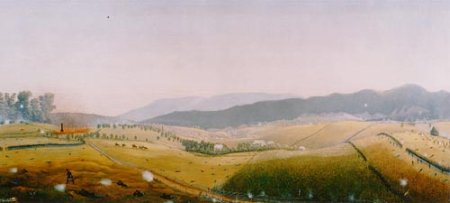
    Hope 2
    A Fateful Turn: Late morning looking east toward the Roulette Farm (James Hope via ANBP)

    This is one of the five famous Hope Paintings, a series of very large panoramic views painted by battle veteran James Hope working from sketches he made during the battle. These were first exhibited to the public in or after 1872 at his Watkins Glen studio.

    The Park Service notes describe this picture:

    … burning Mumma Farm is seen on the left, and Gen. George McClellan is riding with his staff on his only visit onto the battlefield that day at about 2:00 pm. On the right, Richardson’s and French’s Union Divisions advancing on Bloody Lane.

    Is this further evidence of McClellan’s whereabouts on the field or artistic interpretation? (more…)
  • Good source, bad source

    I’ve been lured again by a pretty picture to post about being open to options when interpreting historical information. The image is from the Century Illustrated Monthly Magazine, May 1886:

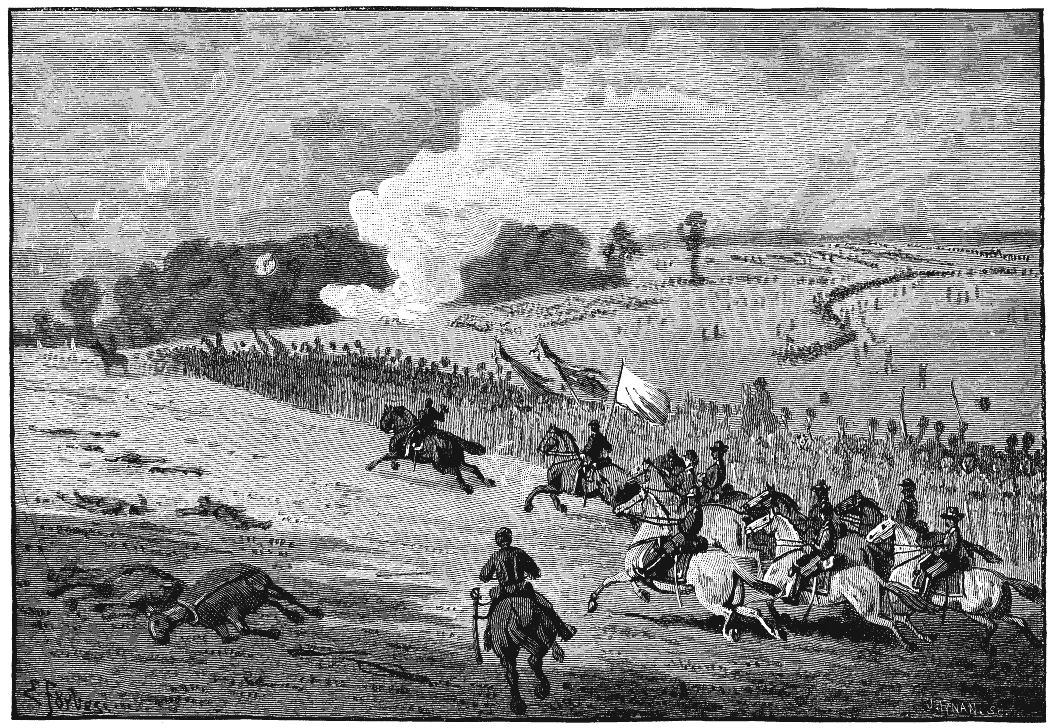
    McClellan rides the line at Antietam (Forbes)click to see larger image
    General McClellan riding the line of battle at Antietam.
    (by Edwin Forbes, after his sketch made at the time.)

    The troops were Hooker's and Sedgwick's, and the time about 11 A. M. of September 17. General McClellan rode his black horse, “Daniel Webster,” which, on account of the difficulty of keeping pace with him, was better known to the staff as “that devil Dan.”–EDITOR.

    I think this is pure fantasy. I don’t remember another reference to such a ride, certainly not in advance of the Federal line between the East and West Woods, as shown here. However, combat artist Forbes was on the scene that day, so maybe I shouldn’t dismiss this image entirely …
    (more…)

  • Getting on with the War

    Berlin, MD. October 1862click to see larger image
    Pontoon bridge at Berlin, Md., October 1862

    In the last week of October 1862, General George McClellan crossed the bulk of his Army of the Potomac into Virginia, ready to again do battle with General Robert E. Lee’s Confederate Army of Northern Virginia. It was the first significant movement of the Army–outside of the scrap at Shepherdstown on 19-20 September–since the Battle of Antietam.

    Conventional wisdom has it that McClellan had stalled continuously since Antietam in defiance of President Lincoln’s impatience with the lack of pursuit of Lee’s battered ANV, and that the President fired the General immediately after the election in November for that lack of aggressive action.

    But is this too simplistic? (more…)

  • Craighill: staff officers, a lighthouse, and copyfraud

    William Price Craighill (1833-1909) may have been something of a prodigy as he entered the US Military Academy at West Point at age 16 in 1849.

    duty honor country
    W.P. Craighill, c. 1849

    He graduated in 1853, ranked second in the class which included famous ACW Generals Sheridan and Hood, and was commissioned a 2nd Lieutenant in the Corps of Engineers. At the outbreak of the Civil War he was an instructor at West Point, and though from Virginia, stayed with the Union, seeing War service on fortifications and other engineering projects across the US. His long Army career peaked in 1895 when he was appointed Brigadier General and Chief of Engineers, US Army.

    I bring Craighill to you in several contexts – a kind of 3-for-the-price-of-one post … (more…)

  • Merry Christmas via 1862

    Season’s Greetings and Happy Holidays!

    In my house that means Christmas and New Year’s. I wish you and your loved ones a joyous celebration in your traditions as well.

    Noel
    St. Nicholas (Thomas Nast, c. 1880)

    Elements of the popular American Christmas celebration–trees, cards, Jolly Santa–are products of the 19th Century. Cut evergreen trees were popular here by the 1840’s, and most people exchanged Christmas cards by the ’60s. Our modern Santa Claus image was established largely by political cartoonist Thomas Nast (1840-1902) during the Civil War and refined over the 30 years or so after.

    Perhaps most recognizable to Civil War readers is this Nast depiction of the Elf himself, in union garb, distributing goodies to Federal troops at Christmas 1862.

    Santa in Camp (Nast -small)click to see larger image
    Santa Claus in Camp (Thomas Nast, 1862)

    The unflattering Jefferson Davis jumping-jack toy in his hand leaves no doubt as to Santa’s loyalties. That illustration, from the cover of Harper’s Weekly*, is also touted as an early attempt at psychological warfare.

    I doubt Southern children were fooled.
    ________________

    * Harper’s Weekly, 3 January 1863, page image from the US Library of Congress.

    See much more about Christmas and the Civil War, from Kevin “Santa” Rawlings and historic Fort Ward.

    added 22 December

    K. Rawlings

    See Kevin Rawlings, above, at work as Santa earlier this week, and an article from Maggie MacLean with much more from the ACW homefront.