Category: biography

  • Ben Witcher’s Story


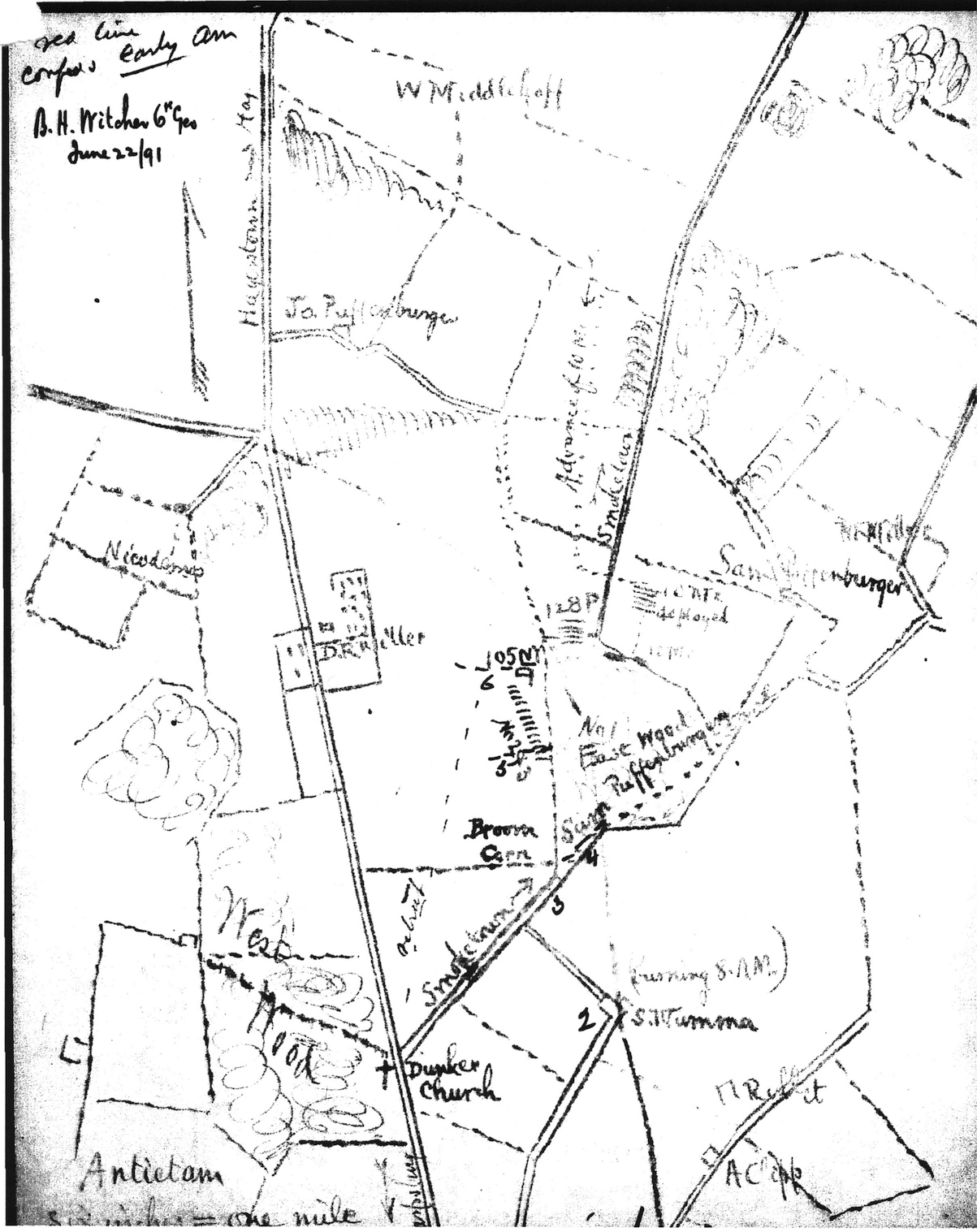
    B. Witcher’s battlefield map (detail, click for full)


    The map above is centered on the eastern part of the Miller Cornfield near the East Woods at Sharpsburg on the morning of 17 September 1862. There has been heavy fighting here since dawn and, along with other regiments in action, the 6th Georgia Infantry has been nearly wiped out. It is between 8 and 9 in the morning.

    Stephen Sears, in his classic Antietam book Landscape Turned Red (1983), wrote this dramatic vignette of that time and place:

    Private B. H. Witcher of the 6th Georgia urged a comrade to stand fast with him, pointing to the neatly aligned ranks still lying to their right and left. They were all dead men, his companion yelled at him, and to prove it he fired a shot into a man on the ground a few yards away; the body did not twitch. Private Witcher was convinced and joined the retreat. 

    Over the years since I first read it, I had forgotten Benjamin Witcher’s name, but not that story. Who could forget that imagery? Even in combat, the shock of shooting into one of your own mess-mates would have been horrendous.

    At least three other well-known books on the battle have used this anecdote, too, citing Landscape as their source. If you’ve read any of the basic literature, then, you will have seen it, and you’d remember.

    But I’ve just found it isn’t true. It didn’t happen that way. (more…)
  • Samuel W. Evans decorative discharge document (1905)

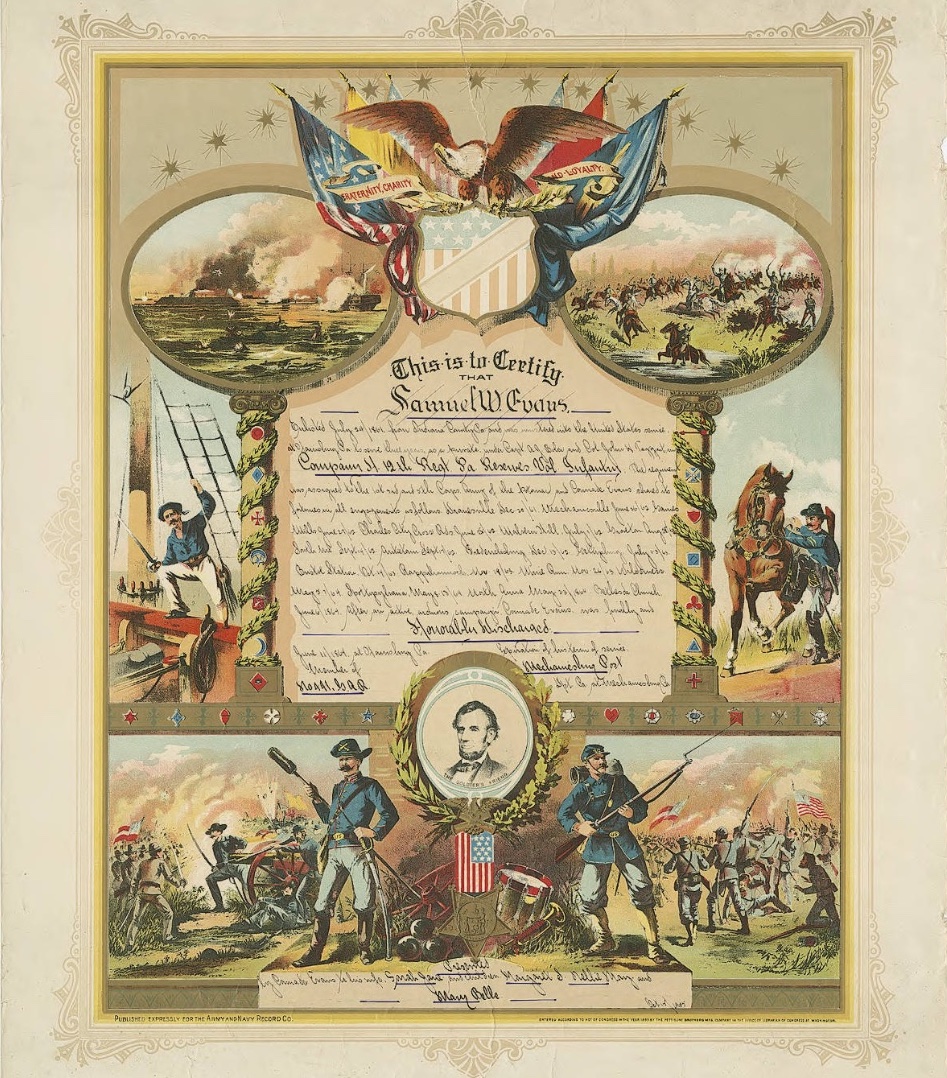
    This lovely piece is a decorative military record – “very tastefully printed in 10 colors” – for Private Samuel Wilson Evans of the 12th Pennsylvania Reserves. He served from 1861 to 1864 and saw action at South Mountain on 14 September and at Antietam on 17 September 1862.

    This certificate was produced by the Army and Navy Record Company, which was started in about 1883 by Walter C. Strickler (c. 1837-after 1920) of Philadelphia – an outgrowth of his personal project to gather an exhaustive timeline for every Union military unit and action of the Civil War. Strickler’s son Theodore compiled some of that work in When and Where we Met Each Other on Shore and Afloat … (1899).

    The colorful parts of this decorative record were printed, but Evans’ name and service details are hand-written. It was “presented” in his name to his wife Sarah Jane and daughters Margaret, Nellie May, and Mary Belle on 1 October 1905. The original is about 19×27 inches and it’s online thanks to the Maryland State Archives.

    Below is an advertisement in the National Tribune of 5 October 1905. By that time the National Tribune had bought out Strickler, and was offering these certificates on their own. Strickler and the Tribune had been in a marketing relationship for some years before.

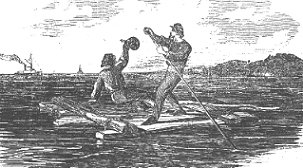
  • Rorty and Kelly making their escape.

    County Donegal native Lieutenant James McKay Rorty was Ordnance Officer of the First Division, 2nd Army Corps (Brigadier General Israel B. Richardson) at Antietam. He was heroically and famously killed at Gettysburg in July 1862 while in command of Battery B, 1st New York Light Artillery – a remnant of the old Irish Brigade/2nd Artillery Battalion in which he’d originally been commissioned in 1861.

    Equally famously, as a Private in the 69th New York Militia he’d been wounded and captured at First Bull Run on 21 July 1861 and held in a warehouse in Richmond, VA. On 18 September he and two other men, 1Sgt. William O’Donohue and Pvt. Peter Kelly, disguised themselves in civilian clothes and escaped. A week later they made it to the Potomac River and rafted out to Federal gunboats.

    That’s the scene in the illustration above, from Frank Leslie’s Pictorial History of The War of 1861, posted online in company with a piece about Rorty from The Wild Geese.

    The escapees are (probably) seen in the photograph below – left to right, Kelly, Rorty, O’Donohue – taken later, after all three were commissioned officers. It’s from owner Matt Regan and is online from Harry Smeltzer.

    [updated February 2021]

  • Walcott’s 21st Massachusetts

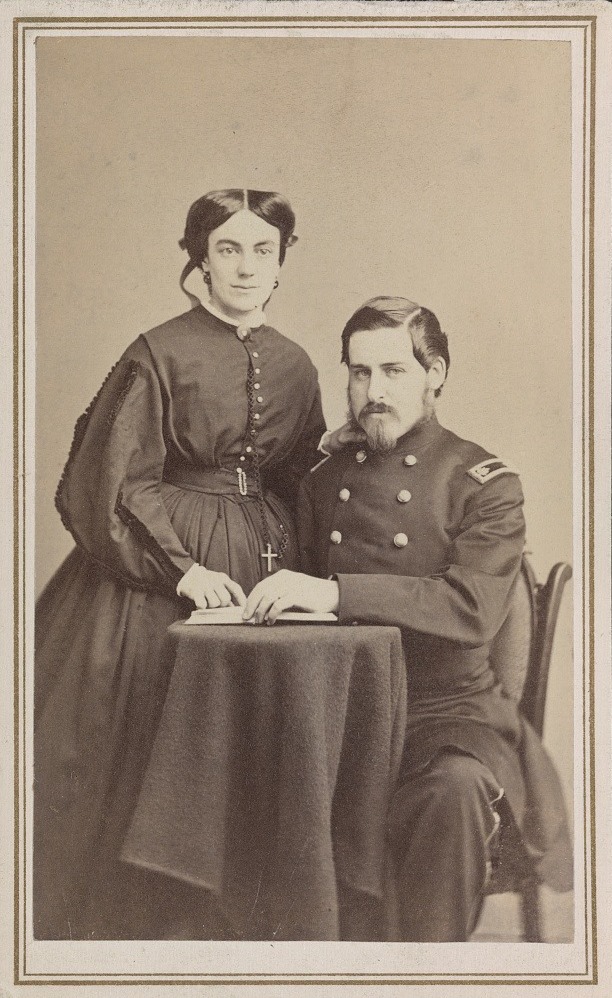
    Captain Charles F Walcott is a hero to those who study Massachusetts soldiers in the Civil War (or at least to me) because he wrote the Regimental History of the 21st Massachusetts Infantry (1882). In the preface he apologized for taking more than 15 years to complete the book while raising children and running a law practice in Boston.

    A Harvard man, he’d adventured West during a “gap year” in 1857 before law school. He had travelled to Minnesota, “living with the Sioux and Winnebago”, went down the Mississippi to New Orleans and returned home by ship by way of Cuba.

    Walcott was the original Captain of Company B of the 21st, commissioned in August 1861, and he commanded it on the Maryland Campaign of 1862 – at Fox’s Gap on South Mountain and right behind the 51st PA & 51st NY over Burnside’s Bridge at Antietam.

    He left the 21st Massachusetts in April 1863 and married Anna Morrill Wyman in October.

    He did a 90-day stint commanding a local militia unit in the Summer of 1864 then was appointed Lt Colonel (soon Colonel) of the new 61st Mass in September. He mustered out in June 1865.

    In 1866 he was honored by brevet to Brigadier General of Volunteers.

    He was a lawyer in Boston for the next 20 years and died at age 50 in 1887.

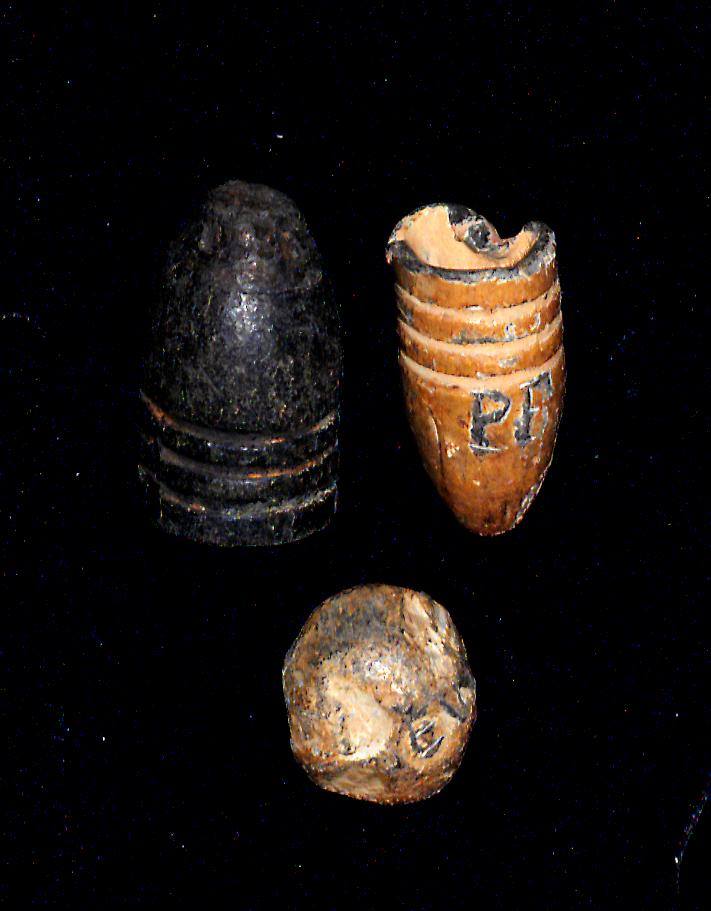
    In about 1980 his grandson Dr. Charles F. Walcott (Harvard, Harvard Medical School) donated a box of Indian artifacts to the Cambridge (MA) Library, a few of which are identified as local to Massachusetts, collected by Dr. Walcott. The rest are apparently of unknown provenance. That collection is pictured online via Flickr.

    “The only outlier to the Native American objects in the collection is a box containing two bullets and a minie ball from the Battle of Antietam” – actually 2 minie bullets and a musket ball or cannister shot, I think.

    Although not documented, I can guess who first collected some of these objects, can’t you?

    ________

    The late-1864 photo with his wife is at the Library of Congress (part of the Liljenquist Family Collection of Civil War Photographs).

  • Antietam faces, artillery edition

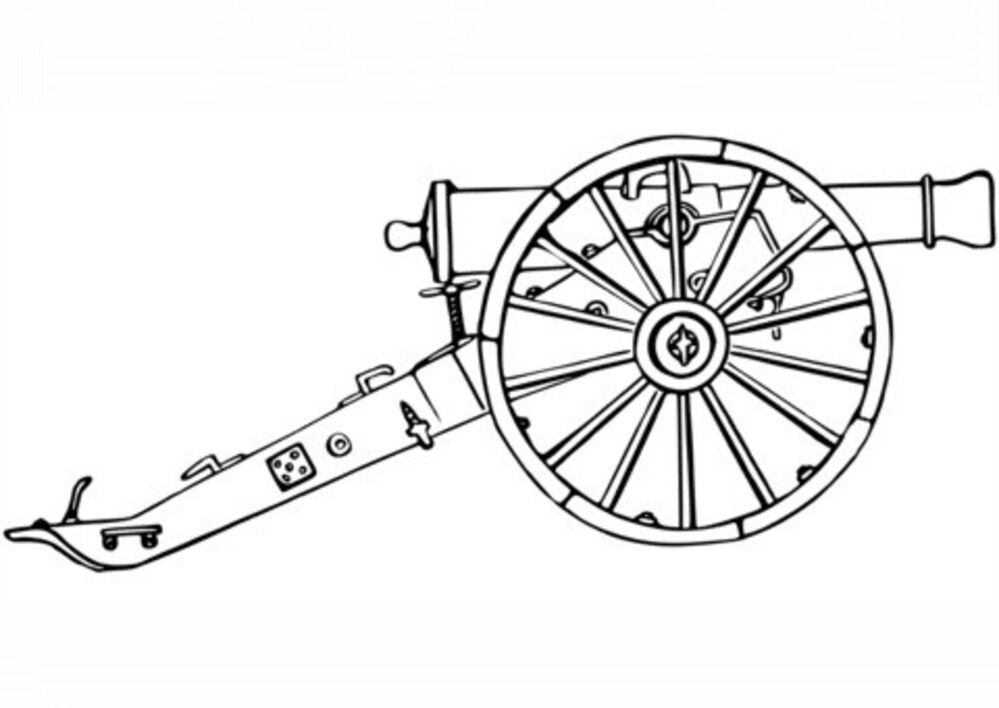
    Lieutenant Evan Thomas commanded the consolidated Batteries A and C of the 4th United States Artillery on the Maryland Campaign.

    He was the 3rd son of US Army Colonel and Adjutant General Lorenzo Thomas (USMA 1823), and at the start of the War in April 1861 received a commission as 2nd Lieutenant, 4th United States Artillery. He was promoted to First Lieutenant in May. He was then just 17 years old.

    He was assigned to Battery C which, due to a manpower shortage, was consolidated with Battery A in October 1861. He was in action with his battery on the Peninsula in mid-1862 and succeeded to command by order of seniority sometime after Captain Hazzard died of wounds in mid-August 1862. Evan had just celebrated his 19th birthday.

    Here’s Lieutenant Thomas with a group of his fellow officers taken at Sharpsburg in September or October 1862, shortly after the battle of Antietam:

    The caption on the picture is Lt. Rufus King, Lt. Alonzo Cushing, Lt. Evan Thomas and three other artillery officers in front of tent, Antietam, Md. (click to enlarge) There is no guide to who is who, but I have had some expert help working to identify them. (more…)