I should be doing something else, but got pulled off track by a trooper of the 3rd Indiana Cavalry, James Williamson, who was killed in a little-known cavalry skirmish at the Quebec Schoolhouse near Middletown, MD on 13 September 1862.
His regiment’s historian, former Corporal William N. Pickerill wrote a fascinating account of that ‘desperate little cavalry battle’ for a newspaper in 1897, and put it in his regimental History in 1906. Because of him, I’ve spent the last couple of days putting names and faces with some of the men who were there.
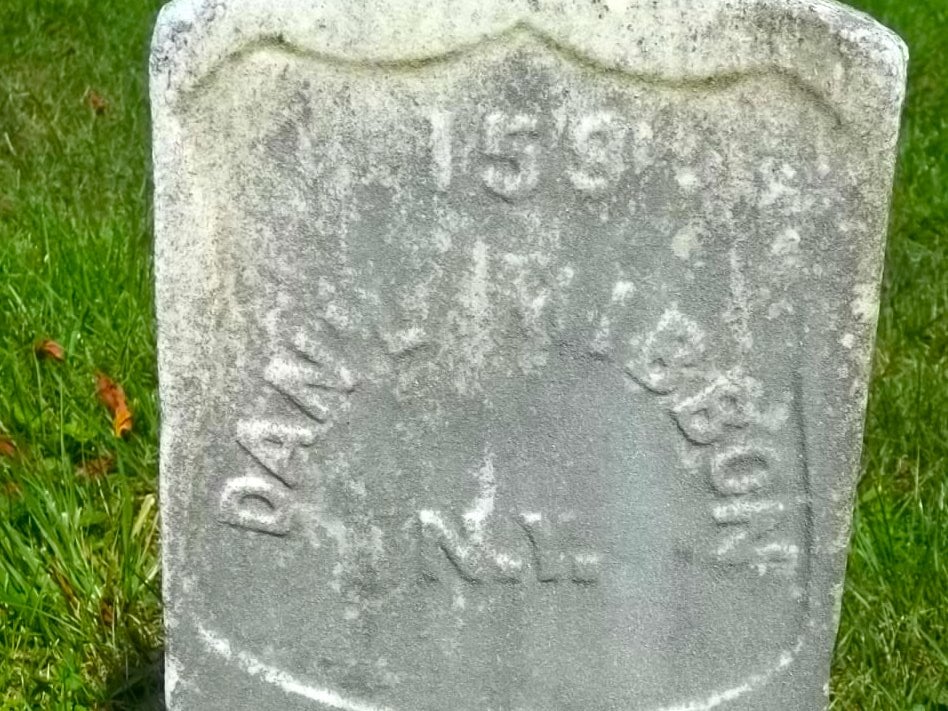
The Antietam Cemetery History has him as Daniel Mibbon, 18th New York Infantry (thanks Western Maryland’s Historical Library/WHILBR!). It’s Dan’l Mibbon, N.Y. on his stone.
He doesn’t appear in the rosters for either of those regiments or any other New York unit, for that matter (thanks New York State Military Museum!). Nothing close.
A little more digging, though, and voilà !!
Under or near this stone in the Antietam National Cemetery lies David Spencer Milburn, late Private, Company D, 13th New Jersey Infantry. A 26 year old farmer, he was mortally wounded on 17 September 1862 just over a month after enlisting. He died in a hospital in Frederick on 2 October.
James McVay was an “old man” in the 14th Connecticut Infantry. He had enlisted as a Private in Company K with his sons Michael and Francis in July 1862. He died of “exhaustion” at the end of the regiment’s first day’s march on what became the Maryland Campaign.
His was the first death in that brand new regiment.
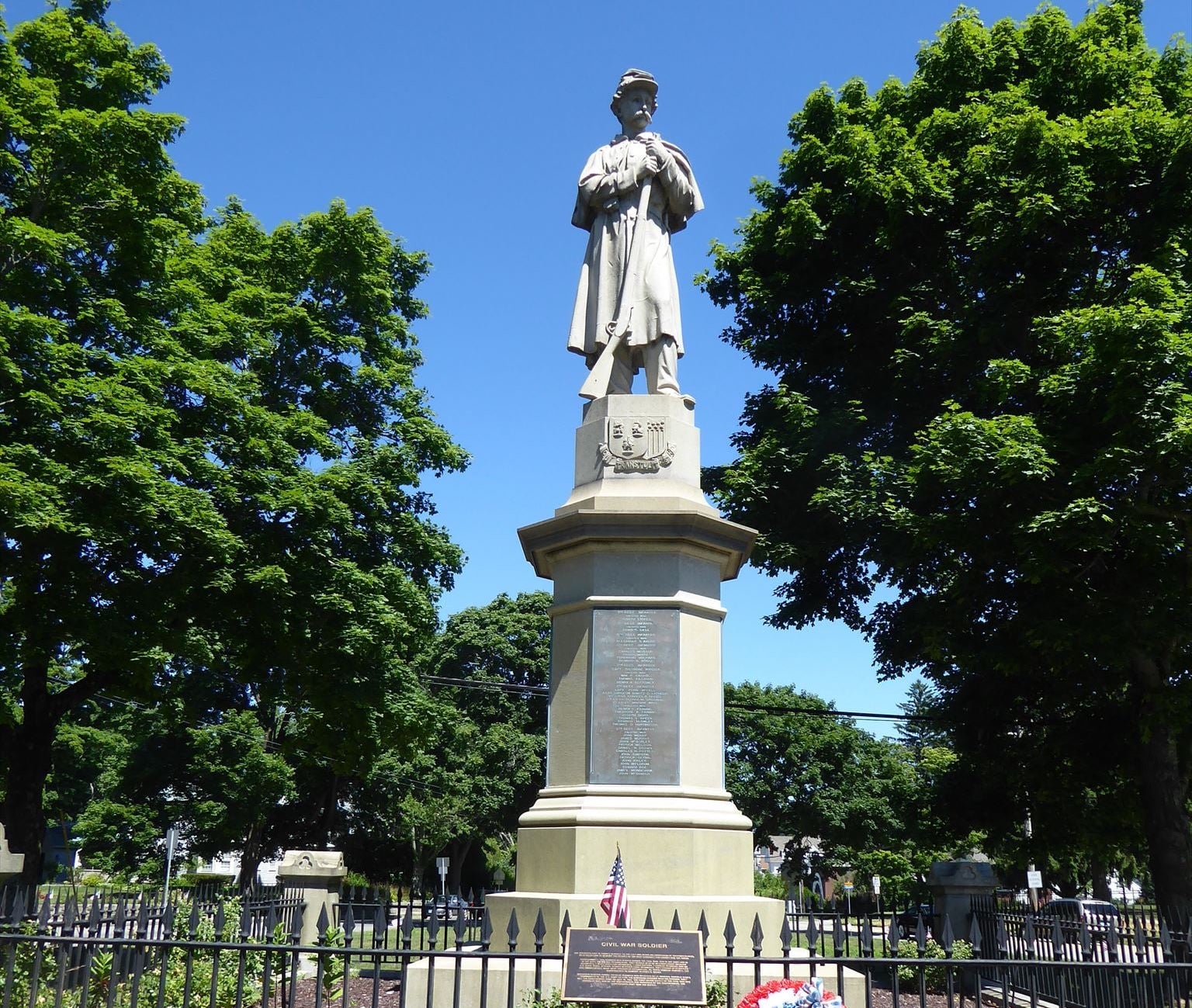
His name’s on a familiar looking monument in Norwich, CT.
___________
Notes
The clip above is from Charles D. Page’s History of the Fourteenth Regiment, Connecticut Vol. Infantry (1906).
The picture of the Soldiers’ Monument in Norwich, CT is online from Waymarking. You’ll notice the statue’s similarity to “Old Simon” in the Antietam National Cemetery.
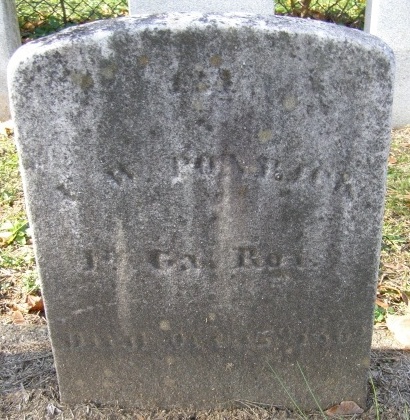
I recently tweeted about adding a new bio page for a Georgia soldier, Andrew W Poarch and, somewhat as an aside, noted that his modern headstone has some problems.
He was buried at Mt. Olivet Cemetery in Frederick, MD in October 1862 and at some point given a basic headstone, now heavily worn.
Much more recently, sometime after 1992, well-meaning persons got him and each of the other Confederate soldiers buried in Mt. Olivet a new headstone from the US Department of Veterans Affairs (VA).
Probably because of transcription errors in his original burial records, they got his name terribly wrong. Apparently the applicant for the new headstone didn’t dig any deeper – into the soldier’s service records, muster rolls, or family genealogies, for example – to verify his information. Although, to be fair, it’s easier to do that today than it was 20 or 30 years ago.
But now the errors are literally carved in stone.
I’ve seen dozens of markers like these with errors large and small over the years of researching my soldiers, but had not thought to make a list or keep a log of them.
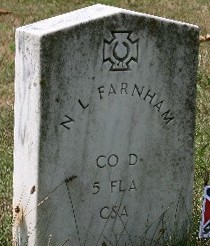
The day after Private Poarch’s, though, I found another such case – the stone for Louisianan Volney L. Farnham at Elmwood in Shepherdstown, WV. It has his first initial/name and his regiment wrong.
And this afternoon a third popped-up: Private William T. Curry of South Carolina. This is his modern VA marker in Dials Cemetery, Gray Court, SC. Minor things, to be sure, but his middle initial and his year of birth are probably wrong.
So taking these 3 stones as huge cosmic hints, I’m starting a visual list here, and I’ll add to it as I find more. I can’t fix them, but I can provide a virtual erratum.
Let me know if you find any more cases like these, won’t you? Or if you have any information that corrects errors I’ve made.
I have had a great time pulling a research “thread” this evening and thought both of my readers might like to share in the journey.
Looking into Sergeant John Martin Rushton (1837-1889) of the 7th South Carolina Infantry.
I started with Glen Swain’s excellent roster in The Bloody 7th (Broadfoot, 2014), based mostly on the Consolidated Service Records (CSRs) from the National Archives.
Those records say Rushton was wounded at Sharpsburg in 1862. In November – December 1864 he was in a hospital in Richmond, VA with a gunshot wound in the shoulder, then served as an attendant in another hospital there. He retired in March 1865, presumably for disability, and was paroled at Augusta, GA in May.
Nothing unusual here; it seemed like a typical soldier story until I looked at his gravesite on Findagrave, which refers to him as Dr. Rushton. Not so many enlisted men were later physicians, so I thought I’d find out when and where he trained.
A little digging online with various forms of his name, and up popped an announcement in the Richmond Dispatch that J.M. Rushton of Edgehill [sic], SC graduated from the Medical College in Richmond (now part of Virginia Commonwealth University).
In March 1865.
Oh-ho! Now we’re having fun: did our man attend medical school while still a soldier and patient/hospital aide in 1864-5?
That would be unusual.
Then I got really lucky. Thanks to the digital archives at VCU, I found an October 1864 letter John Rushton wrote to Levin Smith Joines, the Dean of the medical school. In it, he requested admission to the Winter 1864-65 course, noted he’d had previous training in Georgia 1860-61, and best of all, described what he’d been doing since Sharpsburg.
So, in contrast to the tale of the CSRs, it turns out he was furloughed home after he was wounded in the shoulder at Sharpsburg and I don’t think he ever returned to his unit. By January 1864 he had been judged disabled and was teaching school in Edgefield, SC.
He was admitted to the Medical College for the 1864-65 winter session and graduated in 1865. The day after he’d been “retired” in the Army records, coincidentally.
Long story short – I got to see part of the man’s story in his own hand, in real time. Rare, but very gratifying. And a lot more exciting than the basic and sometimes confused service records.