
Author: Brian

  • Building on a CMS 2

    Lego blocks

    When it rains, it pours goes the old saw. For the last couple of weeks I’ve been up to my ear lobes in two proposal writing projects. I expect two more by the end of March. The normal pace is two in a year. These are good for business, but hard on my personal and online lives.

    This time crunch has tightly focused the effort I told you about in a December post about an off-the-shelf content management system (CMS) as basis for a website. To recap: I’m working a pro bono project to help a worthy historical non-profit upgrade their online presence. Last we talked I had built a demo website on WordPress and was planning to migrate to the more sophisticated Textpattern platform.

    I just won’t have time for that anytime soon, and the non-profit wants to publish fast. So, after some reassuring research, I’ve decided to stick with WordPress and avoid the learning curve and rework needed to implement on Textpattern.

    Why?

    First, there is an array of proven plugins and custom modules available for WordPress to meet all the likely business needs of the client. Just ask Lorelle, for instance. Sure, there is danger that too many plugins or widgets will result in Lego architecture, but for the few functions we’re considering, I think the maintenance burden will be low.

    Second, the client wants to implement new functions and features iteratively–one at a time at a moderate pace–so I will have opportunity to write custom PHP within the WordPress framework or bite the bullet and convert to a new platform later, if worst comes to worst.

    It comes down to the fastest and easiest way to get function online with minimum investment.

    I’d appreciate hearing from anyone with similar projects: I need all the advice I can get! I’ll keep you up on how it goes …

  • Internet time capsule

    In contrast to Wednesday’s Library of Congress announcement, the following highlights significant cultural change in not quite seven years. Let me disclaim up front by saying I really appreciate the organizational attitude change apparent since the following was reported, and imply no criticism of the Library or Librarian of Congress.

    Dr Billington today

    (April 15, 2000 – Tech Law Journal) The Librarian of Congress, James Billington, gave an address at the National Press Club on Friday, April 14, on the role of the Library of Congress in the Information Age. He harshly criticized the Internet, and stated that the Library will not digitize books. However, the Library has plans to expand its web publication of other materials.

    “So far, the Internet seems to be largely amplifying the worst features of television’s preoccupation with sex and violence, semi-literate chatter, shortened attention spans, and near-total subservience to commercial marketing,” said Billington.

    Billington said that the Library of Congress has plans to unveil a new web site. “We hope it will realize one of the earliest promises of the Internet: to put the Library of Congress at the fingertips of every boy and girl where they live.”

    But then he followed up by stating the “we are not digitizing books, but bringing hitherto little used, specially formatted materials like maps and recordings …” He added that the new web site “is not replacing our traditional print library.”

    He said that the Library of Congress now has 28 Million items in its print collection, and 119 Million items in all formats. Its web site currently contains 3 million primary documents, including drafts of the Gettysburg Address, 19th Century baseball cards, and forgotten music.

    Billington elaborated on why the Library will not put books online during the question and answer session. “The rationale is two fold. We have so much special format material that nobody has seen that it is more important to get those out.” He added that the Library is more concerned with “rare pamphlets” than “full books”.

    “Secondly, behind this … is an implicit belief [that books] are not going to be replaced, and should not be replaced.”

    “There is a difference between turning pages and scrolling down,” he said. “There is something about a book that should inspire a certain presumption of reverence.”

    “We should be very hesitant … that you are going to get everything you want electronically.”

    “You don’t want to be one of those mindless futurists,” said Billington, “who sit in front of a lonely screen.”

    “It is isolating. It is a lonely thing.” In contrast, “libraries are places, a community thing.”

    “It is dangerous to promote the illusion that you can get anything you want by sitting in front of a computer screen.” He described this as “arrogance” and “hubris”.

    He added that while electronic books may succeed commercially, they are “seductive.”

    The LoC website now makes available more than 7.5 million digital objects from its American Memory site alone, and the new project looks to add thousands. To be fair, the Library is still not talking about digitizing books generally, but I’d bet Dr. Billington feels slightly differently about the Web–or at least would be embarrased to say some of these things–today.

  • Library of Congress does it right

    bookshelf

    In a press release Wednesday, the Librarian of Congress announced a fantastic new project to digitize selected books from the collection:

    Librarian of Congress James H. Billington today announced that the Alfred P. Sloan Foundation has awarded the Library of Congress a $2 million grant for a program to digitize thousands of public-domain works, with a major focus on at-risk “brittle books” and U.S. history volumes.

    The project, “Digitizing American Imprints at the Library of Congress,” will include not only the scanning of volumes, but also the development of suitable page-turner display technology, capability to scan and display foldouts, and a pilot program to capture high-level metadata, such as table of contents, chapters/sections and index …

    “ÀúDigitizing American Imprints' will make a major contribution to the collective body of knowledge that is accessible worldwide, further democratizing the information that is a key to functional societies and economies,” Dr. Billington said…

    Among the items to be scanned are some of particular interest to Civil War historians including rare regimental histories, memoirs, and diaries as well as selections from the Confederate States of America Collection.

    You’ll notice that the LoC will not be charging the public for access to this material, nor was a sell-out “partnership” with a commercial outfit required to obtain the resources to make it possible. This is worth crowing about. Some creative thinking and financing has gone into this effort and it ought to be rewarded.

    All hail the Library of Congress and the folks at the Sloan Foundation.

  • McClellan on the field at Antietam

    I have some follow-up to the last post, about General McClellan dashing over the field during the battle of Antietam on 17 September 1862. Happily more battle illustration is required in accompaniment.

    Hope 2
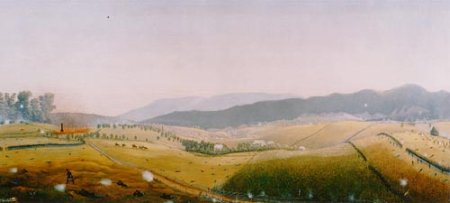
    A Fateful Turn: Late morning looking east toward the Roulette Farm (James Hope via ANBP)

    This is one of the five famous Hope Paintings, a series of very large panoramic views painted by battle veteran James Hope working from sketches he made during the battle. These were first exhibited to the public in or after 1872 at his Watkins Glen studio.

    The Park Service notes describe this picture:

    … burning Mumma Farm is seen on the left, and Gen. George McClellan is riding with his staff on his only visit onto the battlefield that day at about 2:00 pm. On the right, Richardson’s and French’s Union Divisions advancing on Bloody Lane.

    Is this further evidence of McClellan’s whereabouts on the field or artistic interpretation? (more…)

  • Good source, bad source

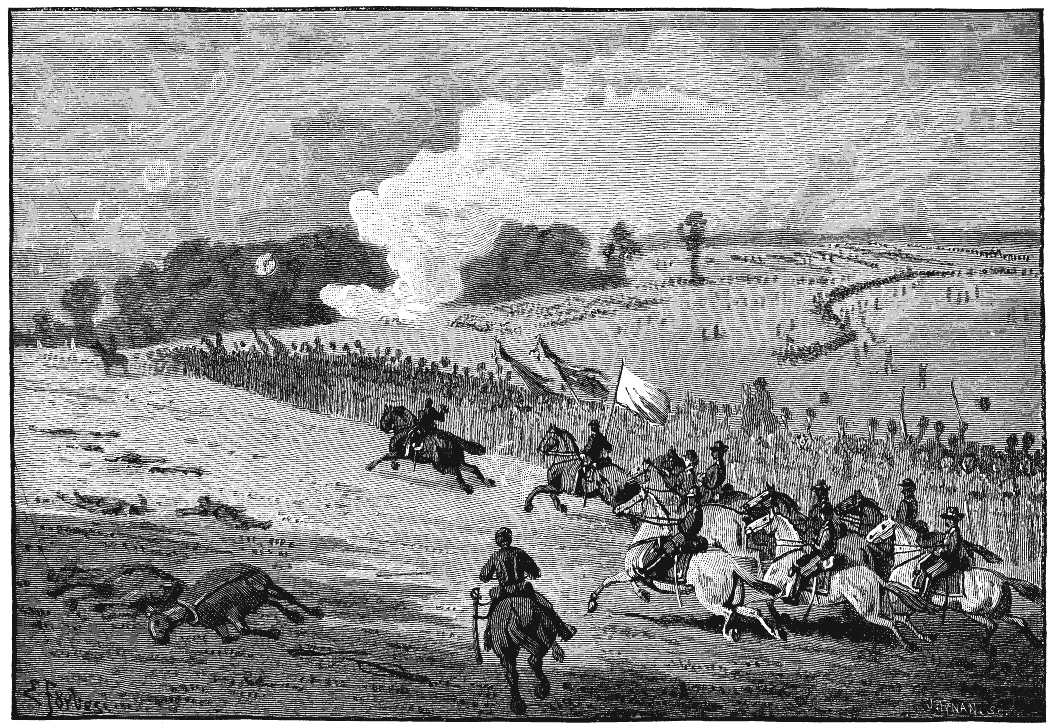
    I’ve been lured again by a pretty picture to post about being open to options when interpreting historical information. The image is from the Century Illustrated Monthly Magazine, May 1886:

    McClellan rides the line at Antietam (Forbes)click to see larger image
    General McClellan riding the line of battle at Antietam.
    (by Edwin Forbes, after his sketch made at the time.)

    The troops were Hooker's and Sedgwick's, and the time about 11 A. M. of September 17. General McClellan rode his black horse, “Daniel Webster,” which, on account of the difficulty of keeping pace with him, was better known to the staff as “that devil Dan.”–EDITOR.

    I think this is pure fantasy. I don’t remember another reference to such a ride, certainly not in advance of the Federal line between the East and West Woods, as shown here. However, combat artist Forbes was on the scene that day, so maybe I shouldn’t dismiss this image entirely …
    (more…)