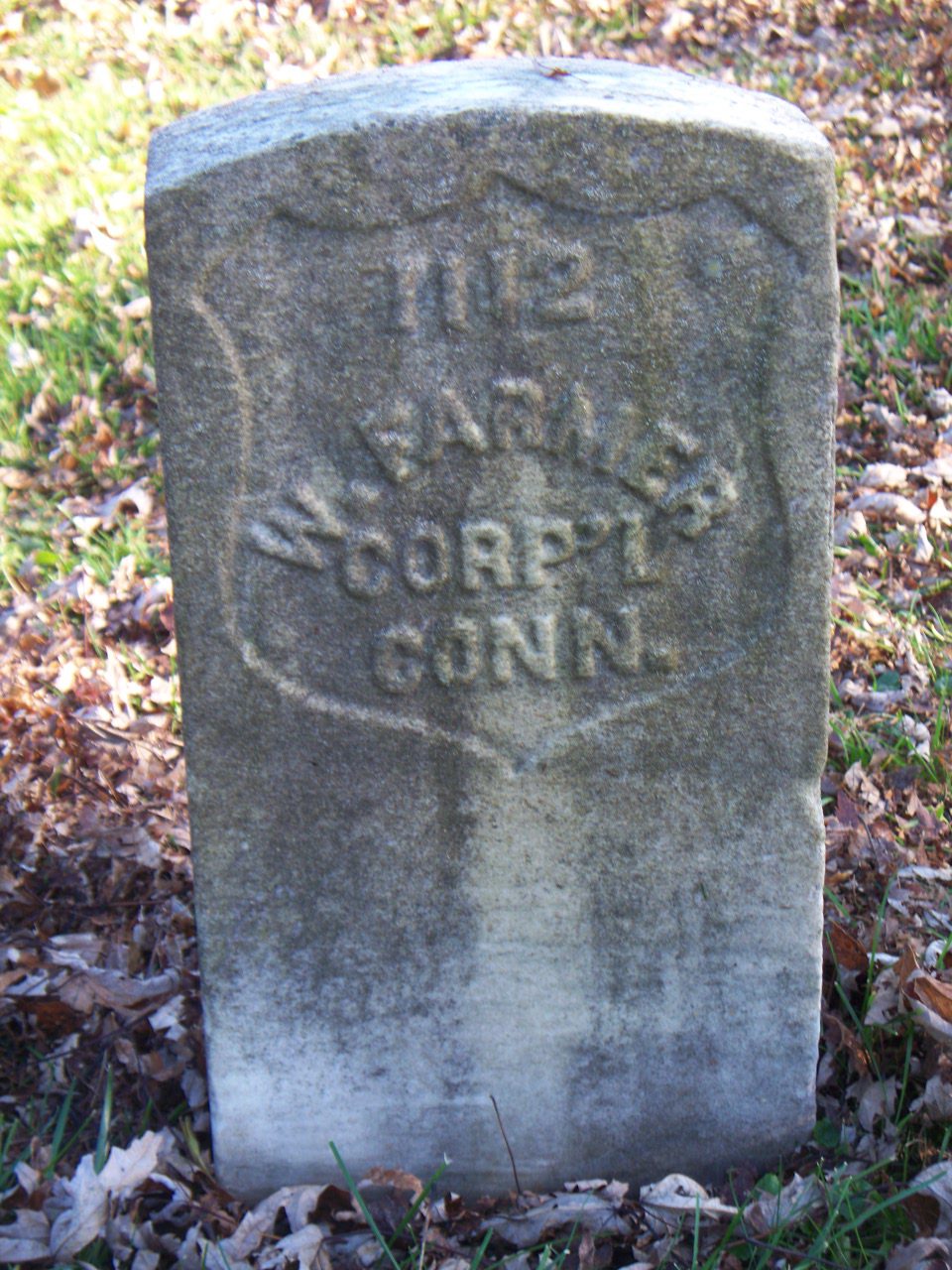
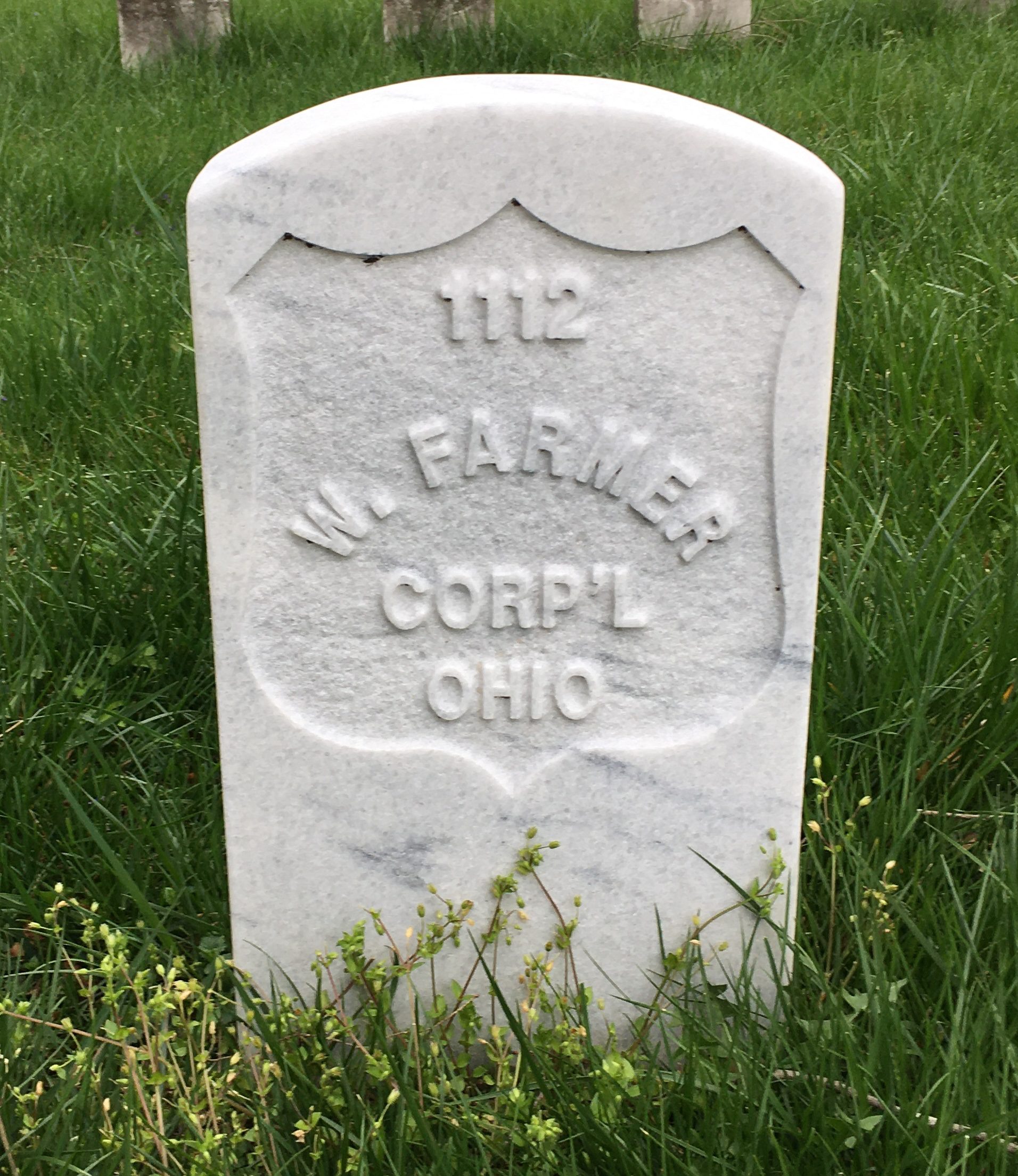
This is the first time I’ve seen this in many years visiting Antietam National Cemetery: an obvious replacement headstone. And not just because of wear and tear. An Ohioan in a row of Connecticut soldiers.
There’s a great story here, I’m sure, but I only know part of it.
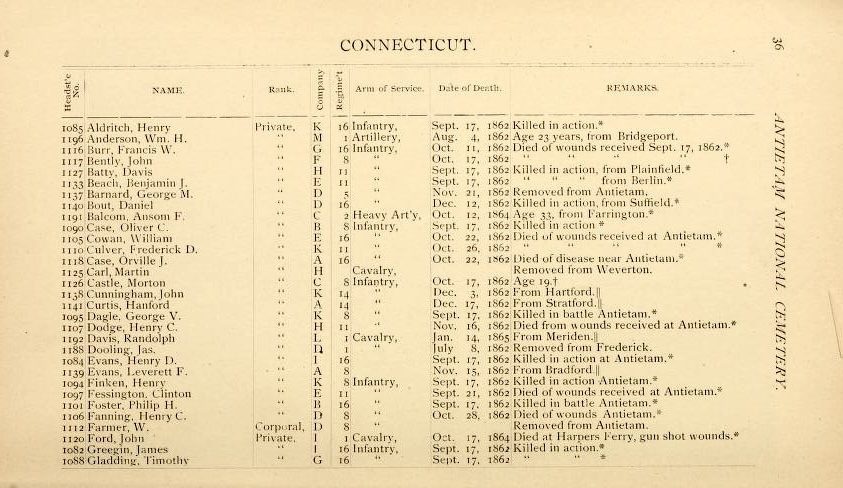
William Whitney Farmer, 34, of Wakeman, Ohio enlisted as a Corporal in Company D, 8th Ohio Infantry in June 1861, and was killed by artillery at Antietam on 16 September 1862. He was mis-identified as being in the 8th Connecticut Infantry when he was removed from his resting place on the battlefield and re-buried in the new Antietam National Cemetery in 1867.
Here’s the headstone that’s been over his grave since then:
On my visit last Friday, though, this brand new, fresh cut stone jumped out at me:
I hope a reader will let us know how this came about. You won’t be surprised to hear there are many, perhaps hundreds of headstones in the Cemetery with errors large and small, and I would never have expected the Park Service or the VA to replace any of them.
And yet … here we are.
Notes
The photos above of Farmer’s new headstone are by the author, taken at the Antietam National Cemetery on Friday 12 April 2024.
His original headstone photo is from contributor Birdman on Farmer’s online memorial at Find-a-grave.
The page image here is from the 1890 version of the History of the Antietam National Cemetery, including a descriptive list of all the loyal soldiers buried therein …, published by George Hess, late Private, 28th Pennsylvania Infantry; online from the Library of Congress. His work is a virtual copy of the History published by the Cemetery Board of Trustees in 1867, except that Hess noted the headstone numbers, which I find more useful than the section/lot/grave numbers in the original volume.
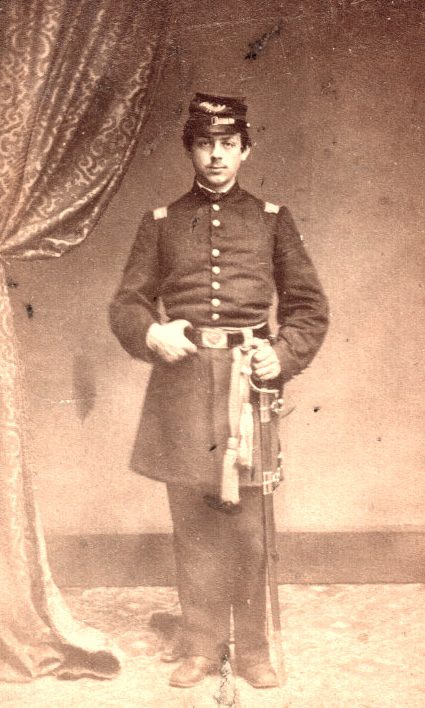
Here’s 2nd Lieutenant Maximilian Wimpfheimer of Company G, 2nd Pennsylvania Reserves, who was killed at Antietam on 17 September 1862, just about 2 months after this picture was taken.
He was born in Germany and was about 21 years old at his death. His father David brought his family to America between 1852 and 1860, and was a vinegar manufacturer in Philadelphia before the war.
This photograph was contributed by Susan Johnson and hosted online by the Shapell Manuscript Foundation, part of an exhibit on Jewish soldiers killed in the Civil War – two of whom were identified as being buried in Antietam National Cemetery: Wimpfheimer and Adolph Brinkmann, a Private in the 2nd Delaware Infantry, also killed at Antietam.
Almost exactly 20 years ago Carolyn Ivanoff shared with me (and AotW) her research about and transcription of the wartime diary of Charles D. M. Broomhall, Sergeant in the 124th Pennsylvania Infantry, describing his experience on the Maryland Campaign.
On my visit to the battlefield last Friday morning I saw this wayside for the first time. Maybe I just never stopped at that spot before.
[touch to expand]
I was stunned to see the heading quote from Sergeant Broomhall, from Carolyn’s work in the diary. That “fluttering” reference comes from a few lines earlier in his narrative:
At the commencement of the battle at day dawn [on 17 September 1862], our boys had been listening to the stray shots on the edge of the 1st named woods called the East Woods, the rebels had come through the corn and deployed pickets on the edge of the East Woods. Our pickets were deployed in the edge of this woods, consequently, at daylight the two picket lines found themselves face to face and that caused the suddenness of the onset. Our brigade was about 1/4 of a mile to the right and rear, and our regiment was brought up to near the clear sod field first spoken of while shot and shell went fluttering over our heads like partridges for sound.
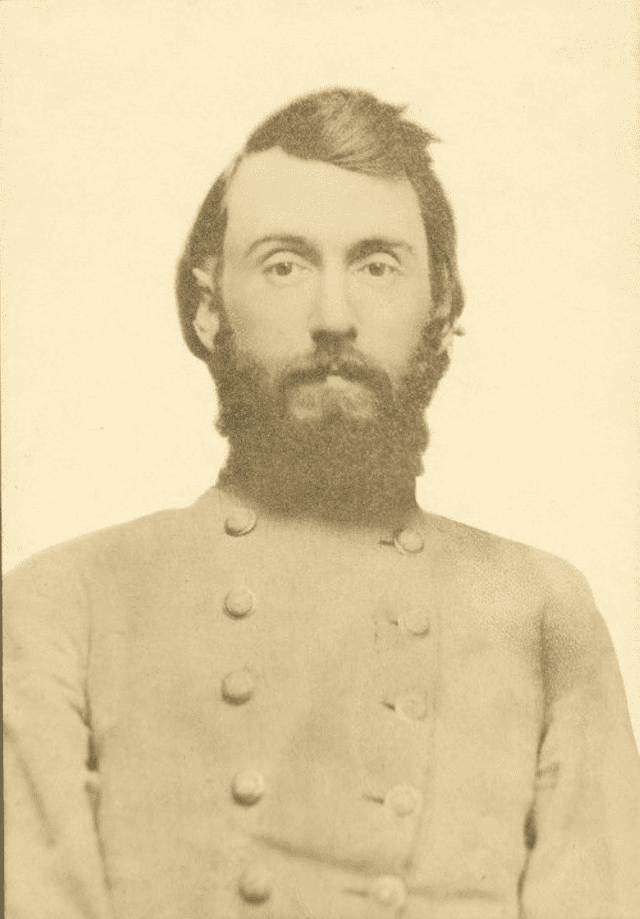
Here’s Lawrence Houston Scruggs in a photograph taken in October 1862 after he’d been promoted to Lieutenant Colonel of his regiment, the 4th Alabama Infantry.
He enlisted as a Private in his hometown of Huntsville in May 1861, and was successively promoted to Sergeant, Lieutenant, and Captain by September of that year. He commanded the regiment in combat at Sharpsburg on 17 September 1862 as senior officer still standing until he was wounded there in the East Woods about 8 am.
Very shortly afterward, on 30 September, he was promoted to Major and just two days later, Lieutenant Colonel. He was afterward in command of the 4th Alabama to their surrender at Appomattox in April 1865.
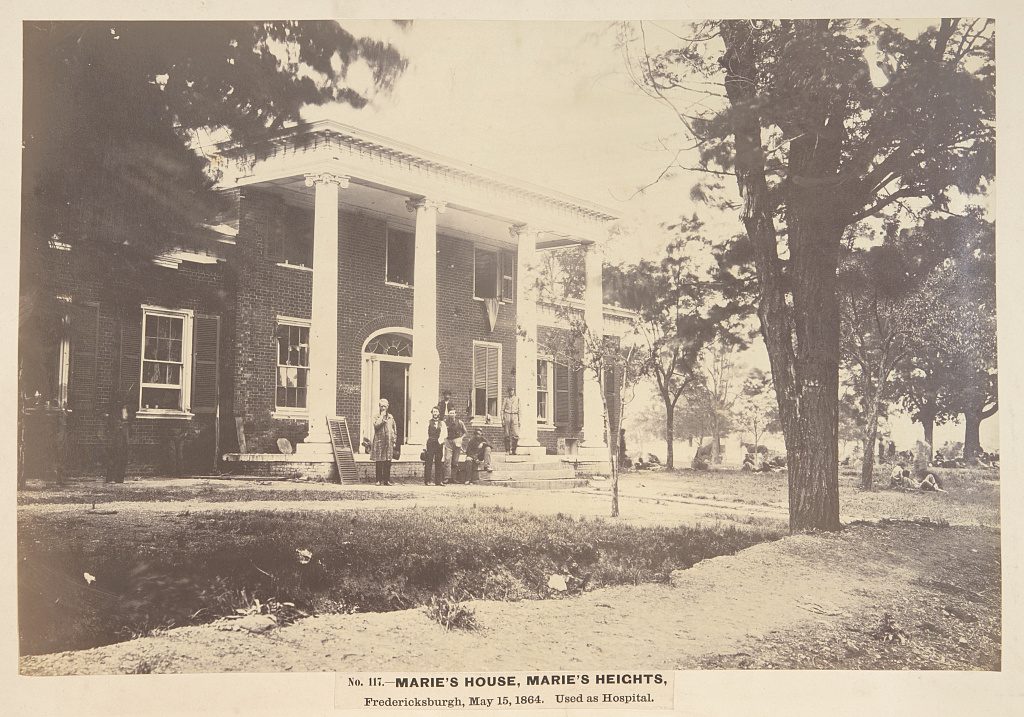
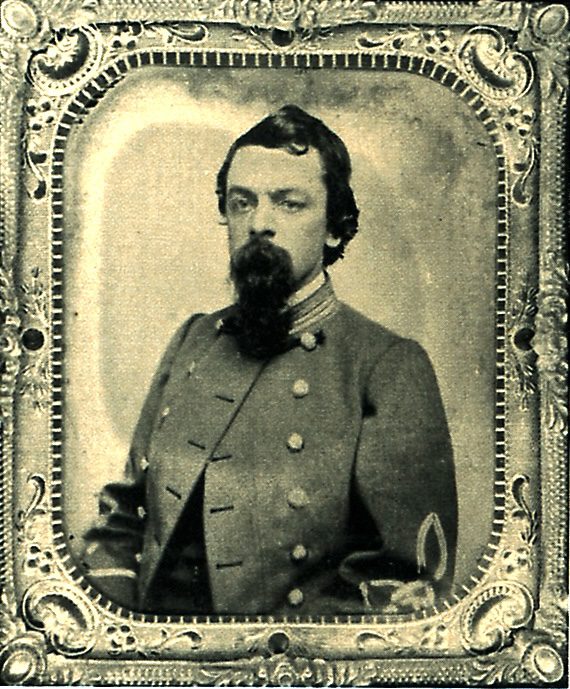
Here’s Lieutenant Edward A. Marye‘s (probably pronounced “Mary”) family home in Fredericksburg, VA as it looked in May 1864, then in use as a Union military hospital for troops wounded during the battle of the Wilderness.
First Lieutenant E.A. Marye (1862)
His father John Lawrence Marye (1798-1868), a successful lawyer and mill owner, bought land and a small house on a hill overlooking Fredericksburg in about 1824. He improved the house and named it Brompton, after the Middlesex village in England from which his Hugenot-Norman great-grandfather Rev. James Marye (or Jacques Marie, 1692-1768) came to America in about 1730.
The high ground around it became known as Marye’s Heights – now famous for the combat there in December 1862.
Lt. Edward Marye commanded a section of 2 3-inch Ordnance rifles of the Fredericksburg Artillery (Brig. Gen. A.P. Hill’s Division) at Harpers Ferry (14-16 September) and Shepherdstown (19 September), and led the battery at least part of the day at Sharpsburg (17 September) while Captain Carter M Braxton acted as Hill’s chief of artillery.
But there were also 4 other Maryes in the battery …
Private Alfred James Marye, Edward’s nephew, was on the Maryland Campaign and was wounded by counter-battery fire at Boteler’s Ford on the Potomac on 19 September. He was barely 16 years old. He served with the battery to the end of the war and was afterward a railroad clerk in Montgomery County, VA.
Private Alexander Stuart Marye (1841-1915), a younger brother of Edward’s, enlisted in the battery in June 1862 and was probably in Maryland in September. He was on detail away from his unit on ordnance and administrative duties for most of the rest of the war and was surrendered and paroled at Greensboro, NC in May 1865.
John Lawrence Marye, Jr. (1823-1902), also Edward’s brother, enlisted as a Private in April 1861 and was promoted to 5th Sergeant in April 1862. He was absent, sick into October 1862, so probably not in Maryland, but was surrendered and paroled with the battery at Appomattox Court House, VA on 9 April 1865. During the war he also served in the Virginia House of Delegates (1863-65). He’d been a wealthy lawyer and farmer in his own right before the war, and Mayor of Fredericksburg in 1853-54. He was afterward again a Delegate (to 1868) and Lieutenant Governor of Virginia (1870-74).
Another of Edward’s nephews, his oldest brother James’ son Private William Nelson Marye (1841-1929) enlisted in Braxton’s Mounted Artillery (later Fredericksburg Light) on 12 May 1861, but was detached from his unit for much of 1862 and probably not with them in Maryland. He was with the battery from March 1863 to September 1864, when he was again detailed, as a clerk to a military court for the 3rd Army Corps, but was back by Appomattox in April 1865.
To complete Edward’s story: he was promoted to Captain and it became his battery in March 1863, but he did not survive the war; he died of disease in Petersburg, VA in October 1864.
Notes
The photograph above of the Marye house “Brompton” is from the Library of Congress.
Details about Brompton from its National Register of Historic Places nomination form [pdf]. The home was acquired by Mary Washington College (now University) in 1947 and it is now their president’s residence.
Lieutenant Edward Marye’s picture here is an ambrotype in the collection of the American Civil War Museum, Richmond.
The Maryes’ military records are found in the US War Department’s Compiled Service Records of Confederate Soldiers, Record Group No. 109, Washington DC: US National Archives and Records Administration (NARA).