At Antietam in the late afternoon of 17 September 1862 the 30th Ohio Infantry was being flanked by troops of General A.P. Hill’s Division. Lieutenant Colonel Jones passed the order to fall back, but only the 4 rightmost Companies heard him. Colonel Ewing sent Lieutenant Reese R. Furbay to get the remaining 6 Companies, but before he could reach them …
Lieutenant Furbay, the memory of whose gallantry and worth is written in the hearts of his comrades, was shot, by three balls, through the body.
This is his stone in the family cemetery in Georgetown, Ohio; photo by Findagrave user AncestorFinder.
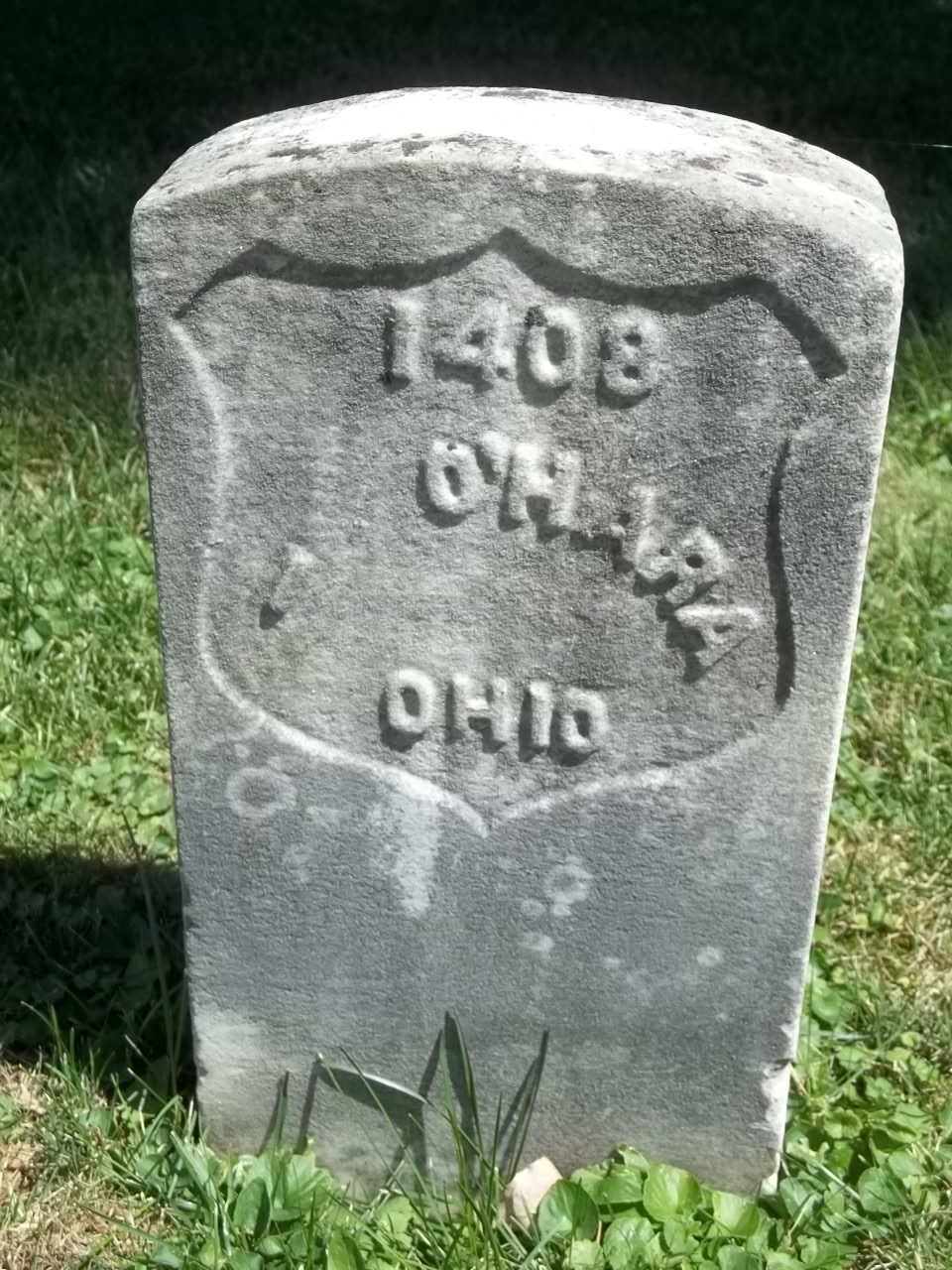
This is probably the headstone in the Antietam National Cemetery for Corporal John O’Harra of Company G, 30th Ohio Infantry. He was mortally wounded at Fox’s Gap on South Mountain on 14 September and died nearby on 24 September 1862. The photo is by Findagrave user Birdman.
Captain Lewis R Stegman led Company E of the 102nd New York Infantry at Antietam, was wounded 4 times during the war, and mustered out as Major of the First US Veteran Volunteers in 1866. In 1912 he was appointed chairman of the New York Monuments Commission and presided over the dedication of the New York State monument at Antietam on 17 September 1920.
This carte-de-visite of him, probably taken in 1865, was posted to Findagrave by Larry Chenault, from his collection.
Washington, DC-born William J.H. White was 35 years old in September 1862 and had been an Army doctor since he graduated from the Columbian College Medical School (now George Washington University) in 1849. At least 10 of his 13 years service had been in the frontier West, with the 2nd US Cavalry in Texas and New Mexico. His had not been soft duty.
Earlier in 1862 he had seen considerable action with the 6th Corps and gained experience with large numbers of casualties, notably at Gaines’ Mill in June and Bull Run in August.
He arrived with his Corps at the battlefield of Antietam about 10am on Wednesday, 17 September and his job as Medical Director was to set up and staff the Corps field hospital; the battle had been underway for some 5 hours when he arrived, which made his work both important and urgent. He established a hospital on the Michael Miller farm, known later as the Brick House Hospital, and nearby at Dunbar’s Mills, both at the north end of the East Woods. He probably didn’t treat any soldiers himself, but would have been closely involved with their care.
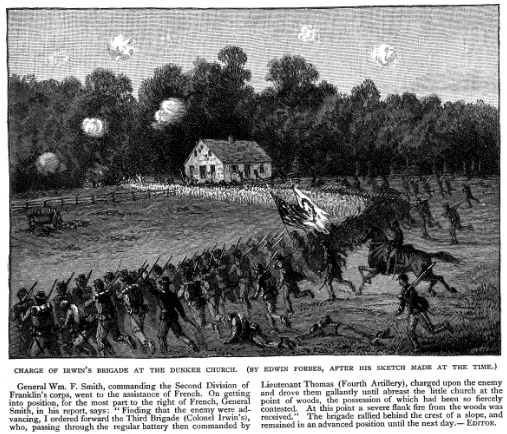
The troops of his 6th Army Corps were placed largely in holding and supporting positions on the field at Antietam, but one Brigade, Irwin’s of Smith’s 2nd Division, made an attack toward the West Woods about mid-day.
That afternoon something went terribly wrong with Dr. William White.
During the whole of the terrible battle of Wednesday Dr. WHITE was superintending the care and removal of the wounded from the battle; and it is supposed the excitement consequent to the occasion produced a species of temporary insanity, for after the battle had lulled somewhat, he rode up to Gen. FRANKLIN and said, “General, if you will give me a regiment of men I will clear those woods of rebels,” pointing to a piece of woods on his right in which was stationed a very large force of rebels.
Gen. FRANKLIN replied, that fifty regiments would be unable to dislodge the enemy from the position, and that it would be useless to attempt the experiment. Dr. WHITE rejoined, “If you will not give me the men to take those woods, I will go and take them myself,” at the same time proceeding in the direction of the place where the rebels were concealed, at a rapid gait. When within about twenty or thirty rods of the edge of the wood, he was fired upon by several rebel sharpshooters, two balls taking effect, one in the forehead and another in the breast, killing him instantly.
_________________________
Edwin Forbes’ engraving of Irwin’s attack is from the Century Magazine of June 1886.
The extraordinary narrative of his death quoted here is from a Memorial of 20 September issued by US Army Surgeon-General William A. Hammond and published in the New York Times of 12 October 1862.