Author: Brian

  • Captain Thomas, Patriot, Soldier, Citizen

    A Crimean War veteran of the Royal Army, Thomas Rice was a Captain in the First Louisiana Infantry by July 1862.

    He should be much more famous than he is. At the railroad cut at Second Manassas on 30 August 1862, after his men had shot off all their ammunition …

    Nothing but a great quantity of rock was lying around, broken in fragments of moderate size as they had been blasted when the railroad was building. Captain Rice drew upon his experience in Crimea. He recalled that battle with stones fought in a rock quarry at Inkerman, close to the Redan – one of the bulwarks of Sebastopol – which had now come to him like a flash, born of the need. Quick as the thought, Rice picked up a piece of rock, and calling out loudly “Boys, do as we did at Sebastopol,” hurled the first stone … The company, the regiment – even other commands of the brigade – followed with more stone, pelting the enemy savagely … Excellent work was done with these rocks … Some of the enemy crawled up the bank and voluntarily surrendered themselves to escape the deadly stoning.

    He led his Company at Sharpsburg in September and was wounded in the hip there. He was wounded twice more – at Chancellorsville and Gettysburg, where he was left for dead – but survived the war to return home to New Orleans.

    Above is a page about him in The Lost Cause: A Confederate War Record, Vol. 10, No. 1 (August 1903). The quote here is from Volume X of the Confederate Military History (1899).

  • Franklin Gardner

    Corporal Franklin Gardner [15th Mass Infantry] was one of the ‘color guard,’ and at the battle of Antietam, Sept. 17th, took up the colors from the third color bearer, who had been shot dead at his side. He received three balls; the first passed through a limb, the second through his thigh, the third in his stomach. Regardless of these wounds he managed to keep the flag waving until the next guard took it. From Wednesday morning, Sept. 17th, until Friday morning of the same week, he lay within the enemy’s lines …

    He died of his wounds in Washington, DC on 6 October 1862.

    ___________

    The quote above and his picture are from William A. Emerson’s Leominster: Historical and Picturesque (1888).

  • Pvt Clarence B Pratt

    19 year old Private Clarence Byron Pratt of the Minden Blues – Company G, 8th Louisiana Infantry – was wounded in action at Sharpsburg in September 1862 and captured there. He was exchanged and furloughed home in November but never returned to his Company. In October 1863 he enlisted in a State Guard cavalry unit, but was captured in Louisiana in November, and spent the rest of the war in Federal prisons.

    He started a newspaper in Minden, LA and was elected to the state legislature in 1868, but he tangled with County Judge and former Minden Blues Captain John L Lewis in the press and in the capitol, and Lewis’ son Robert shot Pratt in a duel in August 1868. Pratt died in December 1869 at age 27. His cause of death is not known, but his dueling wound may have contributed.

    This excellent photograph of Pratt in uniform was contributed to his Findagrave memorial by Edward Wenzell.

  • New Orleans Daily Picayune, 29 October 1862

    Here’s a clipping from the front page of the New Orleans Daily Picayune of 29 October 1862. The complete edition is online from Newspapers.com.

    It’s a source of some casualty lists for units at Sharpsburg including the Washington Artillery of New Orleans. Listed among the wounded of the 3rd Company (battery) was Corporal P.W. Pettis. A 21 year old clerk in New Orleans, Peyton Watts Pettis enlisted as a Private in May 1861, returned to duty after Sharpsburg, and was a Sergeant at the end of the war.

  • Richmond Daily Dispatch, 14 April 1863

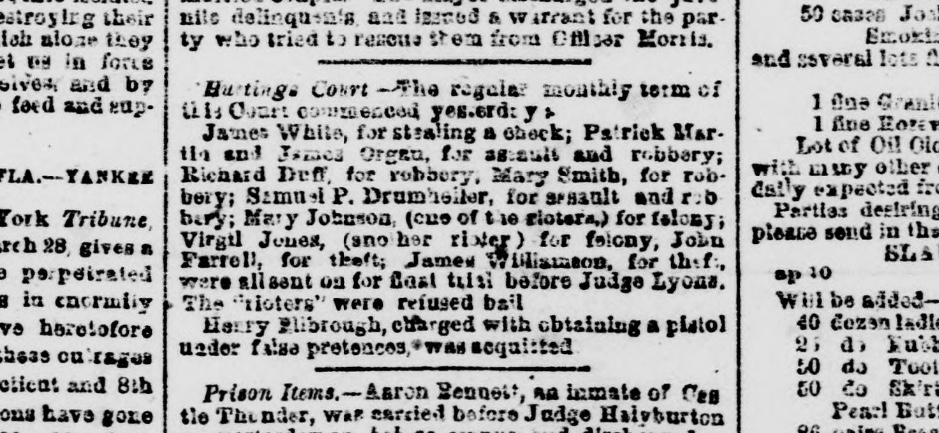
    Irish-born Private James Organ of Company E, 9th Louisiana Infantry was wounded and captured at Sharpsburg in September 1862. While on a detail in Richmond, VA he was involved in the Richmond “women’s bread riot” of 2 April 1863, and was charged with assault and robbery during the disorder. I don’t know the outcome of his trial, but he returned to his Company and was captured at Spotsylvania, VA on 12 May 1864 and died while a prisoner at Point Lookout, MD on 7 August 1864.

    A summary of the Hustings Court actions – including Organ’s case – was published in the Richmond Daily Dispatch of 14 April, seen here. Obviously it was not purely a womens’ riot. That newspaper is online from the Library of Congress.