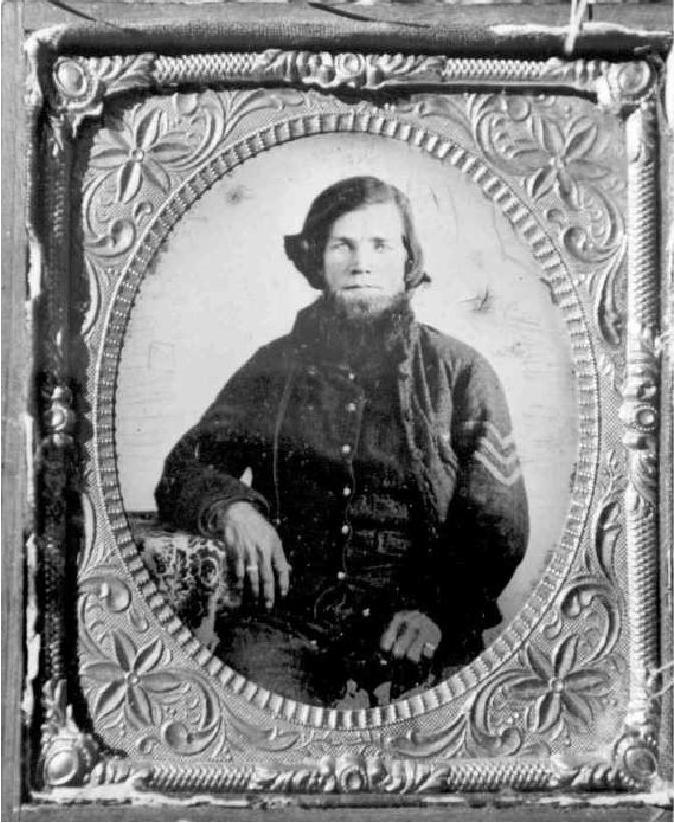
This is Private William W. Bixby, Company D, 23rd New York Infantry, wounded at Antietam on 17 September 1862. He survived the war but died relatively young, at age 37, at the U.S. National Home for Disabled Veterans in Dayton, OH, in 1879. His photograph was contributed to his Findagrave memorial by Edna Crawford King.
Corporal Henry G. Van Vlack, 64th New York Infantry was killed while carrying his regiment’s colors in action at Antietam on 17 September 1862. His photograph was contributed to the Family Search database by Leigh Ann Smith [free membership required].
Two stories, one soldier:Â Sergeant George A Jacobs, Company C, 61st New York Infantry, pictured here.
[After action at the Sunken Road at Antietam on 17 September] The firing had again quieted. [Lieutenant Colonel Miles] directed me [Sergeant Fuller] to take two men and go forward, part way through [Piper’s] corn field in front, and watch and report any appearance of the enemy. If I am not mistaken, I took Porter E. Whitney and George Jacobs of my company. We went forward half way through the corn field, which was for the most part trampled down. We arranged the broken stalks so as to be partially concealed.
After a time to our front and right, and on the brow of a considerable rise of ground, a body of officers appeared on horseback, and with glasses took observations. We discussed the propriety of aiming at these Confederates and giving them a volley. I finally concluded it was best not to take this responsibility, as it might bring on an attack that we were not ready for. In a short time these men disappeared. I sent back one of the men to report what we had seen. Very soon he came back with the word to join the regiment.
Longstreet in his book entitled ‘From Bull Run to Appomattox’ speaks of looking the field over about this time and from near this location, so, I judge, it was he and his staff that we had such a plain view of.
An interesting starting point for some great “what-if” stories, perhaps?
Jacobs was appointed First Sergeant of Company C in early 1863 and in September that year …
He was home on a ten days furlough. Of course, the best in the land was free to him, and he was feasted by parents and friends. As he was about ready to start back, he was taken violently sick with a stomach trouble and died in a few hours [on 18 September 1863 in New Berlin, NY].
_______________
These quotes from Charles A Fuller in his Personal Recollections of the War of 1861… in the Sixty-first Regiment (1906).
This photograph of Jesse A Cook was taken in late 1861 or early 1862 when he was a Sergeant in Company K of the 2nd Mississippi Infantry. It’s in the collection of Joseph M. Bauman, kindly provided by unit historian Michael Brasher.
Jesse was commissioned First Lieutenant in April and Captain to date from 30 August 1862, but he was mortally wounded in the left thigh and both ankles and captured in action at Sharpsburg on 17 September 1862. He died of those wounds on 26 September 1862.
Here’s a page of Frederick Winslow Grannis‘ genealogy from Frederick A. Strong’s Descendants of Edward Grannis (1927). Grannis was 2nd Lieutenant of Company B, 61st New York Infantry and was commended for “behaving in the most excellent manner” at Antietam. He was cited again for bravery at Gettysburg, promoted to Captain, and discharged in February 1864.
He was a Broadway agent by 1882 and may have been well known in the City, but not nearly as well as his second wife, who he married in 1865 and later divorced, without children.
She was Elizabeth Bartlett, pictured above, an Erie College Graduate, and an editor, publisher, and philanthropist in New York who was an early advocate for gender equality and women’s social and political rights. Notoriously, she lived with President Woodrow Wilson’s father Joseph, probably after his wife died in 1888, until about 1894. Her photograph is from The World’s Congress of Representative Women (1894), online from the Hathi Trust.