Author: Brian

  • Deadly crash of two trains

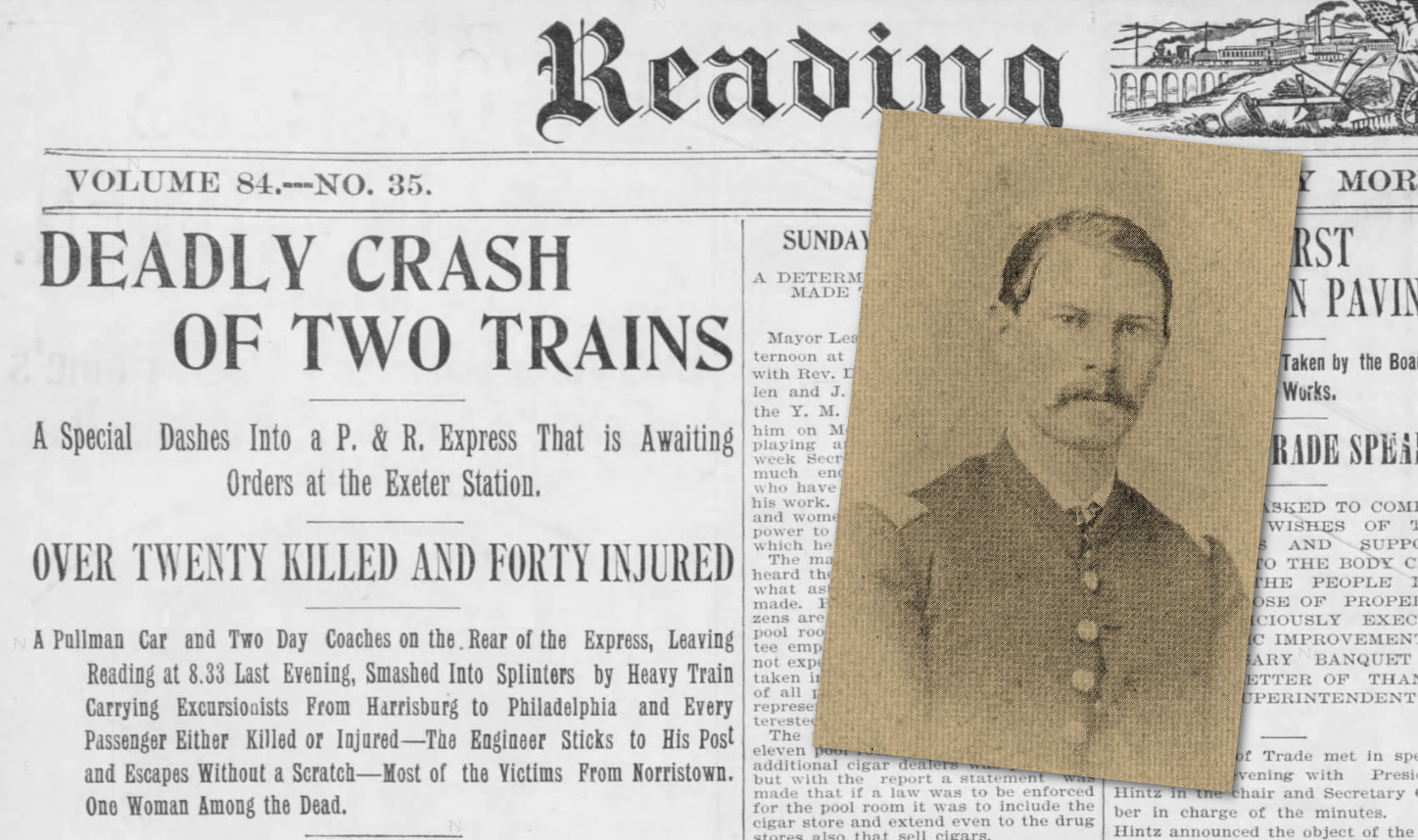
    Corporal John H “Highly” Coulston, Company A, 51st Pennsylvania Infantry was wounded at Fox’s Gap on South Mountain in September 1862. He was Captain by January 1865 and mustered out in July.

    Tragically, he was severely injured in a train crash – known afterwards as the Exeter Station wreck – on 12 May 1899 while returning with many other veterans from the dedication of a statue of statue of General Hartranft in Harrisburg. He died the next day.

    Superimposed on the front page of the Reading Times of 13 May 1899 above is a picture of him c. 1864 from a published photograph contributed to his Findagrave memorial by Charles McDonald.

    The crushed train car below testifies to the force of the collision. Below that is a post-war photograph of Isaac E Filman – also of Company A and wounded at Fox’s Gap, and also killed in the crash (lower two photos from the Pottstown Mercury of 1 July 2012).

  • Will you give us our whiskey?

    An early version of a famous story from the battle:

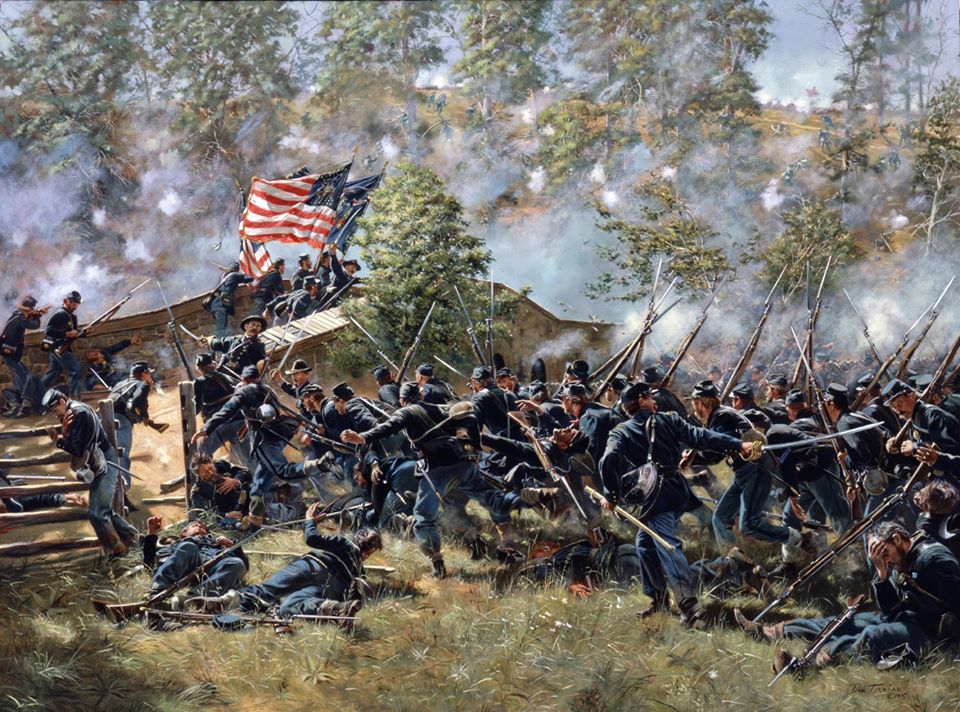
    Brigade commander Colonel Edward Ferrero of the 51st NY Infantry had previously taken away his men’s whiskey ration to reduce drunkenness. On 17 September 1862 near the Lower Bridge at Antietam he called to his own and the 51st Pennsylvania regiments …

    “It is General Burnside’s special request that the two 51sts take that bridge. Will you do it?”

    The request was unlooked for, and the men had not had time to think of it, when Corporal Lewis Patterson, of Co. I [51st PA], although a temperate man, exclaimed, “Will you give us our whiskey, Colonel, if we take it?”

    Col. Ferrero turned suddenly around to the corporal and replied, “Yes, by G–, you shall all have as much as you want, if you take the bridge. I don’t mean the whole brigade, but you two regiments shall have just as much as you want, if it is in the commissary or I have to send to New York to get it, and pay for it out of my own private purse; that is, if I live to see you through it. Will you take it?”

    A unanimous “Yes,” went up that told of the determination of the men to take the bridge, not in anticipation of the whiskey, but to let Gen. Burnside know that his confidence in the twin regiments was not misplaced nor should be abused. After a few words in private by the regimental and brigade commanders, the 51st P. V. led the advance …


    ____________
    Lewis Patterson (1835-1883) survived the charge unharmed, was later promoted to First Sergeant, and was commissioned First Lieutenant in 1865.

    The narrative above is from Thomas Parker‘s “History of the 51st Regiment of P.V. and V.V.” (1869). Parker was First Sergeant, Co. I at Antietam and was wounded in that action.

    The painting of the 51st Pennsylvania at the bridge is by Don Troiani.

  • Lt Col Thomas S Bell, Jr.

    At Antietam on 17 September 1862:

    A short time elapsed after the bridge was taken before any other troops came forward to reinforce the two heroic regiments [51st PA and 51st NY]; during which time the 51st P. V. stacked arms on a line parallel with the creek, and about ten feet from it. A few fires were then kindled by the men for the purpose of making a cup of coffee, but as the smoke towered up to the tops of the trees and rising higher than the hill, it gave unmistakable evidence that the Union soldiers were still in the neighborhood of the bridge; the enemy taking the smoke as a point at which to range their batteries, opened their guns with case-shot, shell, and grape.

    Lieut. Col. Bell had been up the creek about one hundred and fifty yards, and as he was returning towards the bridge and when within fifty yards of it he met private Hugh Brown, and giving him a friendly slap on the shoulder, remarked as he passed him. “We did it for them this time, my boy;” but he had not taken more than two or three steps when a grape-shot grazed his left temple. He made a whirl round as if on a pivot, fell on his side and rolled down the bank of the creek to where the guns of his regiment were stacked. The men rushed to his aid, and taking him up they found that he had received a frightful and mortal wound; he was carried to the other side of the creek in an unconscious state; he lived only a few hours after being removed to the field hospital.

    Lieutenant Colonel Thomas Sloan Bell, Jr.’s photograph was contributed to his Findagrave memorial by Gregory Speciale.

  • Pvt Geo W Bird

    Corporal George Washington Bird of the 51st Pennsylvania Infantry was mortally wounded at Antietam and died two days later on 19 September 1862. His photograph was contributed to his Findagrave memorial by Bob Sampron.

  • Capt Wm J Bolton

    William J Bolton, Captain of Company A, 51st Pennsylvania Infantry was horribly wounded in action at Antietam: a gunshot went through both cheeks, breaking his jaw and carrying away some teeth. He was back on duty in January 1863 and was appointed Major of the regiment, and he was promoted to Colonel in June 1864. He was hit in the face again, by a canister round at the Crater near Petersburg, VA on 30 July 1864. He was honored by brevet to Brigadier General of Volunteers in March and mustered out with the regiment in July 1865.

    Years later, in May 1881, the Galveston Daily News reported

    Since then [his wounding at the Crater] General Bolton has felt pain and oppression in his neck, especially during damp weather. Yesterday he had occasion to stoop while attending to a customer in his store, and was immediately taken with a violent fit of coughing. Placing his hand instinctively over his mouth, something dropped into his hand. On removing the blood and mucous covering of the object he found it to be the painful little ball of Confederate cast-iron. It was covered with rust, weighed 273 grains Troy, and the surface was covered with sharp ridges.

    His carte-de-visite (CDV) was sold by Cowan’s Auctions in April 2014.