Author: Brian

  • Dr Melancthon Storrs, Capt Frederick M Barber

    Dr. Melancthon Storrs (Yale Medicine ’53) was commissioned Surgeon of the 8th Connecticut Infantry in October 1861 and, as Brigade Surgeon, treated wounded soldiers on South Mountain on 14 September 1862 and at the 3rd Division, Ninth Corps field hospital near Sharpsburg during and after the battle at Antietam on the 17th. The postwar portrait of him at the top is from the Hartford Medical Society as published by Dr. Robert M. Bedard in Four Connecticut Physicians: Window to Civil War Medicine and Service in the journal Connecticut Medicine (February 2009) [pdf].

    One of his patients, seen below, was Captain Frederick M Barber of the 16th Connecticut, mortally wounded by a gunshot at Antietam. Surgeon Storrs operated on his hip on 18 September but could not save him. Barber died from “surgical fever” on the 20th. His photograph is in the Scott Hann collection, published online by John Banks.

  • Capt Henry A Sand

    Captain Henry A Sand of the 103rd New York Infantry was mortally wounded at Antietam and was treated in a temporary hospital in the German Reformed Church in Sharpsburg. But he died there in October 1862. This photograph is among many that hung on the walls of the New York State Capitol in Albany during the war – note the pinholes – to remind lawmakers of their sons in the fight. It’s now online from the New York State Military Museum.

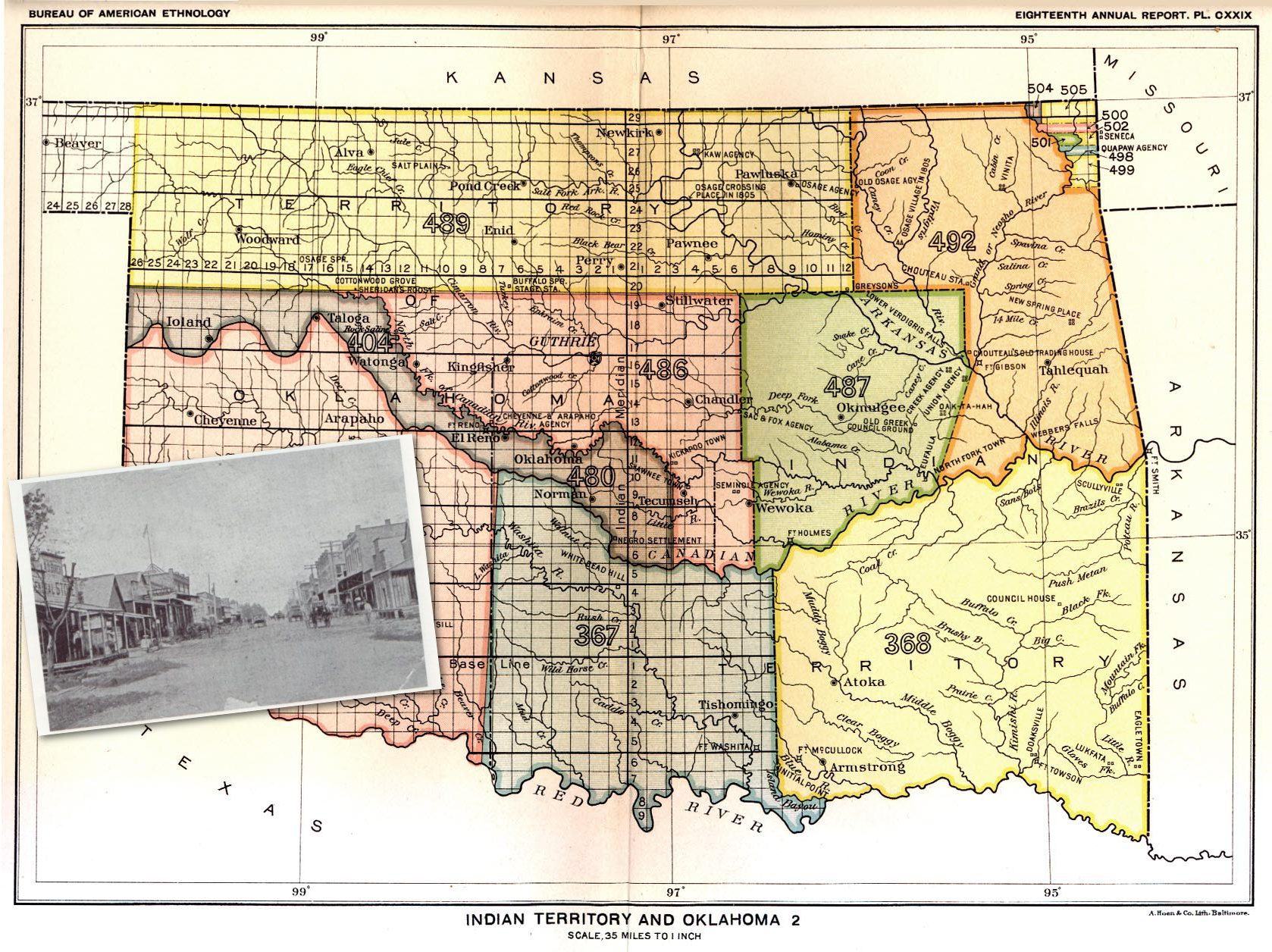
  • Indian Territory and Oklahoma (1897); Pauls Valley

    Antietam veteran Private Hugh A Campbell of the 71st Pennsylvania went West after the war and spent most of the rest of his life in the Chickasaw Nation in the Indian Territory (IT). He hauled freight for the government and raised hogs, and later was a farmer on 1000 acres near Pauls Valley, IT (near #367 on the map). He married Julia Gardner, who was at least part Choctaw, in 1872, and they had 3 children.

    This 1897 map shows the tribal areas of what’s now Oklahoma; it’s online from Indian Land Cessions, a project of the Tennessee GenWeb. It was published in the 18th Annual Report of the Bureau of American Ethnology – 1896-’97 by the Smithsonian Institution.

    Inset is a pre-1890 photograph of the town of Pauls Valley, Indian Territory, online thanks to Pauls Valley History from the Oklahoma GenWeb.

  • Mr. Collier, a young Englishman

    Just one of so many thousands of Antietam stories …
    The few names that are given of the commissioned officers who suffered, tell only a fragment of the story. There were brave hearts in the ranks, as well as among the officers, who went to their death fearlessly, and over whose memories loving friends have not ceased to mourn.
    Especially sorrowful was the death of Edmund Y. Collier, a private in the Seventy-Second [Pennsylvania Infantry]. Mr. Collier was a young Englishman of very respectable connections; who was visiting in this country when the Rebellion broke out. With warm sympathy for the Union, he enlisted as a private, and in this battle [of Antietam] fell mortally wounded; so near the enemy that his body was not recovered for hours afterwards.
    _______
    Quoted from Charles H Banes’ “History of the Philadelphia Brigade. Sixty-ninth, Seventy-first, Seventy-second, and One hundred and sixth Pennsylvania Volunteers” (1876).
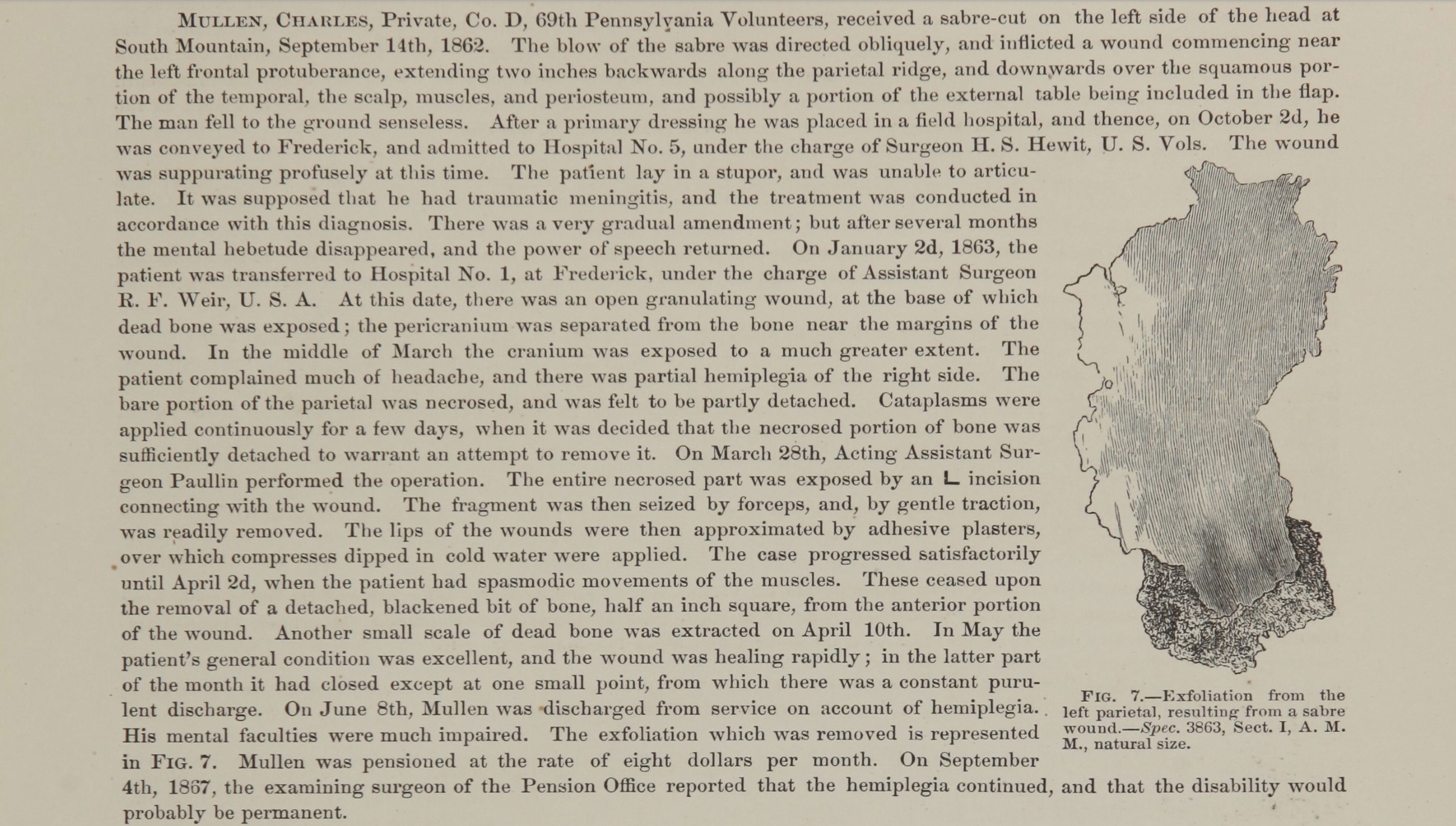
  • Incised fractures of the cranium: Mullen, Charles

    Private Charles Mullen of the 69th Pennsylvania Infantry was born in County Antrim, Ireland, and was an ironworker in Pottsville before the war. He was wounded in an unusual way in Maryland in September 1862: by a saber cut to the left side of his head.

    This excerpt from the Medical and Surgical History of the War of the Rebellion (1870) describes his treatment and outcome and includes an illustration of a piece of his skull. He survived the wound and was sent home with a pension in June 1863. He married and had children, but his “mental faculties were much impaired” and he was permanently paralyzed on one side.