“Fate” Stevens was a Private in the 14th South Carolina Infantry who was wounded in combat near Harpers Ferry, VA on 13 September 1862. He survived that wound and the war to return home to his farm in the Edgefield District, but was killed, probably by accident, at age 49. The news clippings seen here have slightly different views of that incident; the Newberry Herald and News of 27 April 1892 on the right, the Winston-Salem Western Sentinel of 5 May on the left.
I recently tweeted about adding a new bio page for a Georgia soldier, Andrew W Poarch and, somewhat as an aside, noted that his modern headstone has some problems.
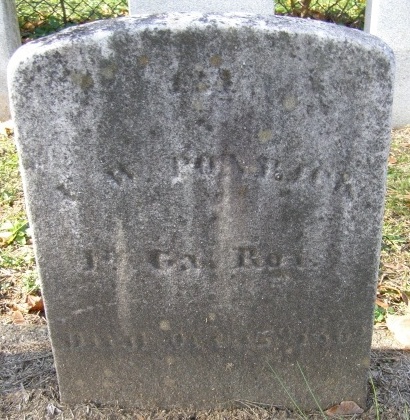
He was buried at Mt. Olivet Cemetery in Frederick, MD in October 1862 and at some point given a basic headstone, now heavily worn.
Much more recently, sometime after 1992, well-meaning persons got him and each of the other Confederate soldiers buried in Mt. Olivet a new headstone from the US Department of Veterans Affairs (VA).
Probably because of transcription errors in his original burial records, they got his name terribly wrong. Apparently the applicant for the new headstone didn’t dig any deeper – into the soldier’s service records, muster rolls, or family genealogies, for example – to verify his information. Although, to be fair, it’s easier to do that today than it was 20 or 30 years ago.
But now the errors are literally carved in stone.
I’ve seen dozens of markers like these with errors large and small over the years of researching my soldiers, but had not thought to make a list or keep a log of them.
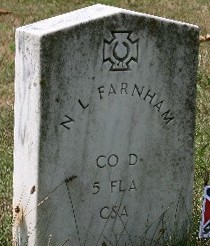
The day after Private Poarch’s, though, I found another such case – the stone for Louisianan Volney L. Farnham at Elmwood in Shepherdstown, WV. It has his first initial/name and his regiment wrong.
And this afternoon a third popped-up: Private William T. Curry of South Carolina. This is his modern VA marker in Dials Cemetery, Gray Court, SC. Minor things, to be sure, but his middle initial and his year of birth are probably wrong.
So taking these 3 stones as huge cosmic hints, I’m starting a visual list here, and I’ll add to it as I find more. I can’t fix them, but I can provide a virtual erratum.
Let me know if you find any more cases like these, won’t you? Or if you have any information that corrects errors I’ve made.
Captain William Covill, Jr of the First Minnesota Infantry was with his Company in action in the West Woods at Antietam on 17 September 1862, and later remembered
As I saw it the whole Division except our Regiment was broken into a mob, madly pressing to the rear followed closely by the enemies lines. Instantly on the breaking up of the 84th [82nd] N.Y. which was next on our left, Col Sully of our Regiment gave the order to about face and march to the rear, which we did double quickly, accompanied with a shower of cannister from a battery which had hurried up the pasture field …
By May 1863 he had been promoted to Colonel of the regiment and was seriously wounded leading them at Gettysburg in July. After mustering out he was elected to the state legislature, in November 1864, but left St. Paul to serve again in the field, as Colonel of the First Minnesota Heavy Artillery from April to July 1865. He was honored with the title of Brevet Brigadier General.
His photograph is in the collection of the US Army Heritage and Education Center in Carlisle, Pennsylvania.
At 80 years old – “four score” – Andrew H Embler sent his daughter this card for Christmas 1914.
Embler was Captain of Company E, 82nd New York Infantry, (2nd State Militia) at Antietam and was wounded in the combat there. He transferred to the 59th NY Infantry in July 1864 and was the Acting Commissary of the 2nd Division, 2nd Army Corps when he led a charge “at the head of 2 regiments” at the Boydton Plank Road, VA on 27 October 1864. He was awarded the Medal of Honor for that action.
He was an officer in the Connecticut National Guard after the war and was appointed Adjutant General (AG) of the CT Guard in 1890. That’s him in National Guard uniform in the small photograph to the right above.
While looking for something else, I came upon what may be the story of the first Confederate soldier killed on the Maryland Campaign of 1862. He was one of the earliest, certainly. [Update August 2025: Pvt Alfred Whitaker, 13th North Carolina, was killed in a skirmish on the Potomac on 5 September].
It happened on 8 September 1862, at Monocacy Junction near Frederick, MD, and probably did not involve gunfire.
On that date much of the Army of Northern Virginia (ANV) was in camp in and around Frederick, MD and Private Thomas Riley of the 6th Louisiana Infantry was part of a detail assigned to destroy the nearby railroad bridge across the Monocacy River. They succeeded in blowing it up, but Riley was killed in the process.
About a week later, after the ANV had moved on, the 14th New Jersey Infantry returned to their post at the bridge. In a somewhat gruesome postscript to our story, Sergeant Terrill of the 14th described what they found:
Everything looked desolate. The bridge destroyed, remnants of wagons, dead horses and mules lying around… It was raining hard and very muddy. Tents were pitched in a plowed field in regular order, guards were stationed around camp …
The rebels [had] left a squad of men to destroy the bridge; in the attempt one man was blown up and buried near the ruins, leaving his arms and head above ground. This was the first rebel the men had ever seen, and for some time was an object of curiosity to us; he lay exposed several days; at last his remains were taken up and decently interred by our men.
________
The picture at the top is a sketch by Alfred Waud of the railroad bridge as it looked in June or July 1863, after it had been rebuilt. The original is in the Library of Congress.