20 year old Private William F Fuller of the First Maine Cavalry was slightly wounded in action at Frederick, MD on 12 September 1862 “while charging into town with the advance.” This post-war photograph of him is from Edward Parson Tobie’s History of the First Maine Cavalry, 1861-1865 (1887).
Author: Brian
-
the Morgans and Lt Wm H Williamson
On the right is a photograph of then-Lieutenant William H Williamson of the 7th Tennessee Infantry. As a Captain he led his Company at Sharpsburg. He was promoted to Major but lost his right arm at Gettysburg and was a prisoner for the rest of the war. In January 1873, by then a circuit court judge, he married General John Hunt Morgan’s widow Martha O.”Mattie” Ready. That’s her with her first husband at the left.
Williamson’s photograph is from the Loewentheil family collection as published in William Thomas Venner’s The 7th Tennessee Infantry in the Civil War (2013). The Morgans’ image accompanied a piece about Mattie by Shirley Farris Jones in The Murfreesboro Post of 26 December 2008. An original carte-de-visite of the scene is at Duke University among their Special Collections.
-
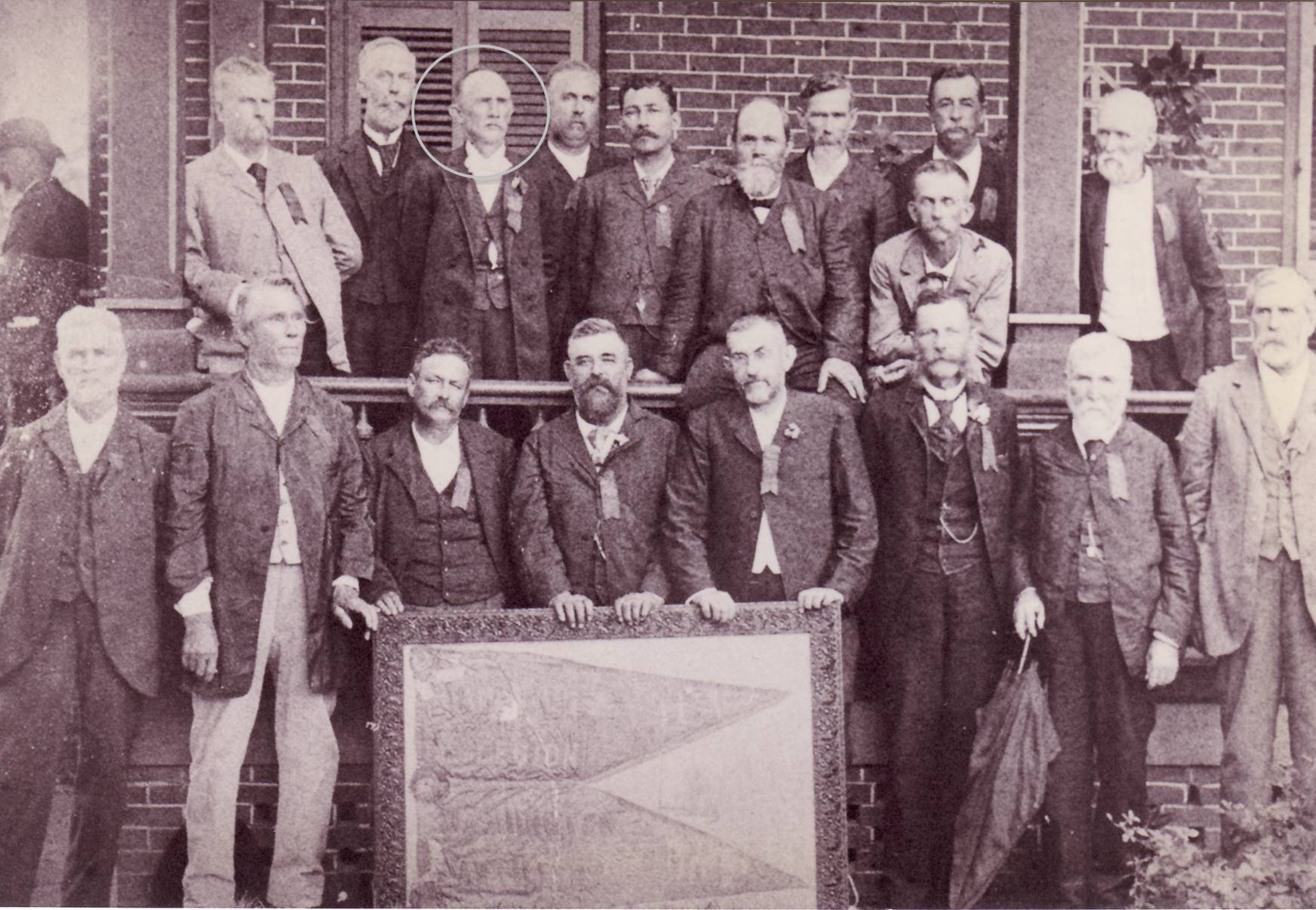
Washington (SC) Artillery (1896)
James Franklin Hart had been a member of the Washington Artillery in Union, SC before the war and was their Captain in Maryland. He’s seen here, circled, with other members of the battery and their guidon at an 1896 reunion in a photograph in the South Carolina Confederate Relic Room and Military Museum in Columbia. It’s online thanks to David Evans on Great Pee Dee.
-
Quebec Schoolhouse: a desperate little cavalry battle
I should be doing something else, but got pulled off track by a trooper of the 3rd Indiana Cavalry, James Williamson, who was killed in a little-known cavalry skirmish at the Quebec Schoolhouse near Middletown, MD on 13 September 1862.
His regiment’s historian, former Corporal William N. Pickerill wrote a fascinating account of that ‘desperate little cavalry battle’ for a newspaper in 1897, and put it in his regimental History in 1906. Because of him, I’ve spent the last couple of days putting names and faces with some of the men who were there.
-
Surg Abner Hard
Surgeon Abner Hard of the 8th Illinois Cavalry treated sick and wounded soldiers along the Army’s march from Washington to Sharpsburg. After Antietam he and his Assistant Surgeon Stull manned a hospital at Keedysville, MD. In 1868 he wrote and published the History of the Eighth Cavalry Regiment, Illinois Volunteers, which is where this etching of him (from a photograph) may be found.