A couple of weeks back Dmitri Rotov made note of Moe D’Aoust’s piece about Burnside and his bridge in the latest Civil War Illustrated. It is nice work.
But it was Dimitri’s posted photo of John Moulder Wilson that caught my eye. A Medal of Honor recipient and on General McClellan’s staff at Sharpsburg, he needs a profile on AotW. Seeing his face was a goad for me to get to him.
Curious, first, about the source of the picture, I followed a link to John M Wilson’s bio on Wikipedia, where it also appears.
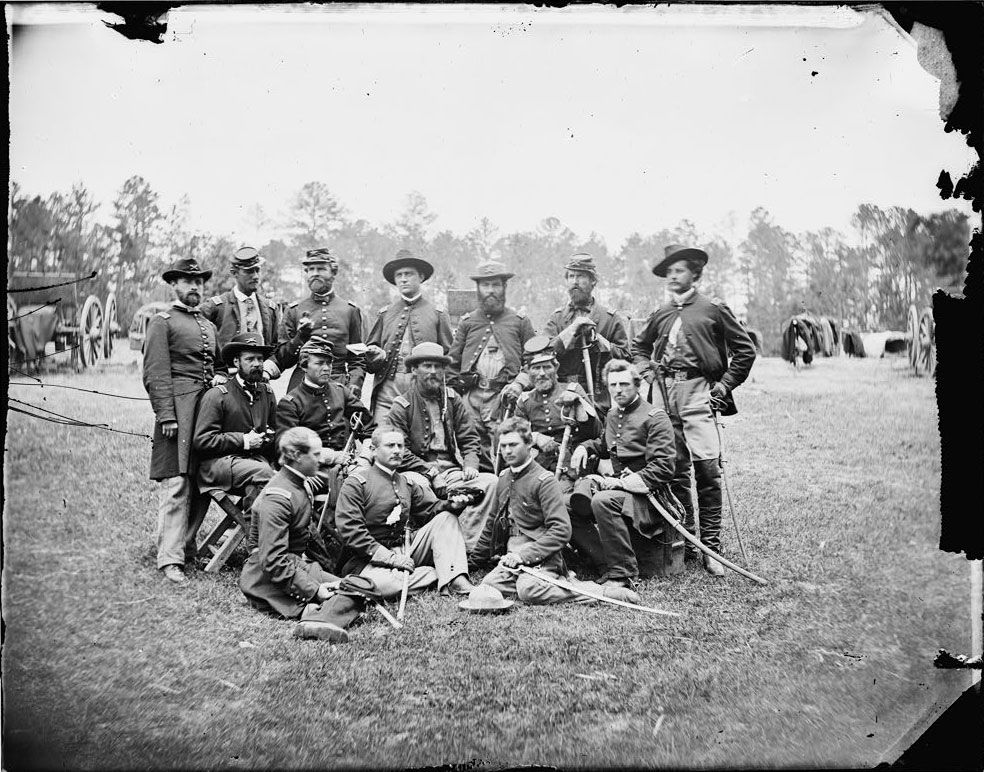
Horse Artillery Officers (J. Gibson, 1862, LoC)
It’s a detail from one of three group portraits of horse artillery officers of the Army of the Potomac taken by James Gibson on the Peninsula in the summer of 1862. That’s “Jack” Wilson in the back row above, standing third from our right.
Looking for more about him, though, got me three Wilsons for the price of one…

John M. “Jack” Wilson (J. Gibson, 1862, LoC)
Those Gibson group pictures, and others taken at the same time, have long been favorites of mine, in part because most of the subjects were later at Antietam. Among these were Lieutenant Colonel Hays, Captains Gibson, Tidball, and Robertson, and Lieutenants Hains and Pennington.
I was first pulled off track when I found the original photograph (above) from the Library of Congress. The LoC caption identifies Wilson as James E. Wilson. I made a quick check on James Eveleth, and found he had only just graduated from the Point with the Class of 1862. Judging from his cadet portrait and the 1st Lieutenant’s straps on the bearded officer’s shoulders, it is unlikely that James E. was the Wilson in question here.

James Eveleth Wilson (USMA, 1862)
James Eveleth Wilson (c. 1842-1887), from Washington DC, was commissioned 2nd Lieutenant in the 5th US Artillery on 17 June and joined the AoP on the Peninsula in July. He was then was in Northern Virgina and on the Maryland Campaign of 1862. He transferred to the 2nd US Artillery in October and was promoted to 1st Lieutenant a year later. For the duration of the War he served in combat with the AoP and–in the last year–in the defenses of Washington.
In 1866 he declined an appointment as Captain in the 38th US Infantry, and remained in the Regular Artillery for the remaining 20 years of his life. He made Captain in 1874. He was assigned duty in the far West, North Carolina, Georgia, Florida, and around Washington DC, where he died of illness, relatively young at 45, in 1887.
It is a James Wilson, by the way, who is identified by Stephen Sears–in Landscape Turned Red–as conspiring with New York Tribune writer (and ad hoc Hooker staffer) George Smalley to have General Hooker “take command of this Army and drive Lee into the Potomac or force him to surrender”, because McClellan just won’t do it. “Mutiny”, complains Smalley, but takes the mission, though without success. Great story, right?
Sears cites a Smalley article for Harper’s in 1894 and Wilson’s Under the Old Flag (New York: D. Appleton,1912) to support this account. Although I first thought this James E Wilson, the book straightened me out.

James Harrison Wilson (c. 1865, Under the Old Flag frontpiece)
Under the Old Flag (vol 1, vol 2) was written by James Harrison Wilson (1837-1925). He too was a West Pointer, class of 1860 (five year program), classmate of John Moulder. In early September 1862, in Washington and at loose ends for a command, he wangled orders to George McClellan’s staff hoping combat would soon follow.
In contrast to Sears’ conspiracy theory–or Smalley’s version of it–in his memoirs James Harrison Wilson did say he wanted to see Hooker return to his command, but for the “inspiration” it would bring to the Army. There is no sign of disgust with McClellan nor plotting nor mutiny in his telling. A matter of interpretation, perhaps.
Enough diversion. I should get back to John Moulder Wilson (1837-1919).
Known as Jack, he had transferred from the 2nd US Artillery to the Topographical Engineers and McClellan’s staff as Aide-de-Camp by the battle of Malvern Hill in August 1862. Years later, in 1897, he was awarded the Medal of Honor for action there:
Remained on duty, while suffering from an acute illness and very weak, and participated in the action of that date. A few days previous he had been transferred to a staff corps, but preferred to remain until the close of the campaign, taking part in several actions.
At Antietam, as shown by Mr D’Aoust, he was probably the Wilson who took the first attack order from McClellan to Burnside on the morning of September 17th between 8 and 9 am. As mentioned by D’Aoust, though, there is no sign of JM’s memoirs, so we’ve got no primary source support here.
Jack Wilson, like classmate James H, had a lengthy and successful Regular Army career. He received 4 brevets for Civil War service, and worked in Ordnance, Artillery, Topographical, and Engineering billets, concluding the War as a Staff Lieutenant Colonel of Volunteers working for General Canby.
His post-war career spanned engineering duty from the Great Lakes to the West Coast, on construction projects from lighthouses and fishways, the Washington Monument in DC and Jefferson’s tomb at Monticello, to public buildings in Washington and the Regular Army markers on the field at Gettysburg.

Colonel JM Wilson (c. 1889, USMA)
At the apex of his career he was Superintendent of the US Military Academy at West Point (1889-93, reports pdf), and Chief Engineer of the Army (1897-1901), from which position he retired as Brigadier General, USA.
Along the way Jack Wilson was also awarded an LL.D (law, 1890) degree from Columbian (now George Washington) University in Washington DC, in which city he lived to the ripe old age of 81.
___________________
Notes
The photo at the top is online from–and was captioned by–the Library of Congress as:
Photograph from the main eastern theater of war, the Peninsular Campaign, May-August 1862. Standing, left to right: Lt. Edmund Pendleton, PLt. Alex C. M. Pennington, Capt. Henry Benson, Capt, H. M. Gibson, Lt. James E. Wilson [sic], Capt. John C. Tidball, Lt. William N. Dennison. Seated, left to right: Capt. Horatio Gibson, Lt. Peter C. Hains, Lt. Col. William Hays, Capt. James M. Robertson, Lt. J. W. Barlow. Seated on the ground, left to right: Lt. Robert H. Chapin, Lt. Robert Clarke, A.C. Vincent.
Speaking of Wikipedia, note what enthusiast “B93” has done in an article on the US Horse Artillery. Great stuff –I’ve never seen a dedicated examination before. Since August he’s posted extensively about these units and officers, and he’s the contributor of the Wilson photo excerpted above. Shame the author doesn’t feel comfortable with his/her real name …
When I say ‘Sears’, I’m referring to: Sears, Stephen W., Landscape Turned Red (New York: Houghton Mifflin, 1983).
All three Wilsons are in Cullum’s Biographical Register, Volume 2, Part 5 (1891). John Moulder is #1858 (Class of ’60), James Harrison (’60) is #1852, and James Eveleth #1987 (’62).
James E Wilson’s cadet photograph is from the 1862 Class album, posted online by the USMA Digital Library. Heitman in his Biographical Dictionary (pdf), has him with the AoP on the Peninsula, but there’s also a “Lt James E Wilson, 5th US Artillery” serving on Folly Island, South Carolina in July 1862. More mysteries to chase.
The portrait of John Moulder Wilson while Superintendent at West Point is from the USMA Digital Library.


Leave a Reply