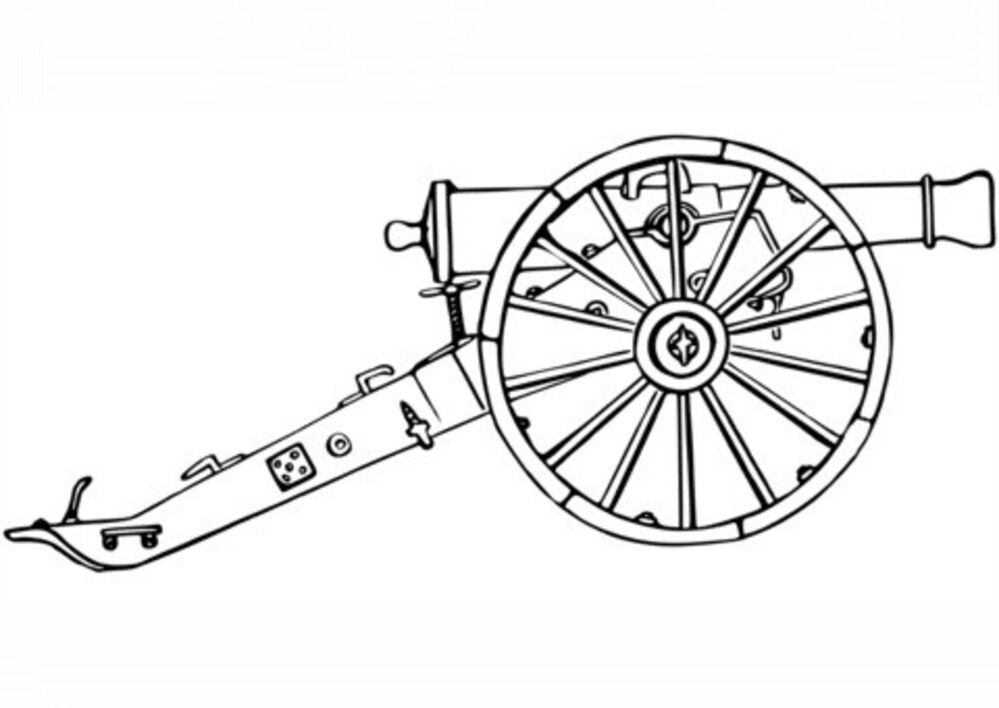
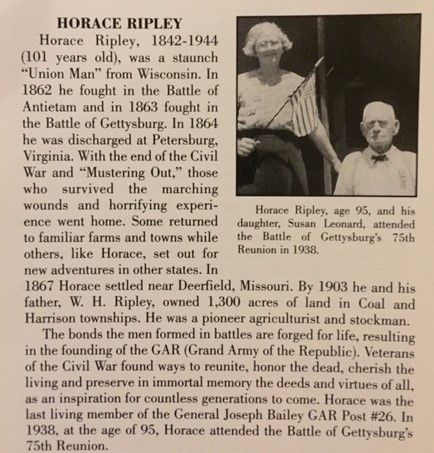
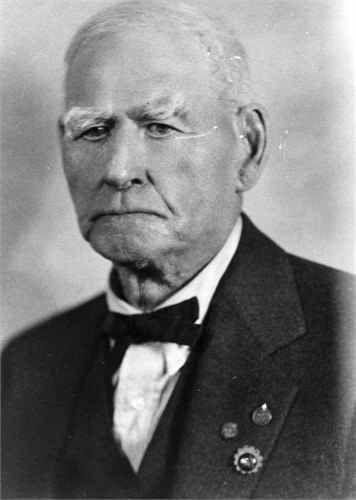
Horace Ripley enlisted at age 19 in 1861 in the 7th Wisconsin Infantry and was detailed to Battery B of the 4th US Artillery less than a week before the battle of Antietam, on 12 September 1862. He learned his new job under fire on the 17th, from Sun Prairie, WI neighbor Elbridge E Packard of the 2nd Wisconsin, an “old hand” who’d been with the battery since November 1861.
The clip at the top is from a local history called Nevada and Vernon County’s Heritage (2005), shared online by Lois Ripley Chavez. His portrait photograph – probably also taken about 1938 – was contributed to the FamilySearch database by Betsy Jill Chesire.
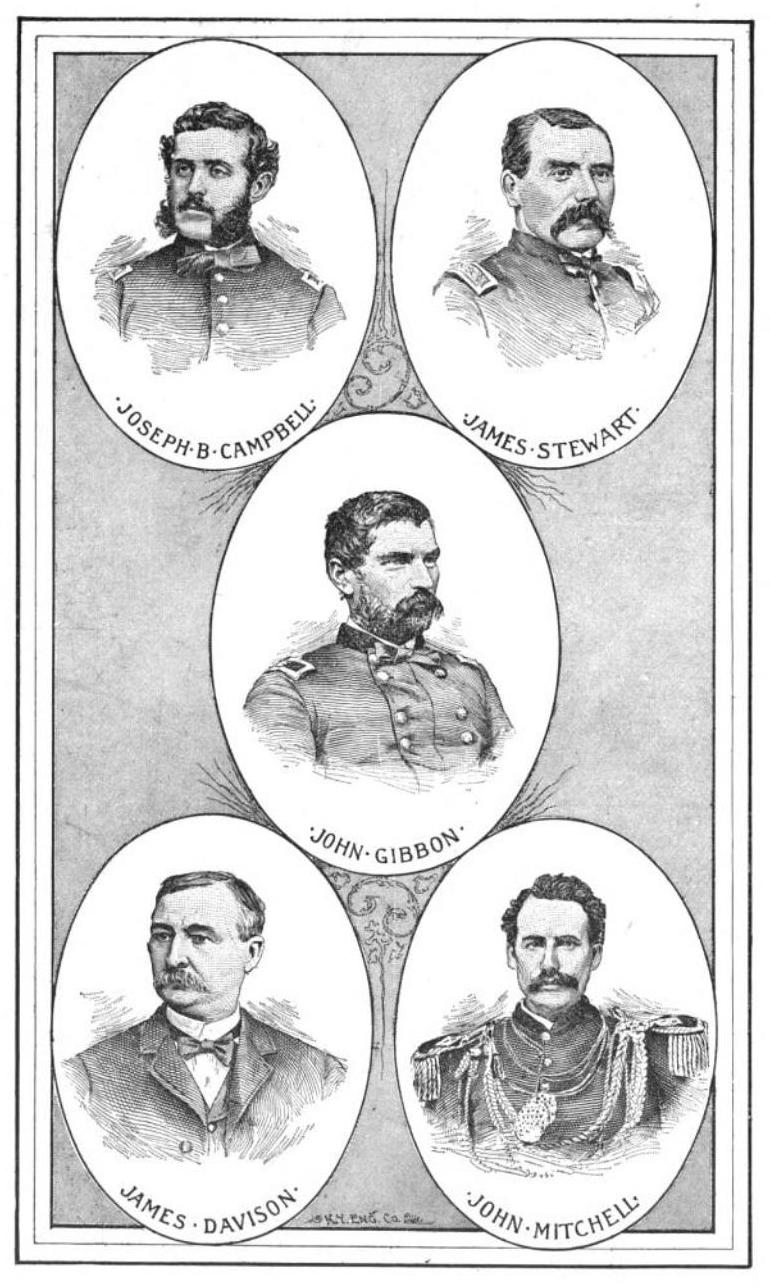
From the frontpiece of Augustus C Buell’s The Cannoneer: Recollections of Service in the Army of the Potomac (1890), here are some of the officers of Battery B, 4th United States Artillery before and during the war. Etchings after photographs.
Captain Campbell commanded the battery at Antietam until wounded, succeeded by Lieutenant Stewart. Brigadier General Gibbon, a career Regular Artillery officer, was Captain of Battery B at the start of the war; he led the Brigade and helped man a gun of Battery B at Antietam. Lieutenant Davison of the 3rd US Artillery joined the battery after Antietam and commanded a “half-battery” of “B” at Gettysburg until he was wounded and replaced by then-Lieutenant Mitchell. Mitchell was First Sergeant of the Battery at Antietam and cited for bravery there. He is pictured here in his post-war uniform as a Captain in the 43rd (later 1st) US Infantry.
Augustus Caesar Buell (1847-1904) is now generally known as a “fraud historian” – particularly because of his biographies: Paul Jones, Founder of the American Navy (1900), Sir William Johnson (1903), William Penn as the Founder of Two Commonwealths (1904), and History of Andrew Jackson, Pioneer, Patriot, Soldier, Politician, President (1904) – all apparently at least plagiarized if not entirely made-up.
He wrote much of Cannoneer as if he was an eyewitness to it all, when he hadn’t actually enlisted in the 20th New York Cavalry until August 1863 and was (probably) detailed to the battery some time later. Although it must be viewed skeptically, the book is an excellent source of detailed information about Battery B/4th US Artillery.
It owes its value to the many soldiers and officers of the battery who contributed to its content, notably Captain Stewart, Sergeant C.A. Santmyer, and Private B.H. Stillman, who had been detailed from the 7th Wisconsin Infantry.
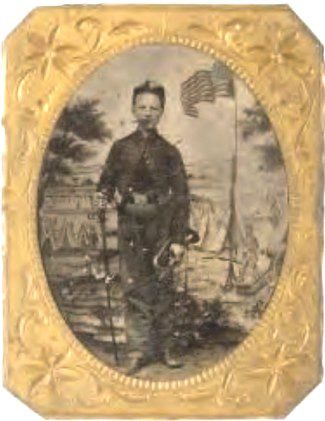
John Cook was not quite 14 when he enlisted as Bugler of Battery B, 4th United States Artillery in June 1861. You probably recognize his name from his heroism at Antietam in September 1862, for which he was much later awarded the Medal of Honor.
Here he is in a widely reproduced image probably taken soon after his enlistment. Thanks to the Adjutant General’s Corps Regimental Association (AGCRA) for putting that online.
In 1860, the companies [of the 4th United States Artillery] in Utah were kept busy protecting the parties of emigrants going West, and keeping open the mail routes. Light Battery B, operating as cavalry, marched during that summer 2000 miles over a barren and desert country, and though the Indians were continually hostile, the roads were kept open. The battery had a successful fight against 200 Indians at Eagan’s Canyon, August 11, 1860, losing three men wounded (one mortally).
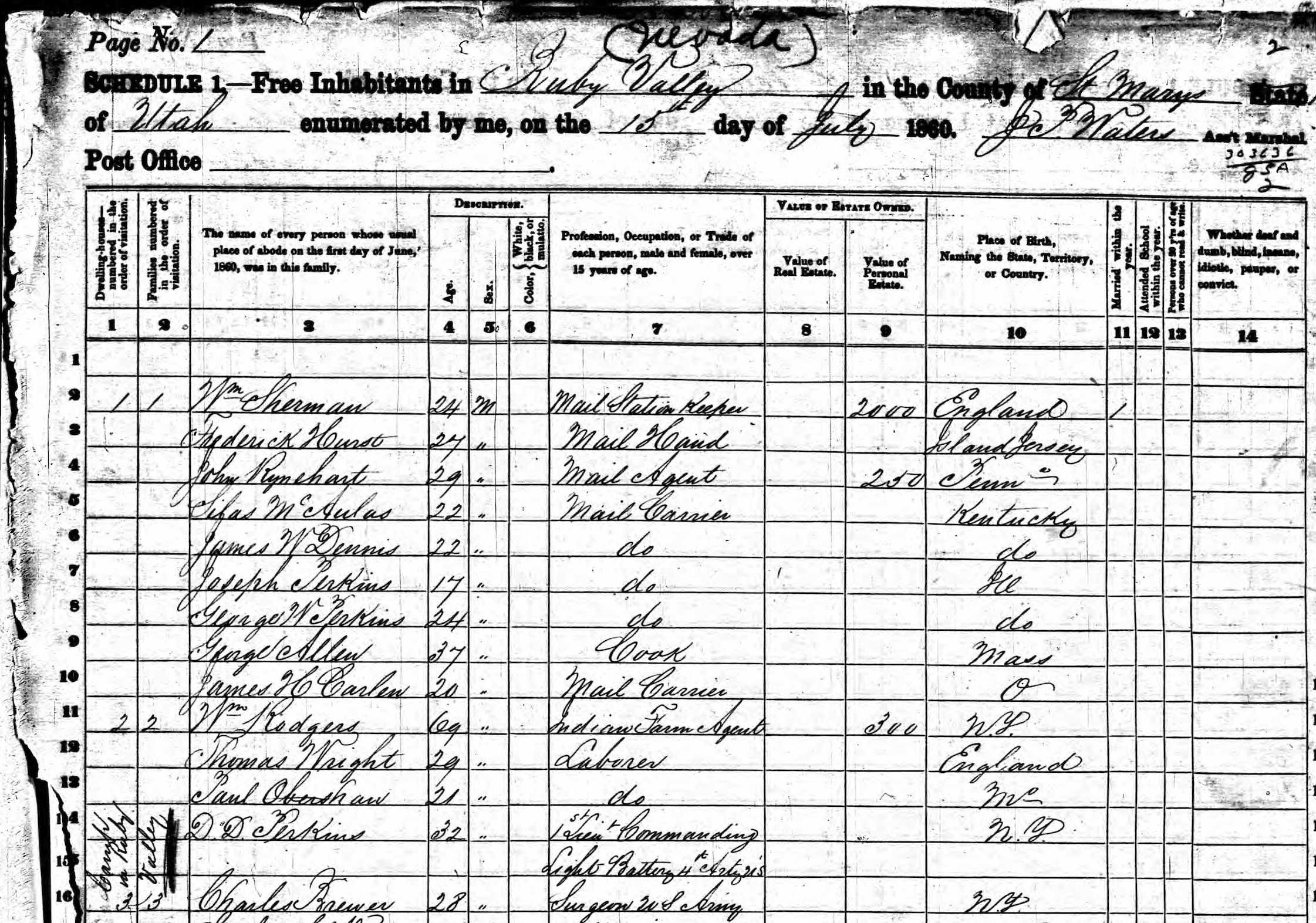
From May to October 1860 Battery B was based at the small Pony Express station located at Station Spring at the southern end of Ruby Valley in western Utah Territory (now Nevada). 32 year old First Lieutenant D.D. (Delavan Duane) Perkins, USMA ’49 was in command; Lieutenant Stephen H Weed USMA ’54 and Surgeon Charles Brewer (Assistant Surgeon CSA 1861-65) were the other officers.
On 15 and 16 July 1860 US Census enumerator J.P. Waters identified 105 Americans there, but did not include the band of Shoshone who lived nearby. His three page [ page 1 | page 2 | page 3 ] listing of the residents is a great reference for students of the Battery.
Among the 70 soldiers listed in Ruby Valley that summer at least 17 were also in action with Battery B just over two years later at Antietam, including then-Sergeant James Stewart, who commanded the Battery at Antietam after Captain Campbell was wounded, and Private Richard L Tea, who was slightly wounded at Antietam, was awarded the Medal of Honor in 1876 for action against the Cheyenne in Kansas the year before, and retired from the Army in 1888 after 30 years in uniform.
Others of the Battery in that 1860 Census list known to be at Antietam in 1862:
_______________
The quote at the top is from the US Army history of the 4th Regiment of Artillery, online thanks to the Center of Military History.
The census pages are from 1860 United States Federal Census, Population, Schedule 1. NARA microfilm publication M653 (1,438 rolls). Washington, D.C.: National Archives and Records Administration. The Ruby Valley, St. Mary’s, Utah Territory set are on roll M653_1314, Pages 1-3. I found these page images online thanks to FamilySearch.
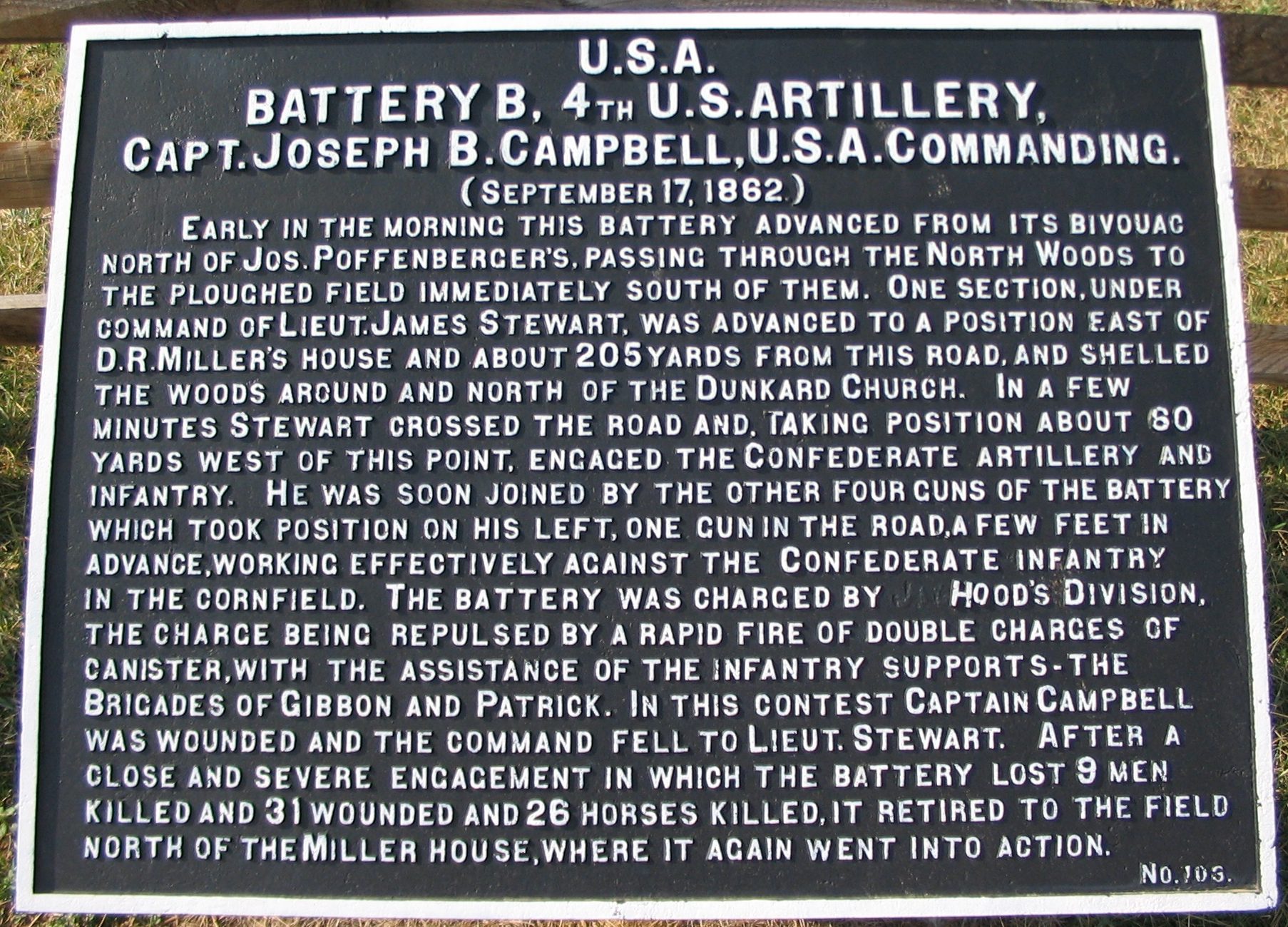
The photograph of the Battery’s battlefield tablet at Antietam was taken by Craig Swain for the HMDB.
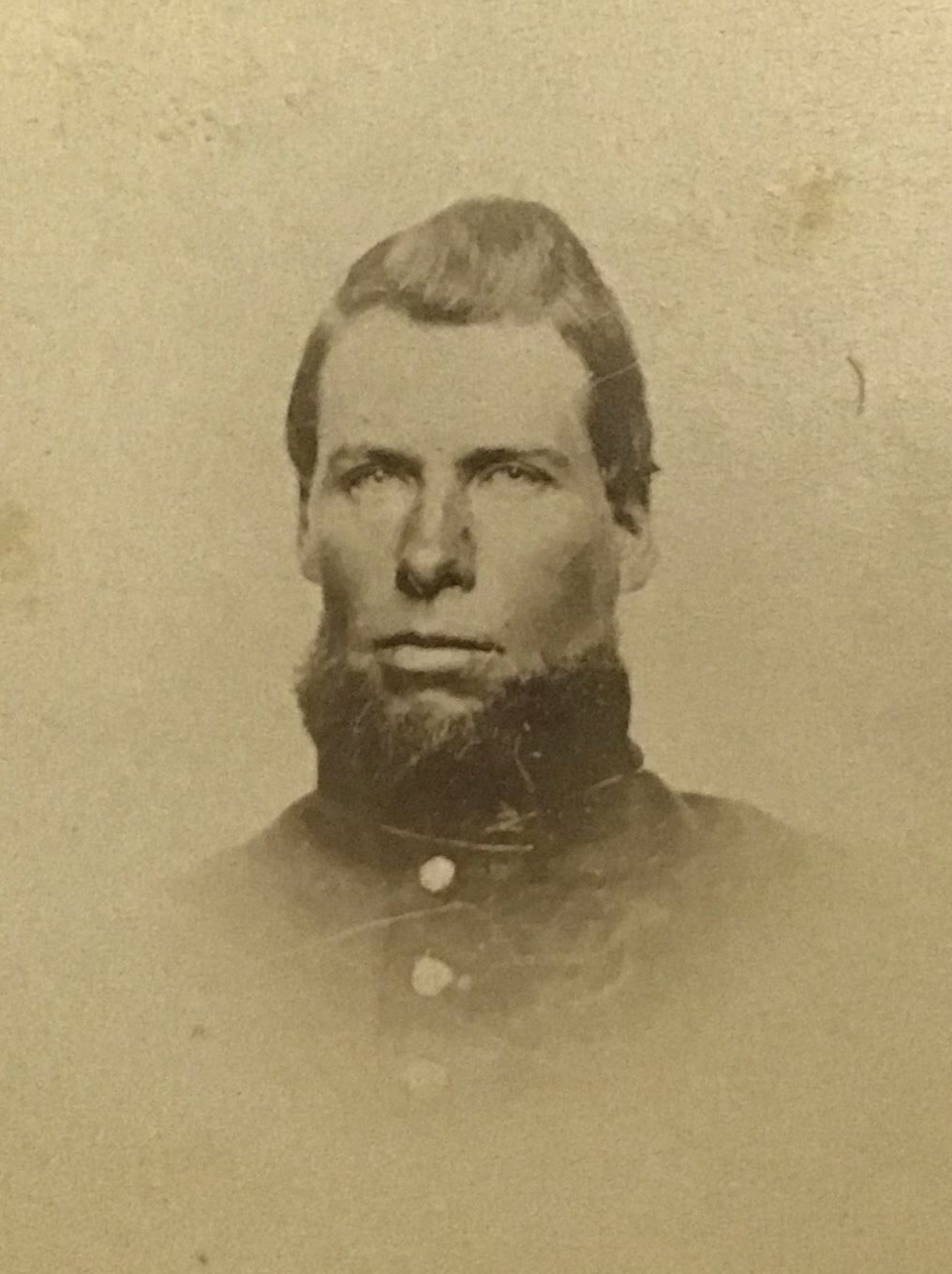
This impressive photograph of George W Cooley, Company F, 7th Wisconsin Infantry is from the massive collection of Dennis Skalstad, who kindly shared it online on Cooley’s cemetery memorial page. Private Cooley was killed at Turner’s Gap on South Mountain in Maryland on 14 September 1862.