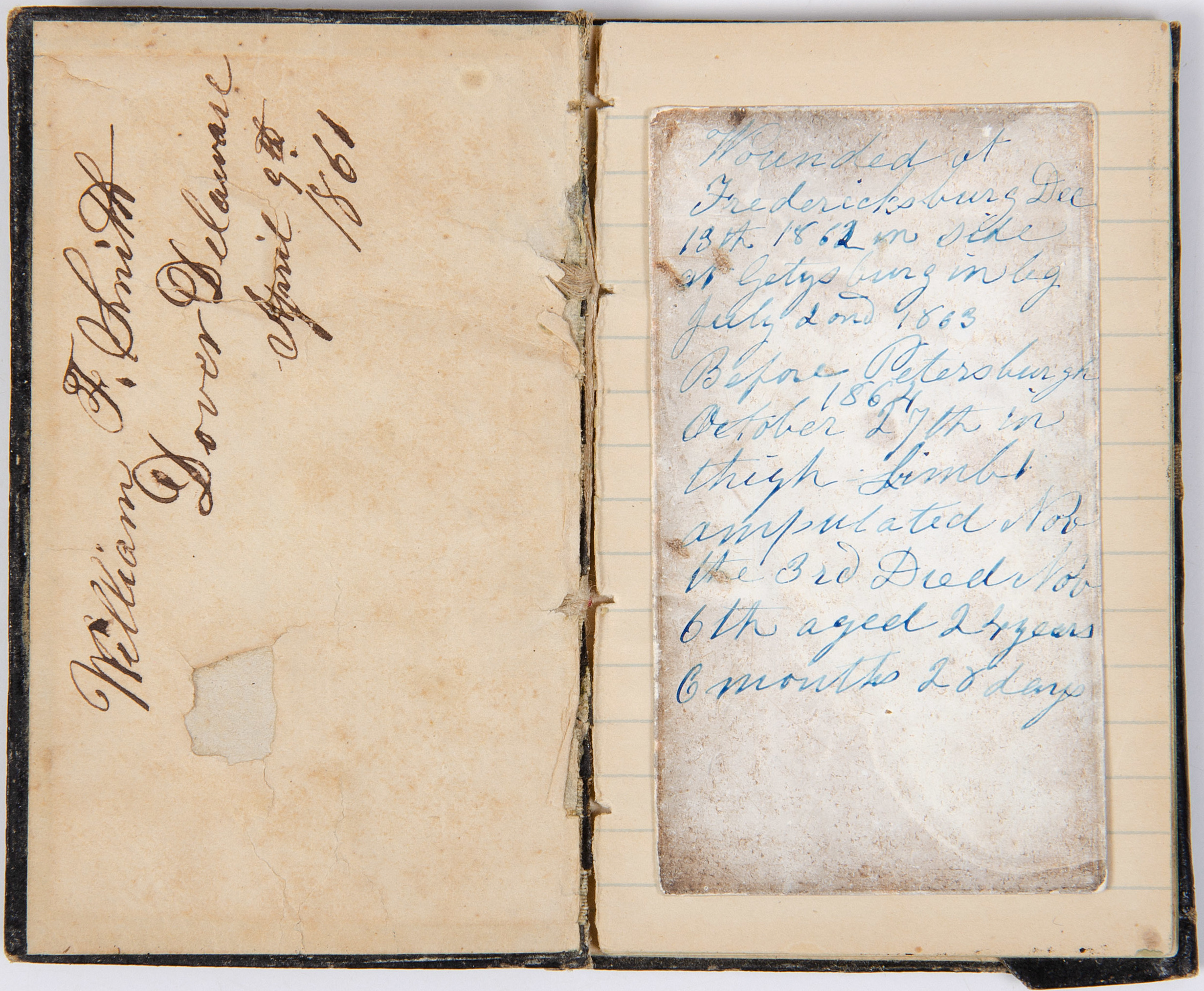
Lieutenant William Frances Smith of Company D, First Delaware infantry wrote home to his mother after Antietam. The letter, seen above, was recently sold by Museum Quality Americana and brought to my attention by John Banks. William Smith also kept a diary during the war, below, and that sold at auction in January 2020.
Private Basil Manly Stedman of the 48th North Carolina Infantry was mortally wounded and captured at Sharpsburg in September, and died in a Frederick, MD hospital on 19 October 1862. This announcement is from the Fayetteville Semi-Weekly Observer of 29 December 1862, online from newspapers.com.
All three sons in this family died in the War. His third brother, David, died at Bentonville, NC in April 1865.
Captain James Archbald led his Company, “I” of the 132nd Pennsylvania Infantry, in action at the Sunken Road – later called “Bloody Lane” at Antietam on 17 September 1862. Two days later he wrote a friend about it …
.. we were ordered forward to the crest of a hill [overlooking the sunken road] where we found the 108th New York; we walked over them, for they were lying down, with but few exceptions, firing from that position. Here we fought for four and a half hours, until we had fired 60 rounds and some of the cartridges of the dead and wounded.
Our bayonets were fixed for a charge upon the rifle-pits of the rebels and the corn-field occupied by them. Just at this point the Irish Brigade came to our relief and we were ordered to the rear …
His obituary is from the Scranton Tribune of 6 October 1910. His wartime picture, below, is from Hitchcock’s War from the Inside : the Story of the 132nd Regiment Pennsylvania Volunteer Infantry … 1862-1863 (1904). Thanks to EJ Murphy for the pointer to Archbald via Twitter.
In April 1988 the US Park Service produced a report about the Antietam National Battlefield and surroundings called analysis of the visible landscape [pdf]. Its stated purpose:
Recently, residents and state and local administrators have become concerned that the rural character and lifestyle of south Washington County, including Antietam National Battlefield, are being eroded by poorly planned suburban development. The National Park Service shares this concern because of the potential threat to the agricultural setting which is so important to the historic scene at Antietam. During the summer of 1987, the Maryland Department of State Planning contacted Antietam Superintendent Richard Rambur requesting National Park Service assistance with the South County Study for land use planning. Specifically, the state sought information on which areas contribute to the scenic quality of the battlefield. This report has been prepared in response to that request.
It’s an excellent work which, along with local preservation activism, contributed to increased zoning and easement protections for the land on and near the battlefield. You can easily see the results when you visit the Park today.
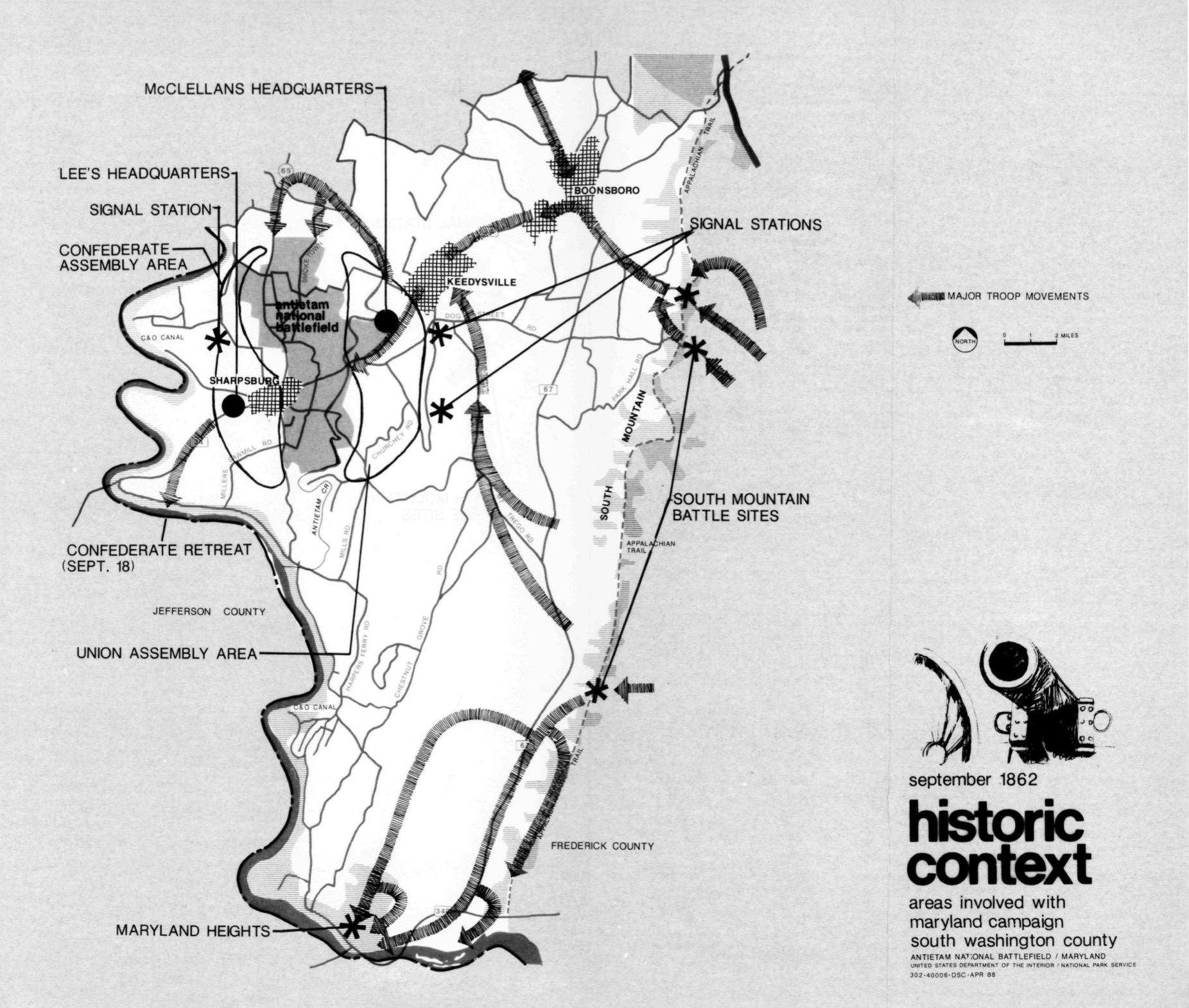
I think this map, from that report, is the nicest overview of the geography and military activity of the Maryland Campaign I’ve ever seen, which leads me to share it with you, both of my readers. It was probably drawn by John Ochsner, Landscape Architect at the Denver Service Center, US Park Service.
Appropriately, the flag has the 34 stars in the blue canton, following the Act of April 4, 1818 signed by President Monroe, which provided that the American flag should have 13 stripes, and one star for each state; new stars to be added to the flag on the 4th of July following the admission of each new state.
A 33-star flag was in use from 1858 to 1861 and the 34-star flag became official on 4 July 1861, a star added for the admission of Kansas (29 January 1861). It was in use for 2 years until 4 July 1863, when a 35th star was added for West Virginia (admitted 20 June 1863).
While probably most common, the rectangular 34-star arrangement above – similar to our modern 50-star pattern, but in rows of 6-5-6-6-5-6 – was not the only one used, as the Act specified only the number of stars. Also frequently seen are flags with rows of 7-7-6-7-7 stars and similar.
Here’s a display flag with quite another design. This particular one was made to be hung on a wall and is only finished on one side (as seen on PBSs Antiques Roadshow in 2016).
Here’s a variation of that circular arrangement, sometimes called the Great Medallion pattern, on a flag sold by Heritage Auctions in February 2007.
Flags were also made with the stars formed in the shape of a large star or flower, such as this one, sold by Heritage Auctions in May 2010.
Let me know of other historical 34-star flags you’ve seen, won’t you?