Year: 2021

  • Attention, Meagher Guard! (1853)

    I’m exploring another Irish unit today – Company K of the First South Carolina Infantry (McCreary’s). Formed in June 1861 as the Irish Volunteers for the War, they came largely from a pre-war militia company organized in Charleston in about 1853: the Meagher Guards.

    When the Guards’ idol and namesake Thomas F. Meagher began recruiting Irishmen for the Union in New York in 1861

    the Charleston company condemned Meagher for “taking arms against us in this most unholy war in support of usurpation and oppression,” struck his name off their roll of honorary members, and on 9 May changed the unit’s name to Emerald Light Infantry.

    Two former officers the Meagher Guard who formed the Irish Volunteers for the War – Company K – were wounded at Sharpsburg in September 1862:

    Dublin-born Captain Michael P. Parker was a carpenter who “had acquired an education beyond his circumstances. He was an able mathematician, and an excellent writer.” Formerly First Lieutenant of the Meagher Guards, he was made Captain of Company K in January 1862. He was “dreadfully” wounded at Sharpsburg, and never really recovered, dying young at about age 35 in 1868.

    First Lieutenant James Armstrong, Jr. was only slightly hurt at Sharpsburg and was eventually promoted to Captain of the Company after Parker. He was born in Philadelphia of immigrant parents but was raised in Charleston and lived for some time in Ireland in the 1850s.

    At least 9 more men of Company K were casualties on the Maryland Campaign and many had probably been members of the Meagher Guard; with Irish surnames like Burns, Dillon, Feeney, Holloran, Kennedy, and Sullivan.

    The announcement for the Guards, above, is from the Charleston Daily Courier of 16 September 1853. I found it and the quotes above in the excellent Meagher Guard, Charleston’s Fighting Irish by Bill Bynum, published in Company Front (Issue 1, 2011) [pdf], the journal of The Society for the Preservation of the 26th Regiment North Carolina Troops.

  • USS Vanderbilt (c. 1862)

    Private John Henry Libben did not impress his commanding officer at Antietam.

    Lieutenant Peter C Hains later wrote of his battery, “M” of the 2nd United States Artillery:

    All the men of the company behaved with their accustomed coolness and courage with one exception, Private Litten [sic], who was not at all remarkable for coolness or courage.

    Language not often found in an officer’s after-action report.

    Libben served with the battery until discharged at the end of his enlistment in March 1864 and he enlisted in the US Marine Corps immediately afterward, in April. He was promoted to Sergeant and spent the last part of his enlistment (c. 1866-68) aboard the beauty above – USS Vanderbilt. I expect he gathered some coolness and courage by then.

    This photograph of USS Vanderbilt is online from the US Naval History and Heritage Command.

  • Huzzah! Hathi Trust

    My favorite basic source for Louisiana troops is Andrew Bradford Booth’s three volume set (in 7 books) of the Records of Louisiana Confederate Soldiers and Louisiana Confederate Commands (1920). A one-stop shop for the military basics on more than 102,000 individuals.

    Until recently I’d consulted an online text transcription of Booth’s work, but it’s disappeared. A couple of days ago I found the Hathi Trust Digital Library has all 7 of the books, but had limited access to three of them for copyright issues.

    Books published in the US before 1925 are now out of copyright – in the public domain – so I took advantage of the feedback form on the Hathi Trust site and pointed the problem out to them.

    Amazing! Within an hour I had an acknowledgement and a few hours later Jessica from user support responded that she was passing my request to a copyright expert. The next day I got an email from Kristina saying she agreed the books are no longer under copyright and would open up access for US users. And she did, immediately. She also took the time to explain why they’d been restricted in the first place: there was a 1974 microfilming date on the copyright page.

    This is in sharp contrast to the results I’ve had over the years from Google Books in many similar situations: Crickets. Nothing. Nada.

    Bravo Hathi Trust!

  • Culpeper, Va. Men of Battery M (Benson’s), 2d U.S. Artillery

    Here’s an unusual view: the enlisted men of Battery M, 2nd United States Artillery at Culpeper, VA in September 1863. One of these men is probably Corporal Michael Frain, who was wounded at Antietam the year before. Corporal Frain had first enlisted back in 1854 and he served in Battery M to November 1873.

    I found that great photograph while looking into an officer of the battery who was a Sergeant when they were in action at Antietam.

    He was Terrence M. Reilly of Glasgow, Scotland. He enlisted in 1857 and was commissioned 2nd Lieutenant, 2nd US Artillery in March 1863. That’s him without a hat in the front row in the picture below, also taken at Culpeper in 1863. Both photographs are online from the Library of Congress.

    Thanks to Jim Rosebrock for the pointer to Reilly in a bio sketch he posted to the Antietam Guides Facebook page.

  • Capt. Creswell A.C. Waller (1910)

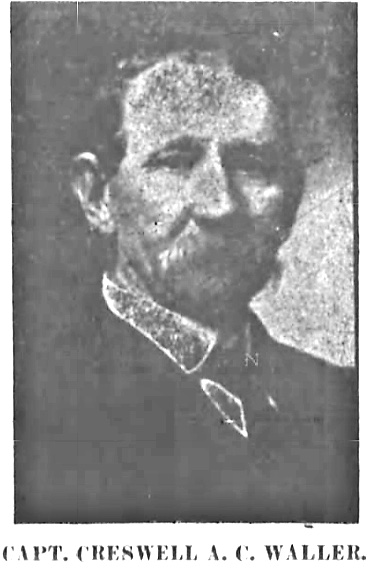
    This is Creswell Archimedes Calhoun Waller of Greenville, SC from a photograph published in the Greenwood Evening Index of 3 March 1910.

    He was a Private in the 2nd South Carolina Infantry at Sharpsburg in September 1862. He later rose to be a Captain in the 36th Georgia Infantry and was a successful business man and politician in Greenwood after the war.

    He was one of 8 children – 7 boys, one daughter – of Albert “Squire” Waller and Jane Elizabeth Creswell “Betsy” Waller, who had a substantial and successful plantation near Greenwood before the war. Many of the boys had interesting names like Creswell, who was named for his mother’s family, the Greek mathematician, and the US Senator from South Carolina. Among his brothers were Codrus D., Cadmus Garlington, and Pelius Augustus Waller, who was killed at Olustee, FL in February 1864.

    Two of his brothers were also at Sharpsburg, and both were killed.

    Robert Aurelius Waller was Captain of Company B of the 8th Florida Infantry and commanded the regiment briefly after Colonel Coppens was killed, but was himself shot down near the Sunken Road “with the colors of the regiment draped over his shoulders.”

    Private James Leonidas Waller was with Captain Garden’s Palmetto Light Artillery at Sharpsburg and was mortally wounded by an exploding shell. He died in October at a hospital in Winchester, VA.