Year: 2021

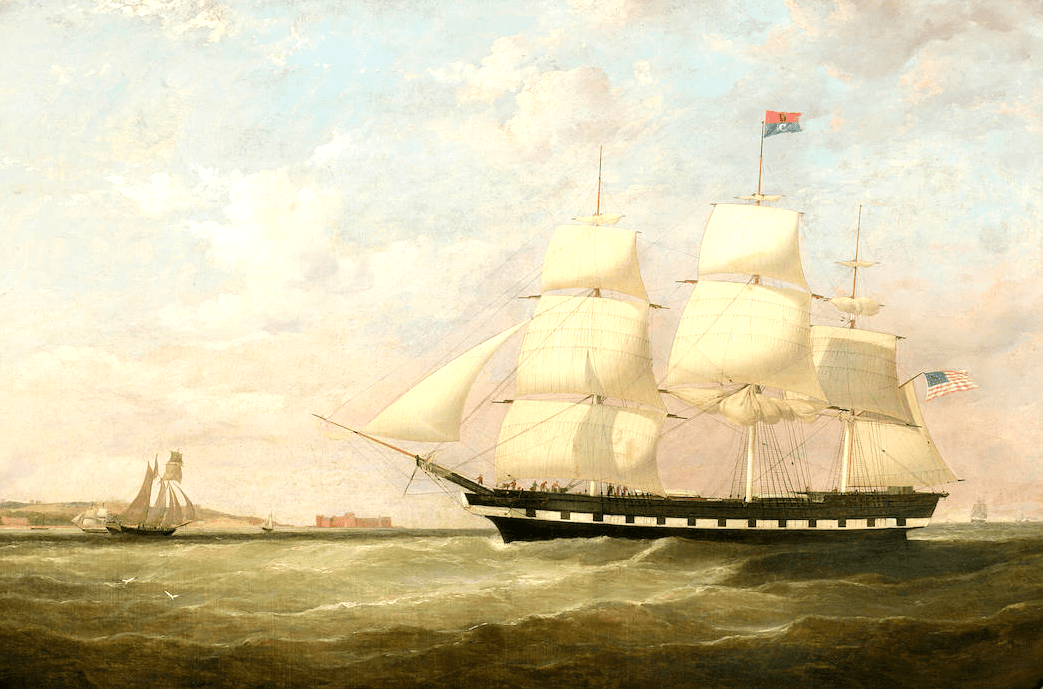
  • The packet ship Dewitt Clinton

    This lovely thing is the packet ship Dewitt Clinton of New York departing Liverpool, an 1865 painting by English maritime artist Samuel Walters offered at auction by Bonhams in January 2011.

    James Fegan was aboard her on a passage from Liverpool to New York City in 1850. From Athlone, he’d been a policeman in the Royal Irish Constabulary before emigrating, and enlisted in the 2nd United States Infantry soon after arriving in America. He was a Sergeant by 1856 and was wounded at Antietam in 1862, but he survived the war and another 20 years of US Army service to retire in 1885.

    He was awarded a Medal of Honor for singlehandedly fighting off “a party of desperadoes” – his fellow soldiers – and getting a powder train through to Fort Dodge, KS in March 1868.

    __________________

    From the New York Times of 10 March 1860:

    The wreck of the DeWitt Clinton.; THE PASSENGERS SAVED AND BROUGHT TO THIS CITY.

    During the severe gale and snow storm which prevailed on Thursday, the packet-ship De Witt Clinton, bound from Liverpool to New York, went ashore on the New Jersey coast, eight miles below the village of Squan. The vessel contained a valuable cargo, and carried a large number of passengers. Information was speedily conveyed by signals to the shore, but the remoteness of the point from the life-saving apparatus, and the sparseness of the population, prevented any active measures. Fortunately, the steamship Quaker City, on her voyage hither from Havana, observed the vessel, and hailed and dispatched the steamtug Jacob Bell, which proceeded at once to the rescue. The Clinton was found to have bilged, but was lying very easily, and there was reason to believe that she might be saved after discharging a portion of her cargo. The passengers were all taken off by the pilot-boat Christian Bergh (No. 13) which came up opportunely, and last evening reached Quarantine in safety.

    The Dewitt Clinton, Capt. DUNN, was built in this City in 1848, by Messrs. PERINE, PATT & SONS. She was of 1,079 tons burden and of 20 feet draft. Messrs. H.L. RICH & Co. are the owners of the vessel, which ranked as A 1-1/2.
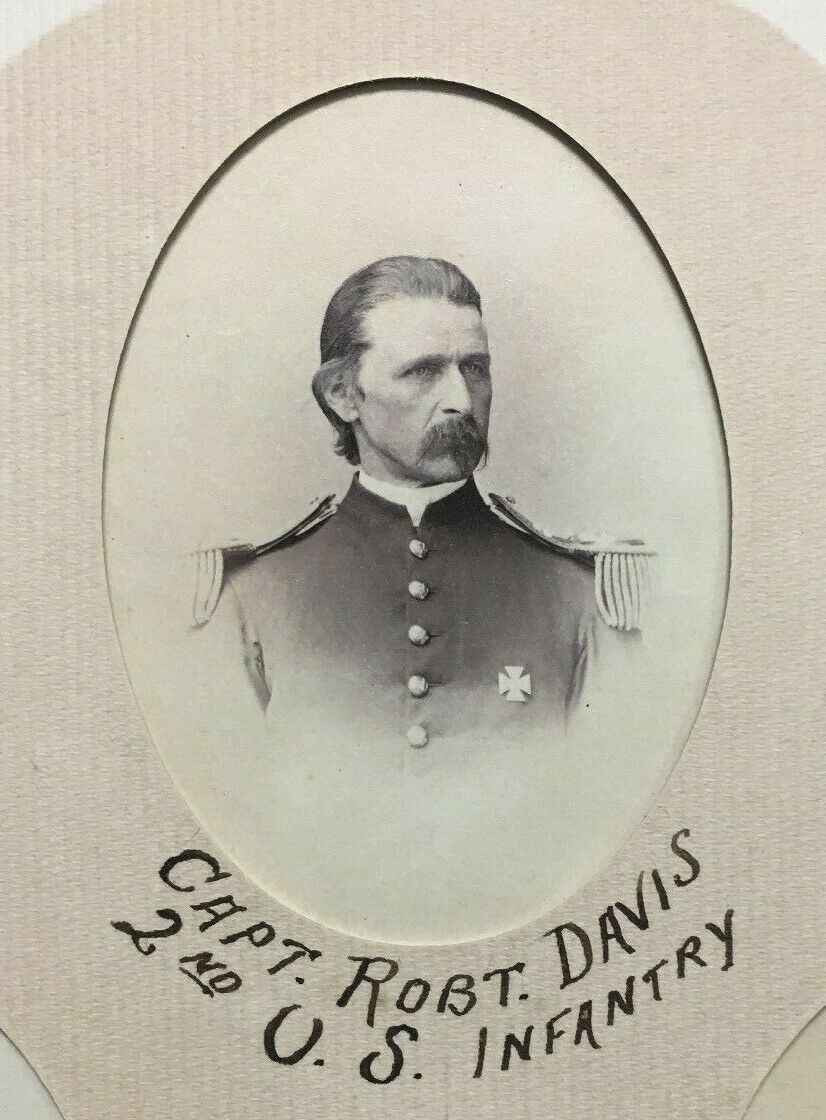
  • Capt. Robt. Davis, 2nd U.S. Infantry

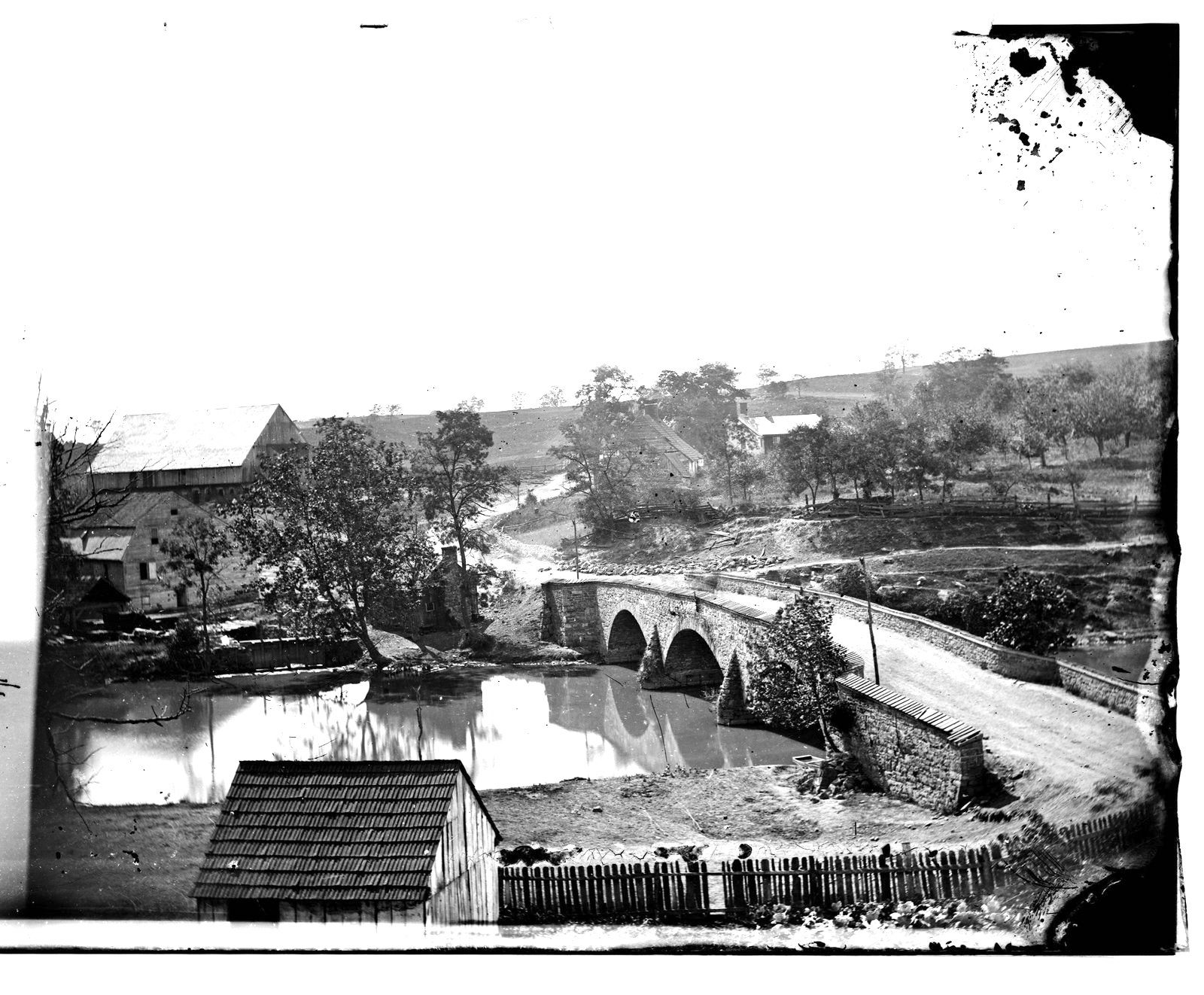
    Mexican War veteran Robert Davis was a Sergeant in Company I, 2nd United States Infantry when he was wounded in action near the Middle Bridge at Antietam on 17 September 1862. His c. 1865 photograph was posted to his Findagrave memorial by Jeffry Burden.

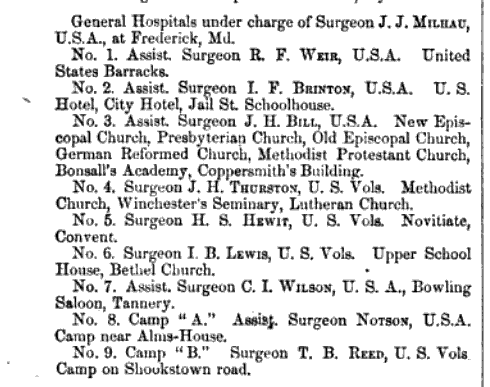
  • Frederick hospitals November 1, 1862

    From the American Medical Times of 1 November 1862 [via GoogleBooks], a list of the Surgeons-in-charge and locations/buildings making up each of the US Army’s ten General Hospitals in Frederick, MD after Antietam.

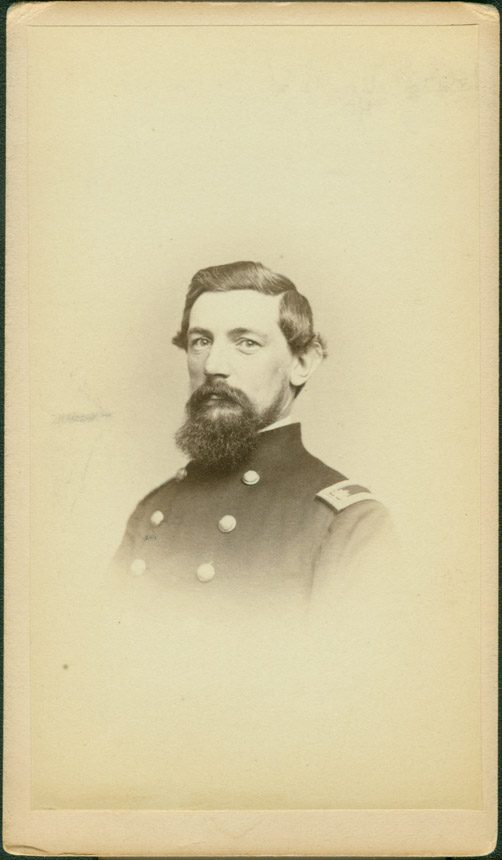
    Here’s Surgeon John Jefferson Milhau in a carte-de-visite photograph posted to his Findagrave memorial by Family Search (the Mormon genealogy database) …

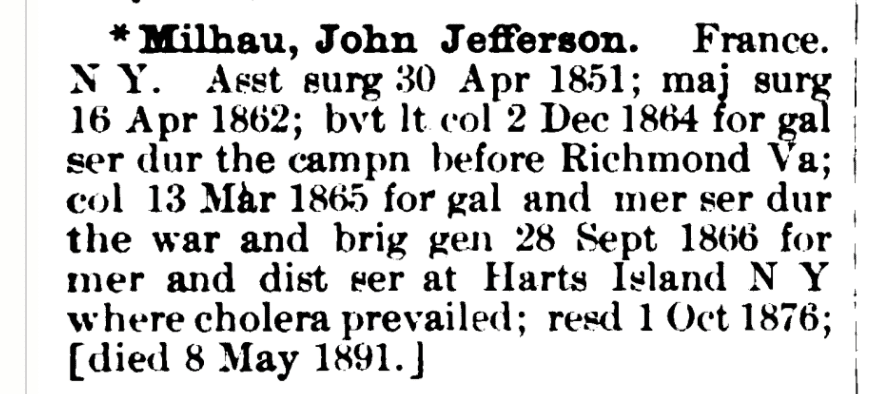
    … and a snapshot of his US Army service from Heitman’s Historical Register and Dictionary of the United States Army (1903).

    _____________________
    List transcription:

    General Hospitals under charge of Surgeon J. MILHAU, USA at Frederick, Md.

    No. 1. Assist. Surgeon R.F. WEIR, USA United States Barracks.
    No. 2. Assist. Surgeon I.F. BRINTON, USA US Hotel, City Hotel, Jail St. Schoolhouse. [probably John Hill Brinton, US Vols]
    No. 3. Assist. Surgeon J.H. BILL, USA New Episcopal Church, Presbyterian Church, Old Episcopal Church, German Reformed Church, Methodist Protestant Church, Bonsall’s Academy, Coppersmith’s Building.
    No. 4. Surgeon J.H. THURSTON, US Vols. Methodist Church, Winchester’s Seminary, Lutheran Church.
    No. 5. Surgeon H.S. HEWIT, US Vols. Novitiate Convent.
    No. 6. Surgeon I.B. LEWIS, US Vols. Upper School, House Bethel Church.
    No. 7. Assist. Surgeon C.I. WILSON, USA Bowling Saloon, Tannery.
    No. 8. Camp “A.” Assist. Surgeon NOTSON, USA near Alms House.
    No. 9. Camp “B.” Surgeon T.B. REED, US Vols. Camp on Shookstown road.

  • Successful Excision of the Head of the Left Humerus

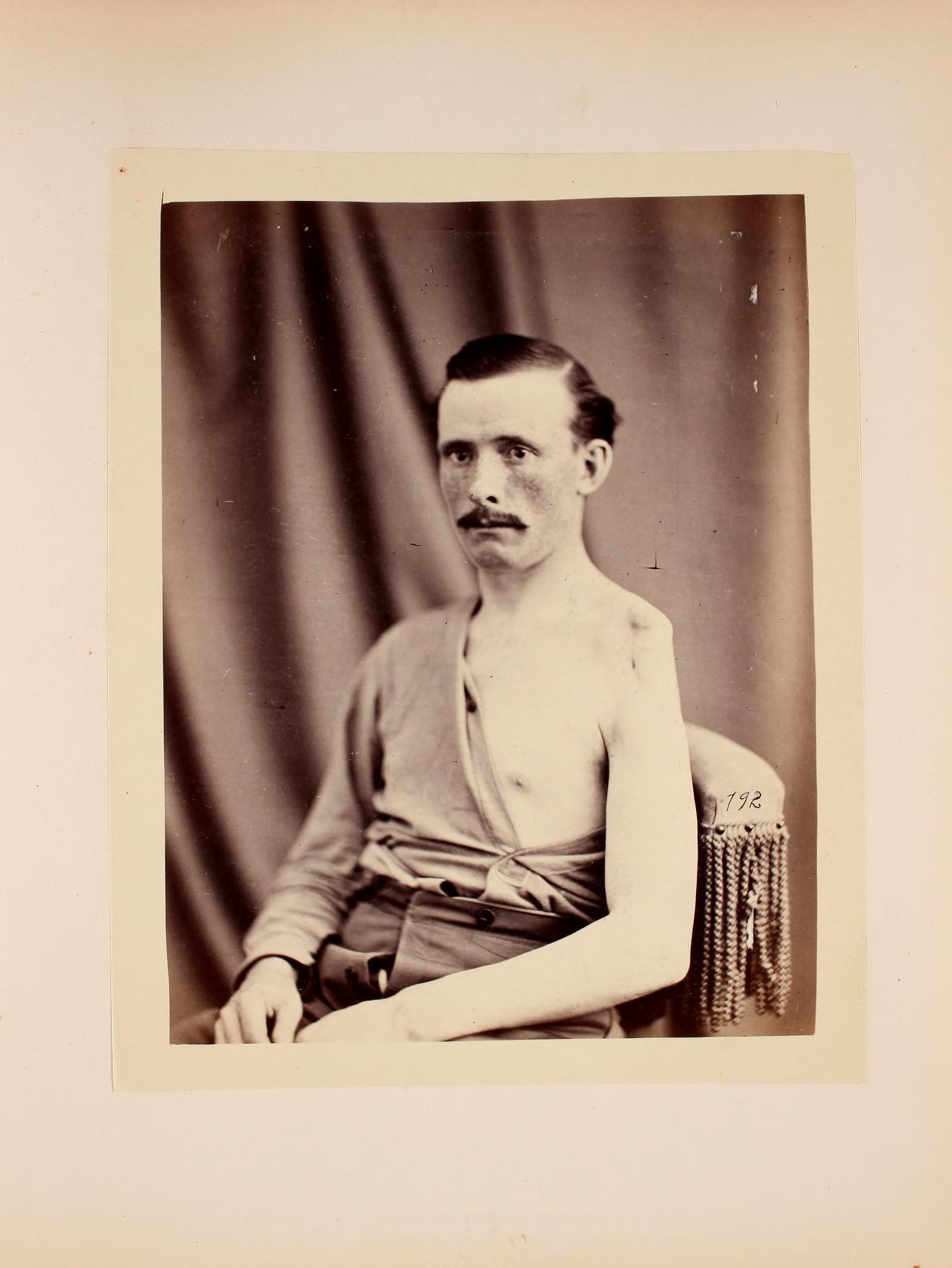
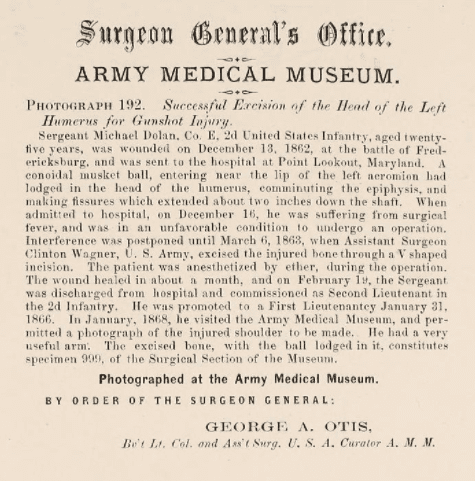
    This photograph, from the US Army Surgeon-General’s Photographs of Surgical Cases and Specimens (1870-1888), was taken in 1868, and is of County Cavan-born Michael Dolan, 2nd United States Infantry.

    A soldier since 1855, he was First Sergeant of Company D of the 2nd Infantry in action at Antietam and was cited among “those who most distinguished themselves for excellent behavior.” He was wounded by a gunshot to his shoulder at Fredericksburg, VA in December 1862 and had a part of his upper arm bone removed. He recovered and was commissioned a Lieutenant, continuing in the Regular Army to his early retirement in 1870, due to effects of his Fredericksburg wound.

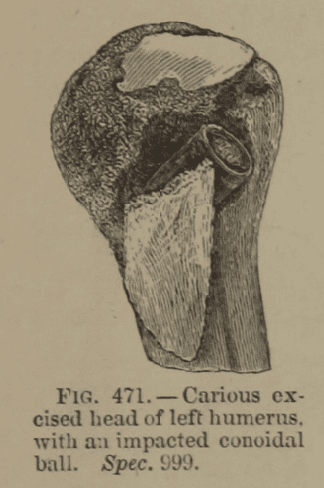
    Part of his arm bone with bullet embedded is in the collection of the National Museum of Health and Medicine in Silver Spring, MD. Here’s an illustration of it from the Medical and Surgical History of the War of the Rebellion (1865).

    And this is the label from the back of Dolan’s photograph with more about his medical case:

  • Killed by guerillas

    I found a couple of excellent accounts which nicely bracket the military career of Captain Samuel A. McKee, 2nd United States Infantry. They are too good not to share and I hope both of my readers will appreciate them.

    McKee was commissioned 2nd Lieutenant, USA on 5 August 1861 and First Lieutenant 5 days later.

    He led Company I of the 2nd US at Antietam, part of a consolidated battalion of companies from the 2nd and 10th United States Infantry regiments. They crossed the creek over the middle bridge about midday on 17 September 1862 and pushed a line of skirmishers up the pike toward Sharpsburg.

    Battalion commander Lieutenant John Poland reported “Lieutenant McKee, commanding Companies I and A, Second Infantry, while deploying to the front, was severely wounded and compelled to leave the field.

    (more…)