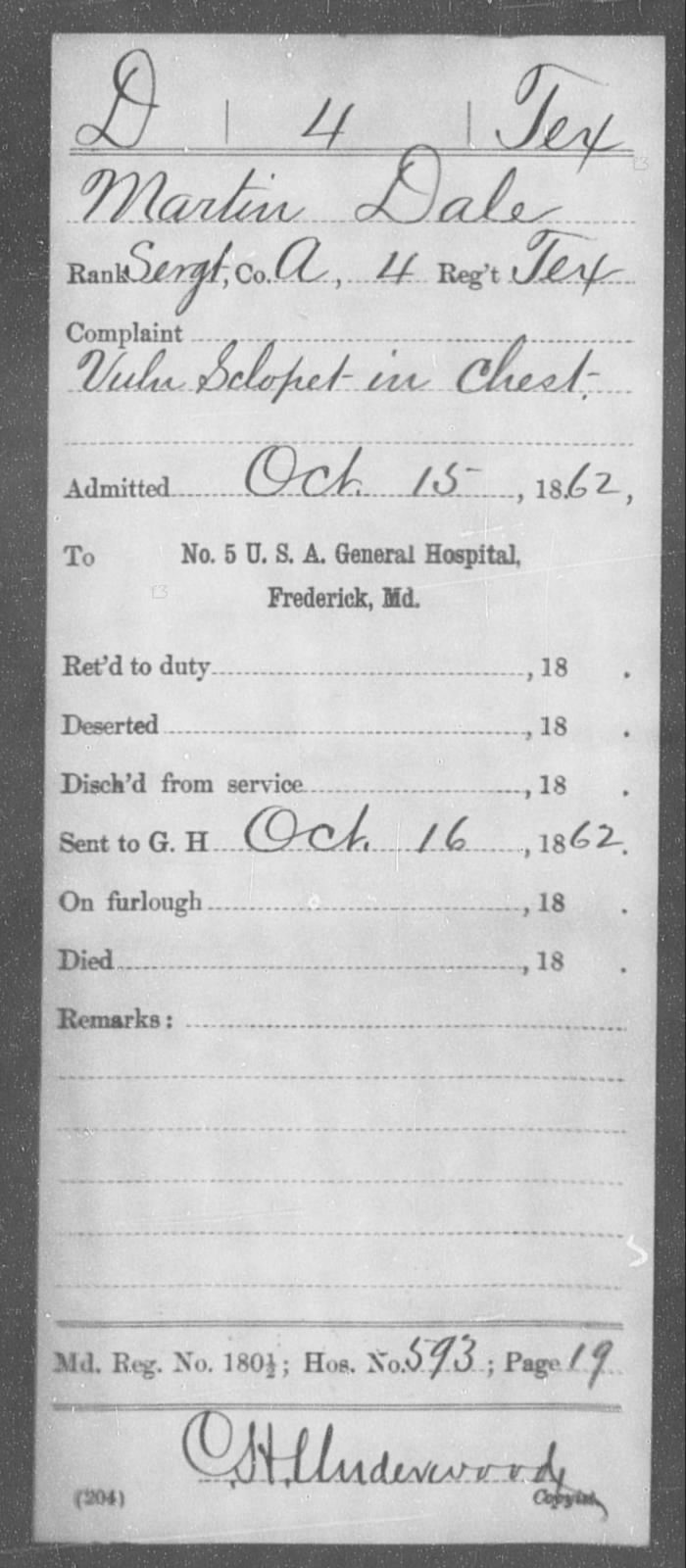
A fairly typical example of the kind of confusion you often find in Civil War records is this card for Sergeant David M Martendale, Company A, 4th Texas Infantry from his Compiled Service Records. It was transcribed from Frederick hospital records, and it’s not hard to image how the medical staff heard his name as Martin Dale.
There again is that marvelous term “Vuln Sclopet”, short for the neo-Latin Vulnus Sclopetarium – gunshot wound.
Sergeant Martendale had been mortally wounded at Sharpsburg on 17 September, and died in a Richmond hospital on 12 December 1862.
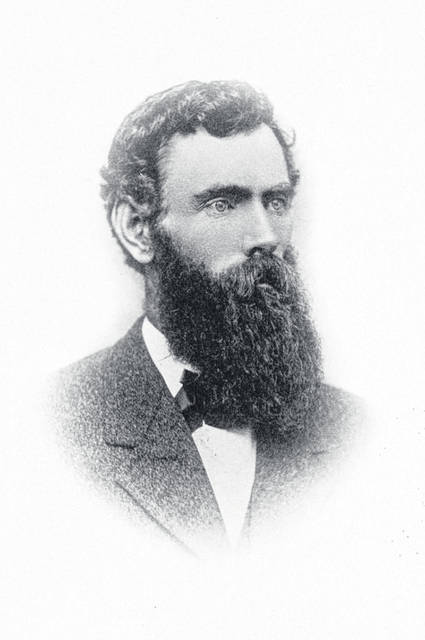
This is Oberlin graduate and part-time teacher James M. Ginn before he enlisted as a Private in the 7th Ohio Infantry in April 1861. An Antietam veteran, he changed his name to Guinn about 1868 and was later a principal in Anaheim (1869-81) and superintendent of Los Angeles (1881-83) schools in California, and a prolific writer of California histories.
This photograph accompanies an excellent piece about his life from the Sidney Daily News – the original is probably in Guinn’s papers at the Huntington Library in San Marino, CA.
Thanks to sharp-eyed reader Rina R for the poke to look back into James.
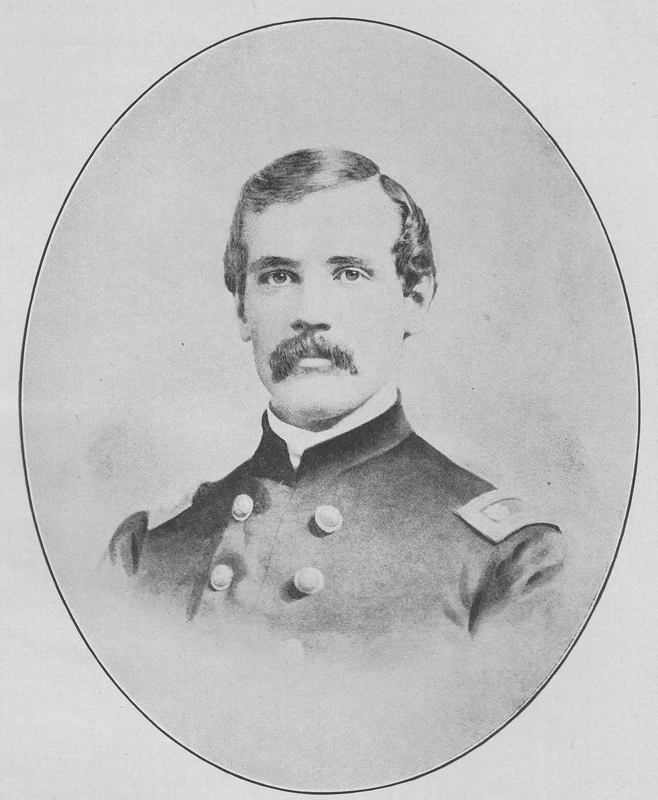
Major Walker was Assistant Adjutant General to General Darius Couch (First Division, Fourth Army Corps) in Maryland in 1862 and later with the Second Army Corps to 1865.
He had quite a post-War career, being twice Superintendent of the US Census (1870, 1880), professor at Yale (’72-’79) and the third president of the Massachusetts Institute of Technology (MIT, 1881-1897).
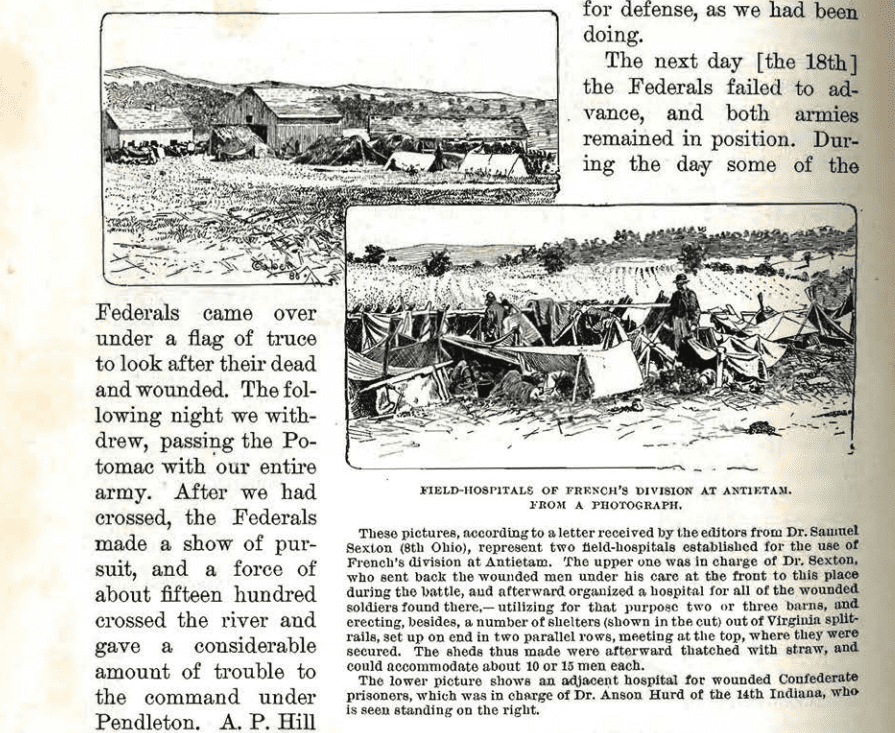
This page from Battles and Leaders of the Civil War (Vol. 2, p. 672; 1884) features two field hospitals shortly after the battle of Antietam, both on Dr. Otho J. Smith’s farm near the Upper Bridge over the Antietam northeast of Sharpsburg.
Mentioned are Doctors Samuel Sexton, 8th Ohio and Anson Hurd, 14th Indiana Infantry – Assistant Surgeon and Surgeon, respectively, of two of the regiments in General Nathan Kimball’s brigade of General William H French’s division. These men, along with other surgeons and staff, treated wounded soldiers on the day of the battle in a barn on the Roulette Farm close to the action and about a mile south of Smith’s, but, being under fire there, moved with their patients back to the main Divisional Hospital here on the Smith Farm late on the 17th or early on the 18th of September 1862.
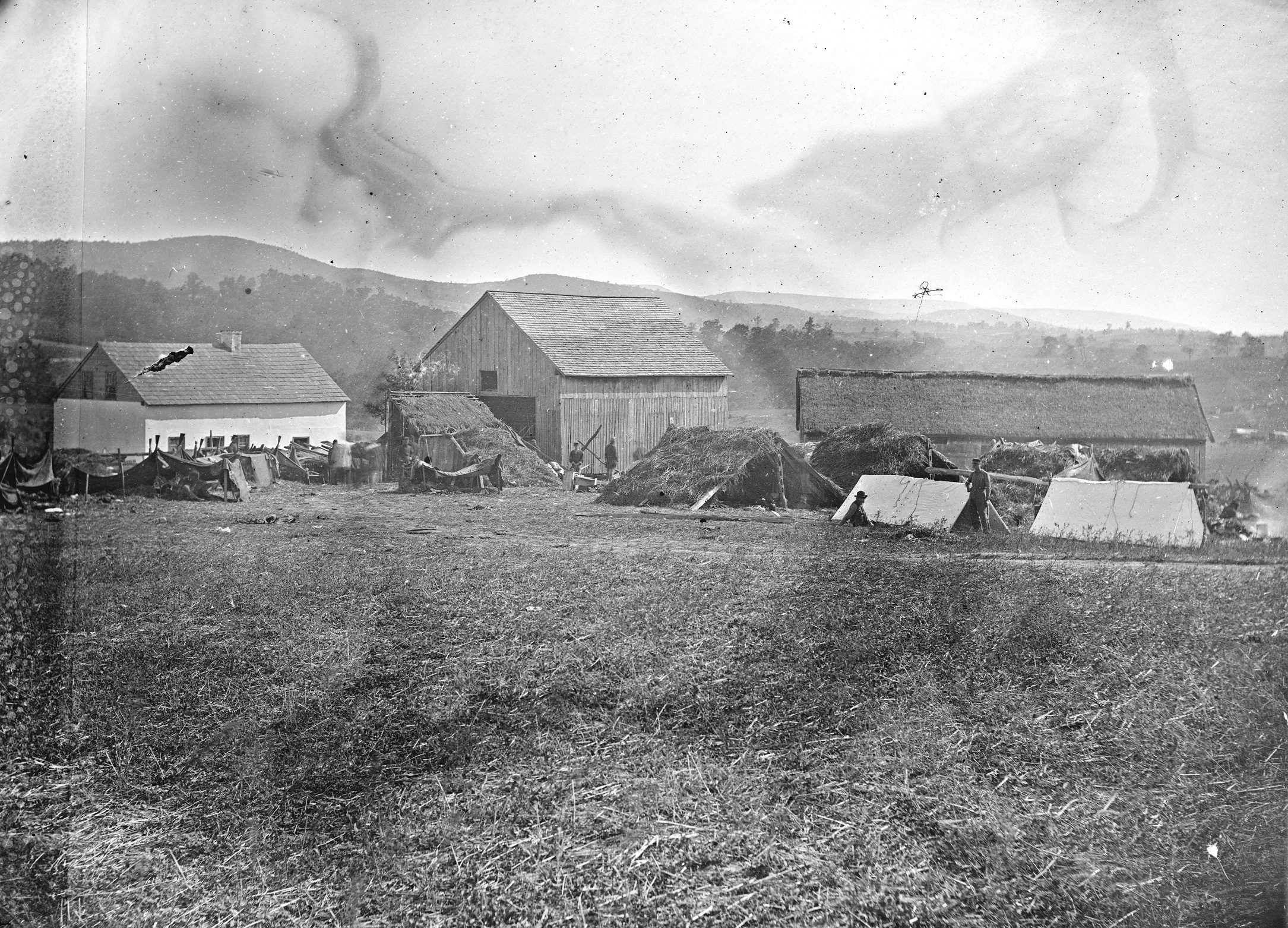
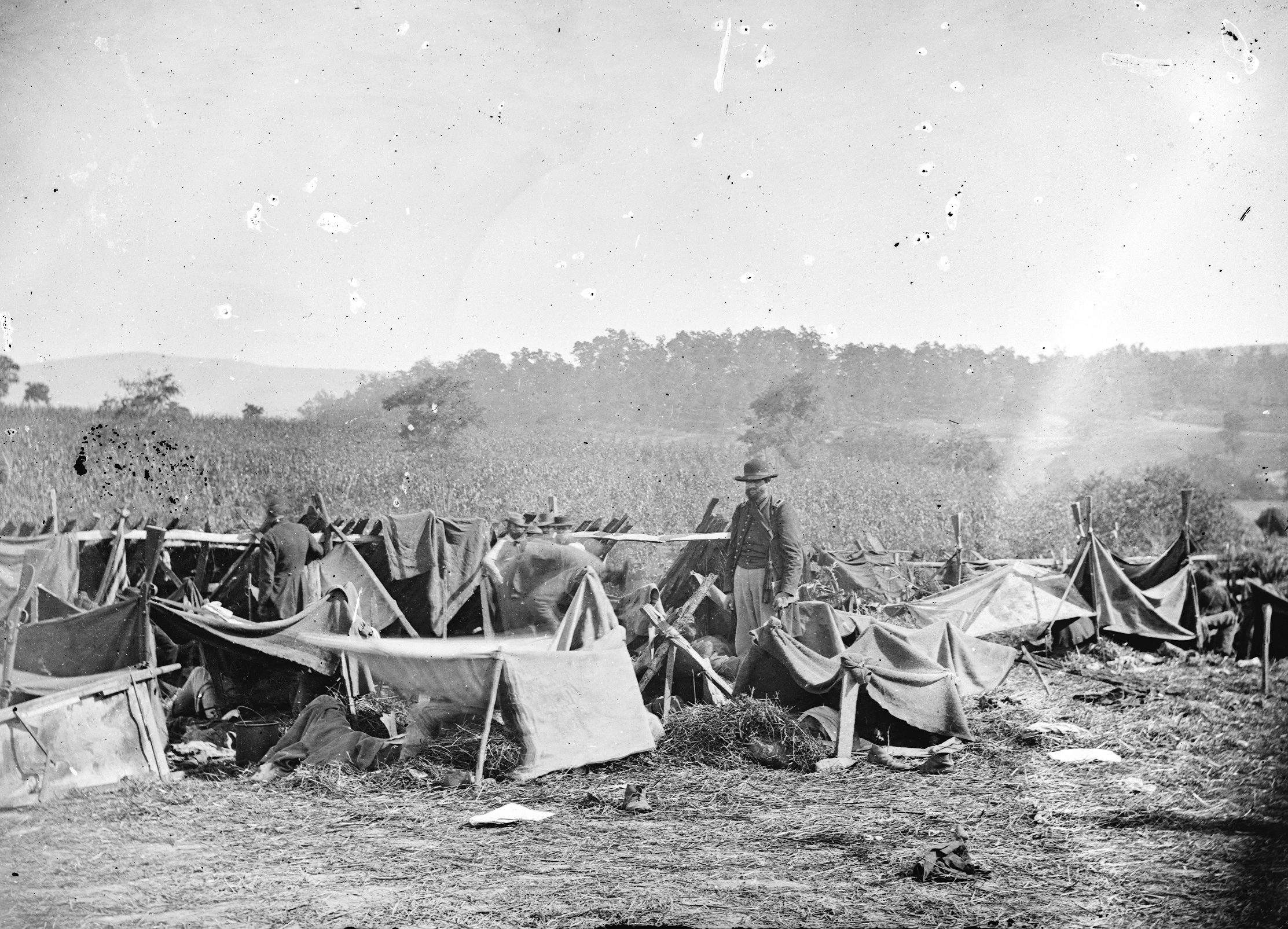
The pictures in B&L are from two stereo photographs taken about 20 September 1862 by Alexander Gardner:
Keedysville, Maryland (vicinity). Smith’s barn, used as a hospital after the battle of Antietam [Library of Congress]
Keedysville, Md., vicinity. Confederate wounded at Smith’s Barn, with Dr. Anson Hurd, 14th Indiana Volunteers, in attendance [Library of Congress]
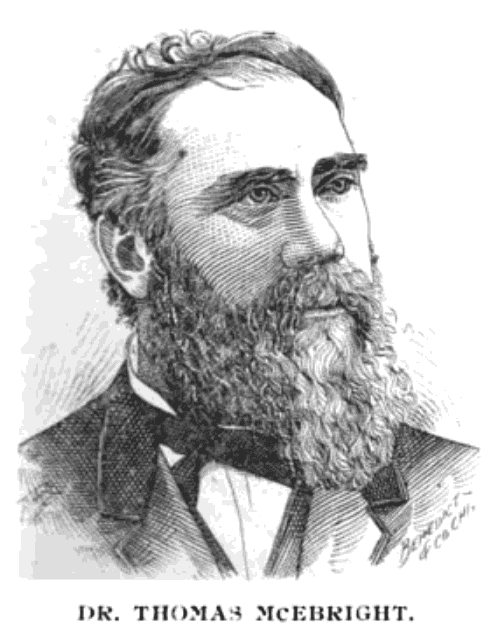
This is a considerably post-war engraving of Dr Thomas McEbright, who as Surgeon, 8th Ohio Infantry, established his “operative depot” in the Roulette barn and treated wounded soldiers there after the battle of Antietam.
On 24 September 1862 on Bolivar Heights near Harpers Ferry he wrote a letter to the editor of his hometown newspaper describing the battle and the horror afterward. Notable in the letter is this brief description of Sharpsburg farmer William Roulette during the battle:
Covered by the houses and stone wall, the barn and out houses, the natural features of the ground, the home of Mr, Rulette [Roulette] was the pivot of the field, when our Regiment passed his cellar door the gentleman who had been up to this time cooped in the cellar emerged and with hat in hand I think did some of the tallest one man hollowing and tip-toe shouting I ever witnessed.
Tallest one man hollowing and tip-toe shouting, indeed.