Year: 2006

  • Eyewitness Cavalryman

    I’ve recently read a contemporary letter from Confederate trooper James K. Munnerlyn about what he saw in Maryland as part of the cavalry rear-guard of Lee’s Army on and after 9 September 1862.
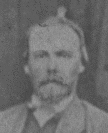
    J.K. Munnerlyn, 1867

    Munnerlyn (above, in 1867) was a Private in Company F of the Jeff Davis Legion Cavalry: the Georgia Hussars. They were nominally part of Wade Hampton’s Brigade for the Maryland Campaign, but were often on independent duty, notably on the turnpike from Frederick to Baltimore on 7 and 8 September, and as the sole defense at Turner’s Gap til the afternoon of 13 September.

    For your enlightenment, here’s the text of part of Munnerlyn’s letter, as transcribed and imaged from UNC, from their Southern Historical Collection: (more…)

  • Pimping the History web?

    If you’re doing high quality history (or related commentary, technology, criticism, publishing) online, should you also host advertising?

    I don’t think so. I believe advertising detracts in a number of ways, and doesn’t return enough to compensate.

    I’m referring to the ubiquitous Google targeted ads, Amazon, B&N, and other shopping and “affiliate” programs, DVD vendors, and so forth, found on sites related to digital history.

    Hawking your own book(s), by the way, doesn’t count! Nor am I knocking making money on the web for its own sake. God love Capitalism.

    14 of the 38 blogs I read most often – listed at right – have one or more monetizing features on them. More then one-third. This seems like a high proportion for blogs without overt commercial purpose. Is there value here I’m missing?

    Lots of history websites use these strategies, too. Some of them look like simple honey pots – sites designed specifically to drive advert revenue, some are well-meaning amateurs*, but others purport to be serious resources, yet water down their credibility with advertising. (more…)

  • Carnival! Carnival!

    A belated thanks to history hacker William Turkel for posting a Roundup of Digital History Blogs, this one among them. I’m humbled by the company. There were a number I hadn’t seen before: all the more to keep up with, I guess. A pleasant burden. I’ve updated my blog links to add several for routine viewing.

    Dr Turkel says we don’t have enough for a carnival – but how about if we stretch to include manifestoes and forth-holding; journals, umbrellas, and fora; how-to‘s and workshops; hints to coming attractions; not to mention articles, ‘papers‘ or news items on the techno-classroom, academic initiatives, public history, personal archives, wikiHistory, learning with primary sources, etc.

    OK, so these don’t technically make a blog carnival …

  • More on Moses Luce, late Sergeant, 4th Michigan Infantry

    I’m having too much fun pulling the string on one of my guys: Moses Luce of the 4th Michigan. I mentioned him in an earlier post about his alma mater, Hillsdale College. I got a great email from Hillsdale’s archivist, Linda Moore, with some quotes, a new photo, and a pointer to the college newspaper.

    Hillsdale has digitized and posted online the Hillsdale Herald for the years 1878 to 1896. These are searchable, but displayed as page images (photos of the printed papers) – a digital historian’s dream. I’ve felt like a kid in a candy store.

    As a prominent alumnus, Luce is referenced and discussed dozens of times in those years. Social gossip, event records, family history, and biographical information are all here. Tidbits from the paper have also suggested other avenues of reseach for confirmation or clarification. Great stuff.

    I’ll be using this material to update our capsule biography soon.

    Meanwhile, I have a mystery – take a look and see what you think … (more…)

  • Geek Speak

    I am pleased to see Laurie’s “This Week in the Blogs” survey on CWi. Thanks to Drew for putting the word out. It’s great to see how an outside reader sees what we do. It’ll probably help new readers find us, too.

    In the inaugural edition Laurie notes that, in commenting on the JFK Library digitizing records, I used

    some geek-talk , as in “…proprietary software platforms or storage formats, but trust that core data will be available to the end users in standard web-friendly formats like .txt, .xml, .pdf, .jpg.”

    Such things are important even for those of us who are not as geeky as we ought to be.

    I apologize for the jargon. I’ll watch out for that in future.

    To translate the snippet quoted above:

    I am worried that the JFK Library will create digital records that can be read only by people using EMC products, but expect they would also make the information available to the public in standard formats all of our browsers can read.

    ____________________

    While I’m at it … the CWi blog listing on Link Central says of behind AotW that we

    get into some very interesting, albeit scholarly, issues.

    “Scholarly” usually means stiff, pedantic, even dry and uninteresting. It also suggests a subject of interest only to academics. I am a life-long student, and I try to be careful with History, but don’t want to come across as scholarly. Nor would I want to portray doing History on the web in those terms.

    I’ll work on that, too.