Year: 2006

  • Selling-off more history

    Writing previously on this subject, I worried about a soldier’s wartime letter disappearing into a private collection, never to be seen again. That was as nothing compared to what I found online today. Oh how I wish now I’d gone for the money instead of personal satisfaction and life-balance in my career choices.

    Cowan Auctions is selling a mass of Americana on November 16th. There are some truly magnificent finds for the student of the American Civil War listed in the catalog. This looks like a wide array of archives and artifacts.

    I’d be overjoyed if collectors of historical ephemera would publish online, or loan to museums, or at least make scans or transcriptions of their treasures available to the rest of us. In the meantime, I’m snatching digital samples related to Antietam and the Campaign as they go by.

    After a little more research, I expect to use some of this material on AotW:
    W.W. Blackmar
    W.W. Blackmar

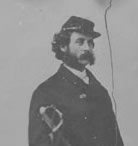
    I have a special fascination with Medal of Honor recipients. One I’d not previously associated with the Maryland Campaign is Captain Wilmon Whilldin Blackmar of Boston. That’s him above, from a gilt-framed CDV, part of Lot 232 (est. $3,000-4,000). Blackmar

    … enlisted as Corporal in Company K, 15th Pennsylvania Cavalry in August 1862. The novice regiment participated in the Maryland campaign before transferring west to join the Army of the Cumberland in December 1862 …

    (more…)

  • Horn, tooting one’s own

    Public thanks are overdue to Bill Turkel for the flattering profile on his blog, Digital History Hacks. He makes me and AotW look really good, and finds the things of which I’m most proud from the last ten years online — in two paragraphs. Hail Turkel.

    Of course, now the pressure is on me to step it up …

  • Horror of the wounded

    I apologize to you if you’re interested in history, but not the Digital kind, especially. The past several posts have undoubtedly glazed your eyes, and those of most readers, I should think.

    Let’s get back to another of the notable people of Antietam and a quick look at history from her perspective.

    Isabella Fogg

    This dedicated looking woman is Isabella Fogg, a volunteer with the Maine Camp and Hospital Association, and mother of a soldier in the 6th Maine Infantry1. On the first of November 1862, about 6 weeks after the battle of Antietam, she ventured out from Washington DC to observe the conditions of the sick and wounded troops around Sharpsburg, and to do what she could for their comfort. (more…)

  • Jumping into digital history with both feet

    No more fooling with theory and generalities. Its time to get started with your new web project. How better to learn?

    Off we go, then.

    We’ll start with a very simple, single-page project. We’ll get the development server up and running and use it to demonstrate how the XHTML, PHP, and database components work together, in more concrete terms. This will not, I hope, turn into an extended tutorial, there are plenty of those already out there, but this will give you a starting point for noodling around on your own.

    Step 1: Install the XAMPP package on your home PC

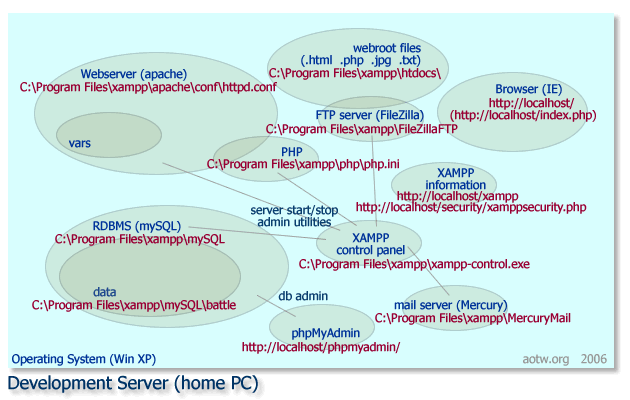
    Download the basic package – the 33 MB Installer [MD5] version. Ignore the Devel and Upgrade packages, and the Add-Ons. Do the full installation, and say “yes” to all the defaults. This will only take a few minutes. When finished, the following structure, very similar to that which you’ll use on your hosting service’s box, will be in place:

    map: the development server with XAMPP (smaller size) (more…)

  • PHP + database + webserver

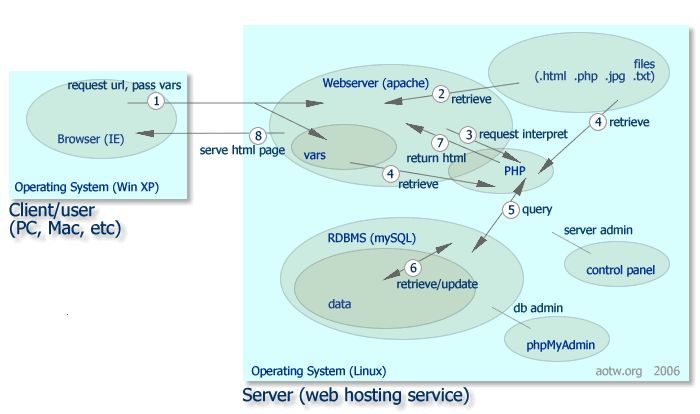
    In a previous post I talked about how an aspiring digital historian might learn some fundamental software technologies applicable to building a dynamic website. Today I’ll try to better explain how those work together to produce web pages.

    In the simplest kind of website, a person using a browser requests an HTML page by clicking a link or typing a URL. The browser then sends that request across the great wide internet to a webserver–a specialized kind of software program living on a network server. The webserver finds the requested HTML file on it’s filesystem and returns it to the requesting browser. The browser interprets the HTML and displays the resulting page on the user’s screen.

    Antietam on the Web (AotW), and many other sites, however, need more sophisticated functions than can be provided by plain old HTML. In our case we’ve chosen a combination of tools including PHP and a mySQL database to help get the job done.

    PHP+database+webserver flowchart_small (more…)