Year: 2006

  • Grubby details of digital history: link checking

    This past week I was reminded of a website maintenance chore I’ve been neglecting. An observant and sympathetic reader noted our link to the Meade Archive was broken because the site had moved. This kind of thing happens all the time, of course.

    Cross-linking to other information is the best thing about the Web, but also its Achilles’ heel. Sites move, change, and disappear at an alarming rate. I have, at this point, thousands of links from within AotW to other sites. If there were dozens or even a hundred, I might be able to click on them every three months or so, to check to see that they still work.

    Xenu button

    Since that’s not practical, I depend on a lovely little automatic tool called the Xenu Link Sleuth (review w/screenshots). It’s a Windows desktop program–written by Tilman Hausherr–that runs through the site checking every link and reporting results. It’s quite fast, and also free. I’ve using it for 4 or 5 years now, and recommend it highly.

    Xenu produces a variety of reports to show broken links, redirects, and other link issues. You can control how deeply Xenu spiders your site, include or exclude directories, and configure the reports to meet your needs. Very easy.

    Word to the wise for our new digital historians: check those links, prevent link rot. ‘Course, now that I’ve done my first check in about a year, I have a huge pile of issues to chase down and resolve.

    It’s not all glamor and glitz, you know.
  • From the bayou to Gettysburg: V.J. St. Martin

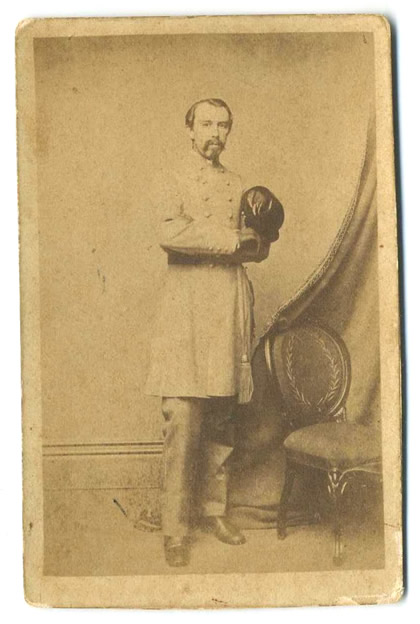
    Mr Erik Himmel of Schriever, Louisiana has kindly sent me a pile of information about his great-great-grandfather, the late Captain Victor Joseph St. Martin, for use in a biographical sketch on Antietam on the Web. Captain St. Martin was wounded and captured in action at Sharpsburg while commanding Company K of the 8th Louisiana Volunteer Infantry.

    St. Martin CDVclick to see larger image
    V. J. St. Martin (CDV courtesy E. Himmel)

    St. Martin returned to his Regiment, but was later killed on Cemetery Hill Ridge at Gettysburg. (more…)

  • Digital history rubber 3

    I chanced yesterday upon another of those people doing great history online.

    Yeager stone
    stone of Major Thomas Yeager, 25th & 53rd PA Infantry (photo: E. Carr)

    Low profile, but not to be missed is the work Everette Carr is doing–and blogging–on behalf of the Union and West End Cemetery of Allentown, Pennsylvania. I really appreciate the perspective and insight to be gained learning about an individual at War, and Mr. Carr does a very nice job of presenting some interesting people. A fine example of digital history ‘rubber’ hitting the road, as he blogs about his charges.

    Typical of his nicely written posts are biographical tidbits for members of several local military units, including the ‘First Defenders‘, 5th Militia, and 128th Pennsylvania Infantry–rookies at Antietam. He has also put up excerpts from the wartime Allentown Democrat newspaper, for additional color and flavor.

    Thanks to Everette for his hard work both on the cemetery and the history, and for sharing the results. I look forward to reading more.

  • Rufus Pettit: solid artilleryman, vicious jailkeeper

    I should avoid online Civil War discussion groups. They just give me more research threads to pull. Like I need more.

    I’d been following a discussion about artillery over on the American Civil War Message Board. I was thinking I could contribute on a question about unit organization, which referred to Battery B, 1st New York Light Artillery, as an example.

    Capt. Rufus D. Pettit
    R.D. Pettit, c. 1861-65

    First, I looked to see what that battery was doing at Antietam, and noticed the commander was Captain Rufus Petit (above). I didn’t have much on the Captain, but did know that he had been dismissed from the service in 1865. I wondered why. He seemed to have served honorably on the Peninsula and at Antietam. “Dismissed” is usually bad. (more…)

  • 1860 Federal census hits the street

    Dimitri Rotov was blogging about numbers and wondering if Federal Generals had available the 1860 population figures for the South. Data that might support large numbers for a Confederate field army. At least in retrospect.

    Well it’s not central to any argument, but I was curious. So I asked the nice folks at the US Census Bureau when the results of the 1860 Census were published, and when/if the President and Army officers might have had an advance peek. The answer’s just in:

    A preliminary report of the 1860 results was printed in May 1862. The final report of the 1860 census was contained in four volumes: population (1864), agriculture (1864), manufacturers (1865), and mortality/miscellaneous statistics (1866).

    Data were likely available before publication of the final reports. The preliminary report was approved by Congress and printed within the same month (May 1862), so any advance look at the data may have been measured in days.

    History Staff

    So there you are. Army commanders would have had access to Southern population figures after May 1862. Doesn’t help much in 1861 or earlier in ’62, of course.

    These preliminary numbers did break out population by place, race, and gender, but not by age. A military-aged (white) male population could be estimated or calculated by formula, but is not expressly given.

    It’s interesting that the data were available, but it would be more meaningful to know if anyone actually used census data for the purpose of evaluating or confirming enemy numbers. Anybody got any evidence for this, either way?

    Was this kind of analysis taught at West Point or otherwise known before the War, such that McClellan or any other senior officer was likely to do it?

    Inquiring minds.